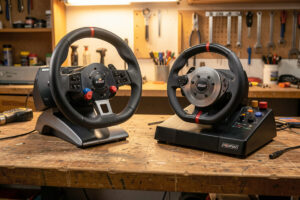
The real force feedback difference between a direct-drive and a belt-drive sim wheel is slew rate and detail resolution — how fast the base can change force and how fine a texture it can reproduce. Direct drive bolts the rim straight to the motor, so it reacts faster and cleaner, which is why even a 5–6 Nm direct-drive base reads tyre grip better than an 8 Nm belt unit that’s strong but slower to respond.
I’ve run both technologies head to head across the bases I’ve bolted onto my rig, and the gap isn’t really about raw torque — it’s about honesty. A belt base smooths the signal on its way to your hands; a direct-drive base hands you the raw thing and lets you decide how to tune it. This guide is about how each one feels and how that changes the way you tune it. For the broader buying decision — price tiers, brands, and what to actually purchase — see the dedicated direct drive vs belt drive sim racing wheels comparison. This one stays on force feedback character, which is where the sim racing force feedback tuning hub lives.
How Each Technology Makes Force
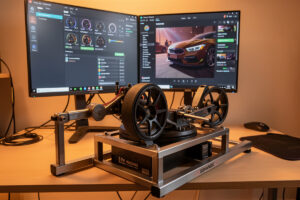
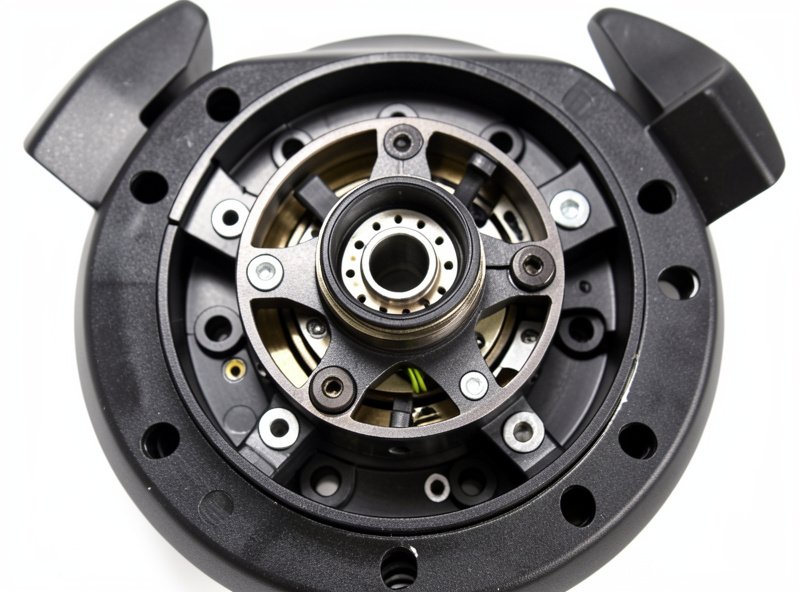
A gear-driven wheel uses a small motor and a gearset to multiply torque. It’s cheap and can feel strong, but the gears introduce cogging — a faint notchy, stepped sensation as they mesh — and they limit how fine the detail can be. A belt-driven base replaces gears with toothed belts and pulleys, which removes most of the cogging and adds smoothness and more torque, but the belts have a tiny amount of give and the pulleys add rotational inertia, both of which round off the fastest, smallest forces. A direct-drive base removes gears and belts entirely: the wheel mounts to the motor shaft, so there’s nothing between the force calculation and your hands.
That mechanical chain is why the feel differs even when two bases list the same torque. Torque is how hard; slew rate is how fast; resolution is how fine. Direct drive wins the last two decisively, and those two are what your hands read as “detail.”
Slew Rate: Why Direct Drive Feels Sharper
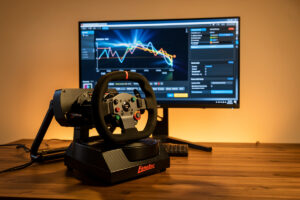
Slew rate is how quickly the base can change from one force level to another. Kerb strikes, a sudden snap of oversteer, the rapid flutter of a tyre at the limit — these are fast events, and a base that can’t change force quickly enough rounds them into mush. Belt and gear bases are slower here because the belt’s compliance and the pulley inertia resist quick changes. Direct drive, with the rim on the motor, slews fast enough to reproduce those events crisply. On my telemetry overlay the same kerb shows up as a sharp spike on the direct-drive base and a rounded bump on the belt base, even with gain matched.
This is also why the “more Nm is always better” framing misleads people. A strong belt base can deliver a big steady cornering load convincingly, but it can’t snap as fast, so it tells you less about what’s happening at the edge of grip — which is exactly the information that makes you faster.
Detail Resolution and Cogging
Resolution is the fineness of texture the base can reproduce — the difference between a smooth surface and a slightly abrasive one, the subtle grain of a tyre approaching its limit. Gear bases have the coarsest resolution and the cogging artifact on top. Belt bases are much finer but still soften the smallest textures. Direct drive reproduces fine texture cleanly because there’s no mechanical filter between motor and rim. This is the single biggest reason drivers describe their first direct-drive base as “feeling the road for the first time.”
| Characteristic | Gear Drive | Belt Drive | Direct Drive |
|---|---|---|---|
| Slew rate (force change speed) | Slow | Moderate | Fast |
| Detail resolution | Coarse | Good | Excellent |
| Cogging / notchiness | Noticeable | Minimal | None |
| Typical filtering needed | Smoothing helps | A little smoothing | Little to none |
| Min force needed | Often yes | Sometimes | Rarely |
| Tuning approach | Mask the mechanics | Light touch | Strip filters, let signal through |
They Want Opposite Tuning
Because the technologies feel different, they’re tuned differently — and copying settings between them is a mistake. Gear and belt bases often benefit from a little smoothing to mask cogging or notchiness, and from some minimum force so small signals overcome the motor’s static friction at the center. Direct drive wants the opposite: strip the filters out, run little or no smoothing, and let the raw signal through, because anything you add is hiding detail the motor could deliver. The instinct to “calm down” a direct-drive base with damper and friction usually means it’s clipping, not that it needs filtering — check gain first, which the FFB wheel gain and clipping guide covers.
Does Belt Drive Have Any Feel Advantage?
To be fair to belt drive, its slight mechanical compliance isn’t purely a loss. The tiny give in the belt can make a strong base feel a touch more organic and forgiving, smoothing out harsh signals from older or poorly made content that a direct-drive base reproduces unflinchingly. Some drivers coming from belt to direct drive initially find the rawness fatiguing, because every flaw in a car’s physics or a bumpy old track now comes through unfiltered. That’s not the hardware being wrong — it’s honesty you have to get used to, and you can dial a hair of smoothing back in on the rough content if you want it.
Belt bases also tend to run quieter than gear units and produce their torque smoothly, which matters if your rig shares a room. But none of this overturns the core point: where belt drive feels “nice,” direct drive feels “accurate,” and accuracy is what makes you faster once you’re past the adjustment period. The forgiveness of a belt is a comfort feature, not a performance one.
Response Beyond the Motor
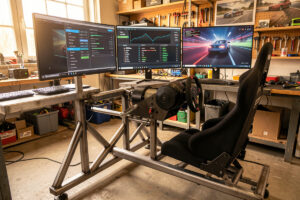
The motor is only part of the response chain. A direct-drive base can only show you its slew-rate advantage if the rest of the system keeps up — a rigid mount so the frame doesn’t flex away the fast forces, a clean USB connection, and stable frame pacing in the sim. I keep the sim PC on a wired link and the base on a braced steel frame for exactly this reason. Bolt a fast direct-drive motor to a wobbly desk and you’ve thrown away the very thing you paid for, because the frame becomes the slowest, softest element in the chain. The hardware hierarchy is always rig first, then base — the order matters as much for belt as for direct drive.
Where the Hobbyist Sweet Spot Sits
You do not need a flagship 20 Nm base. For the vast majority of home rigs, a mid-torque direct-drive base in the 5–8 Nm range is the sweet spot: enough torque that you never run out of detail headroom on a rigid rig, clean enough that you feel everything, and not so violent that it fights you over a long stint. I run a Fanatec CSL DD in the mid-torque class as my daily for exactly this reason, and the higher-torque bases I’ve tested — a Moza R12 and a Simagic Alpha among them — deliver diminishing returns on feel for most cars — the extra Nm mostly matters for heavy, high-downforce machinery and for people who specifically want the workout.
If you’re choosing between a strong belt base and a modest direct-drive base at the same price, the direct-drive unit will almost always feel more honest, because slew rate and resolution beat raw torque for reading grip. The one caveat is rigidity: a direct-drive base demands a stiff mount to deliver its detail, so budget for bracing your rig, not just the base. A flexy frame wastes a direct-drive motor’s biggest advantage.
One more practical point: don’t let a quick-release wheel or a fancy rim distract you from the base decision. The rim changes how the wheel feels in your hands, but the base decides what information arrives there in the first place. A plain rim on a direct-drive base tells you more than a premium rim on a gear base. Spend on the motor and the mount before the rim, and you’ll feel the difference on the very first lap, not just on the spec sheet.
The Verdict
Direct drive wins on feel, full stop — faster slew rate, finer resolution, no cogging, and the cleanest signal to tune. Belt drive remains a reasonable choice if budget or noise rules out direct drive, and a well-tuned belt base with a little smoothing and min force feels good; it just can’t match direct drive’s sharpness at the edge of grip. Gear drive is where people start and quickly outgrow. If you’re buying once and tuning for honesty, a rigid rig plus a mid-torque direct-drive base is the setup I’d point anyone toward — then spend your time in the menus stripping filters out rather than piling them on. For the next step, the beginner tuning guide and the damper and friction settings guide both build on whichever base you land on.
Keep Building
- Sim Racing Force Feedback Tuning: The Complete Guide — the full tuning system.
- Direct Drive vs Belt Drive Sim Racing Wheels — the buying-decision comparison.
- FFB Wheel Gain and Clipping Guide — get the most from whichever base you run.
- Sim Racing Wheel Damper and Friction Settings — filter belt and gear bases right.