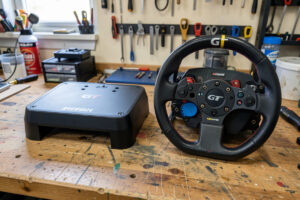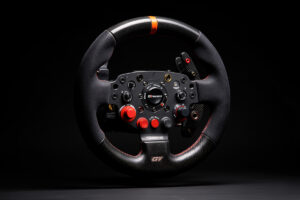
After bolting a belt-drive Thrustmaster T300 and a direct-drive base to the same welded steel-tube rig I built — and running the telemetry traces side by side in iRacing — the gap is unambiguous: direct drive transmits noticeably more force-feedback detail because nothing sits between the motor and your hands. A belt-drive wheel mechanically filters out the fine texture that tells you exactly when a tyre is about to let go. Unless you need near-silent operation in an apartment, direct drive is the better investment once your budget reaches the mid-$300s to $400 — the point where the two technologies now overlap on price (Moza’s entry R5 bundle runs $399.99 direct from Moza, roughly the same as a premium belt-drive wheel).
I have run both technologies long-term on my own cockpit — a T300 for three years, then a mid-torque direct-drive base as my daily — and the decision stopped being about budget the moment Moza and Fanatec pushed entry-level direct drive under $400. It became about two things: how much FFB detail you can actually use before clipping flattens it, and whether your rig is stiff enough to transmit the torque without frame flex eating half the signal. Across the bases I have bolted on, these two factors decide whether the upgrade is worth it far more than the spec-sheet torque number.
How Direct Drive Transmits Force — No Filter, No Slack
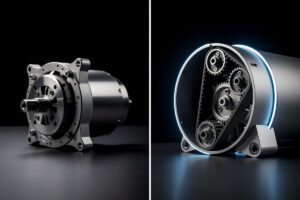
Every direct-drive wheelbase I have mounted — from entry 5 Nm units up to the mid-torque class I run daily — shares the same architecture: the steering rim bolts directly to a large servo motor shaft with nothing between them. When the sim outputs a kerb strike or rear-tyre slip, the motor rotor moves immediately. On my telemetry overlay, the FFB trace from a direct-drive base shows spikes that rise and settle in single-digit milliseconds. The belt-drive trace I compared it against smears those same events across 20-40 ms of mechanical compliance in the timing belts.
That instant response — what reviewers call slew rate, the speed at which torque builds — is the sensation direct-drive owners mean by “feeling the road.” The motor in a typical DD base is an industrial-grade servo rated between 5 and 32 Nm. This is far beyond the 2-6 Nm range of belt-drive mechanisms, and the torque figure is not just about wrestling the wheel. A 5 Nm base running a high-downforce corner at 80% clips — the signal hits the ceiling and goes numb. An 8 Nm base in the same corner at 50% leaves 4 Nm of headroom for the fine texture: the asphalt grain, the initial understeer scrub, the brake-lock vibration that the 5 Nm base flattens into mush. This is why our torque guide treats headroom, not peak number, as the real metric.
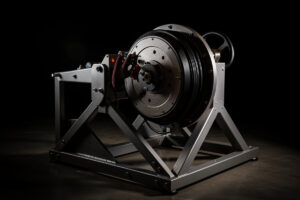
One thing spec sheets understate: direct-drive bases are heavy — 5-12 kg of dense motor and housing — and that mass must be rigidly mounted. On the desk clamps I tried early on, anything above 5 Nm turned the desk into a drumhead and absorbed fine FFB detail before it reached my hands. Frame flex at the mounting point is a signal killer. My welded steel-tube rig transmits every Nm without complaint, but a wheel stand or aluminium-profile cockpit is the realistic minimum. If you are still clamping a wheel to a desk, read our first sim racing setup guide before buying a direct-drive base — the rig comes first.
How Belt Drive Filters Force — Smoother and Quieter, But Less Textured
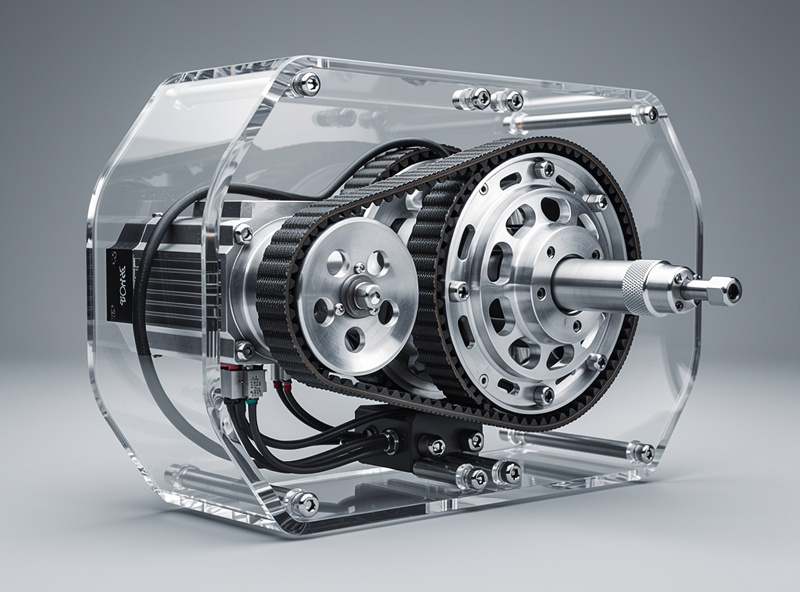
Belt-drive wheelbases route motor torque through one or two reinforced timing belts before it reaches the steering shaft. The belts are the entire story — they are the mechanical filter. They absorb high-frequency vibrations (motor coil whine, asphalt micro-texture) and transmit only the larger, slower force events. Major understeer push, weight transfer, and heavy kerb strikes come through clearly; the fine grain between track surfaces does not. For a deeper look at what exactly the FFB feels like between the two technologies, see our direct drive vs belt drive FFB feel comparison.
The noise advantage is real and, for some living situations, decisive. On my rig, the T300 belt-drive base I ran for years was effectively silent — the only sound was the cooling fan. A direct-drive motor, by contrast, generates audible coil whine: a high-pitched electronic tone that changes frequency with the FFB signal. In a thin-walled apartment or a bedroom adjacent to a partner, that whine travels. Belt drive absorbs most of it through the belt material itself, which is why I tell anyone racing in a shared living space to weigh noise as heavily as fidelity.
The trade-off is what the belts erase. The moment a tyre transitions from grip to micro-slip — the half-second warning before a full slide — is a texture belt drive simply cannot reproduce. Switching from the T300 to a direct-drive base on my rig made the track surface readable for the first time, particularly the subtle differences between asphalt, concrete, and painted kerbs that I had been guessing at. It is the difference between wearing thin gloves and bare hands. If you are chasing casual hot-laps at 90% pace, belt drive gives you everything you need. If you are chasing the last tenth in a competitive race — or if you are working through our FFB tuning guide and want to feel what each slider actually does — direct drive is the tool for the job.
Direct Drive vs Belt Drive — The Comparison on My Rig
| Feature | Direct Drive | Belt Drive |
|---|---|---|
| Force Feedback Detail | Maximum — every texture and vibration reads on telemetry | Good — major forces clear, fine detail filtered |
| Torque Range | 5-32 Nm | 2-6 Nm |
| Noise Level | Audible coil whine — noticeable in quiet rooms | Quiet — fan only |
| Slew Rate (Response) | Near-instant — rotor moves in milliseconds | Slight belt compliance — 20-40 ms smear |
| Price Range (2026) | $300-$1,500+ | $150-$470 |
| Weight | 5-12 kg | 3-5 kg |
| Minimum Mounting | Wheel stand or cockpit — desk clamp unreliable above 5 Nm | Desk clamp works — low torque, light weight |
| Key Brands | Fanatec, Moza, Simucube, Simagic | Thrustmaster, Logitech |
| Console Compatibility | Fanatec only (PS/Xbox with compatible rim) | Thrustmaster (PS), Logitech (all) |
| Longevity | 10+ years — no wear parts in the drive mechanism | 5-8 years — belts stretch and lose tension |

Direct drive wins on every performance metric I care about: detail, speed, headroom, and longevity. The belt-drive advantages that remain — lower noise and desk-mount compatibility — are real but situational. If you race with headphones (as I do) and have a rigid cockpit, the noise argument disappears. If you are still on a desk, the mounting argument points to a rig upgrade before a wheelbase upgrade. For the dedicated sim racer who wants to feel what the car is actually doing — and I include beginners who intend to stick with the hobby — direct drive is the objectively better path.
Price-to-Performance: Where Each Technology Belongs
Under $250, belt drive still makes sense and no direct-drive option exists. The Thrustmaster T150 (entry pricing around $150-250 depending on the bundle) delivers usable, graduated force feedback for the money. The step-up T300 RS GT actually lists at $379.99 direct from Thrustmaster — closer to entry direct-drive territory than a true budget belt-drive wheel, so do not assume the T300 line keeps you under $250. If your hard budget ceiling really is $250, the T150 is the correct choice — I started on belt drive and do not regret it as a first wheel. Just know that within a year you will likely be reading about whether a high-torque DD base is worth the jump.
Once you are spending $380-400 either way, direct drive has won. The Moza R5 bundle at $399.99 and the Fanatec CSL DD base in the same range deliver direct-drive feedback at a price that a premium belt-drive wheel — the Thrustmaster T300 RS GT at $379.99 or the flagship TS-XW near $470 — cannot match on quality per dollar. Our head-to-head comparison of the Fanatec CSL DD and Moza R5 breaks down the ecosystem trade-offs. If your budget has already climbed into premium belt-drive territory, spend the same money on direct drive instead.
At $500+, belt drive ceases to exist. Every wheelbase above that threshold is direct drive — from the Fanatec CSL DD 8 Nm kit through the Simagic Alpha to the Simucube 2 Pro at 25 Nm. The only question becomes how much torque you actually need, which depends on your rim weight, your rig rigidity, and how hard you push the FFB. For a breakdown across every brand at every tier, our direct-drive wheelbase brand comparison covers the full landscape.
Noise and Living Situation: The One Reason to Stay Belt Drive
Direct-drive noise has two sources: motor coil whine and mechanical vibration transmitted through the mounting structure. Coil whine is a high-pitched electronic sound from the motor windings at certain FFB frequencies — the same phenomenon you hear from a GPU under load. On my rig, it is audible in a quiet room at arm’s length and carries through an open door. The vibration transmitted through the cockpit frame creates a low-frequency hum that travels through floors — my bass shaker setup amplifies this, but even without shakers the hum is noticeable one room over on a hardwood floor.
If noise is a primary constraint, the hierarchy is straightforward. First, choose a belt-drive wheel like the T300 — it is functionally silent beyond the fan. Second, if you want direct drive, opt for a 5 Nm model: lower current means less coil whine than the 8-12 Nm class. Third, install rubber isolation pads between your cockpit and the floor — a $20 fix that dramatically reduces floor-coupled vibration. Fourth, race with closed-back headphones, which mask the coil whine entirely at moderate volume.
Most direct-drive owners I have spoken with report the whine is jarring during the first session and completely ignorable by the third. The sound is constant and predictable — unlike a clicking keyboard or a rattling fan — which lets your brain tune it out. I race with headphones and after the first week I stopped noticing the whine entirely. If headphones are in your setup regardless, direct-drive noise is a non-issue.
Upgrading from Belt Drive to Direct Drive: What I Found
If you currently own a belt-drive wheel and are considering the jump to direct drive, the improvement is immediate and permanent. The first thing I noticed on my rig — beyond the headline sensation of “the car feels alive” — was that I could feel the rear axle. Weight transfer to the rear under throttle, the moment the inside rear unloads mid-corner, the vibration of a locking inside tyre under braking: none of this existed on the T300. It was not subtle. It was information I had been reading off the screen because the wheel could not deliver it. For an overview of every wheel worth considering, our sim racing wheels buyer’s guide walks through the full ecosystem.
The upgrade path depends on your current ecosystem. If you own a Thrustmaster T300, you will need a new wheelbase, a new rim, and potentially new pedals — Thrustmaster does not make a direct-drive base that works with the T300 ecosystem. The Moza R5 or R9 bundle is the most common jump point for value. If you own a Logitech G29, the same applies: the Fanatec CSL DD Ready2Race bundle and the Moza R5 bundle are both excellent upgrade targets. Console racers should note that PlayStation compatibility requires a Sony-licensed base — currently only Fanatec offers this in the direct-drive space.
When upgrading, do not sell the old wheel immediately. I kept my T300 mounted on a secondary desk setup for casual racing and let visitors use it while the direct-drive base stays on the main cockpit. A belt-drive backup is also insurance: if your DD base needs firmware recovery or an RMA, you can still race.
Is direct drive better than belt drive for sim racing?
Yes. Direct drive delivers noticeably more force feedback detail with zero mechanical filtering because the wheel rim bolts directly to the motor shaft. In 2026 the price gap has narrowed to the point that entry direct drive (around $400) now costs about the same as a premium belt-drive wheel, making direct drive the better choice once your budget reaches the high-$300s.
How much more does direct drive cost than belt drive?
Entry-level direct drive starts around $400 (Moza R5 bundle) while a genuinely budget belt-drive wheel like the Thrustmaster T150 starts around $150-250. Premium belt-drive wheels like the Thrustmaster T300 RS GT ($379.99) now cost about the same as entry direct drive, which is the real sign the gap has closed.
Is direct drive too loud for an apartment?
Direct drive produces audible coil whine that can carry through open doors. If noise is a constraint, pick a 5 Nm model (quieter than 8+ Nm), install rubber isolation pads under the cockpit, and race with closed-back headphones — the whine becomes ignorable within a few sessions.
Can I desk mount a direct drive wheel?
You can desk mount up to 5 Nm with a quality clamp, but frame flex absorbs FFB detail. Above 5 Nm the torque can damage furniture. A wheel stand or rigid cockpit is the realistic minimum for 8+ Nm bases.
What is the best direct drive wheel for someone upgrading from belt drive?
The Moza R5 bundle at $399.99 is the best entry point for 2026, including the base, a rim, and pedals. The Fanatec CSL DD QR2 Ready2Race bundle (base, wheel, and pedals) runs around $659.99 and is the best console-compatible option. Both deliver dramatically better feedback than any belt-drive wheel.