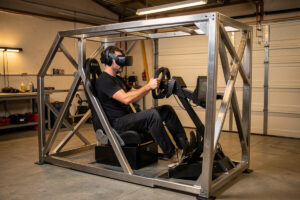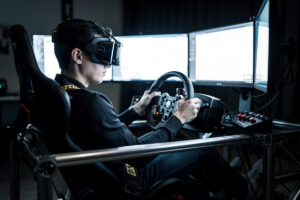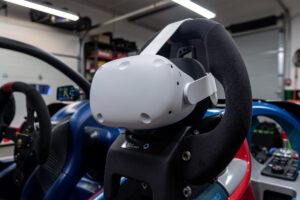
The best VR headset for sim racing is the one your graphics card can actually feed at a stable refresh — for most people in 2026 that means a Meta Quest 3 as the versatile starting point, a featherweight Bigscreen Beyond (around 127g against the Quest 3’s roughly 515g) if comfort over long stints matters most, or a Pimax Crystal if you have the GPU to chase maximum clarity. There is no universal winner, and any reviewer who hands you one without asking about your PC is selling, not advising.
As an Amazon Associate I earn from qualifying purchases.
I have swapped headsets across the same wheelbase on my rig — a standalone-plus-PCVR unit on a wired link, a featherweight micro-OLED, and a high-resolution PCVR headset — and the lesson every time is that the headset is half the decision. The other half is the card behind it. This guide sorts the real options by what they are actually good at in a cockpit, not by spec-sheet bragging rights.
The Quest 3: The Default Starting Point
The Meta Quest 3 is where most sim racers begin, and for good reason: it is self-contained, drives PCVR over a wired Link cable or wirelessly, and its pancake lenses give edge-to-edge clarity that the old Fresnel headsets never managed. You get a genuinely sharp center, a usable sweet spot you do not have to fight, and the option to use it untethered for everything else when you are not racing.
Its weak point in a cockpit is the LCD panel — blacks are grey rather than true black, which shows in night races and dark cockpits. But for the money it is the most flexible headset on this list, and it is the one I recommend to anyone buying their first VR unit for sim racing. Pair it with a quality Link cable and a card with real headroom and it punches well above its price.
Check current pricing on the Meta Quest 3 and budget for a good Link cable in the same order — the bundled cable is rarely the one you want for racing.
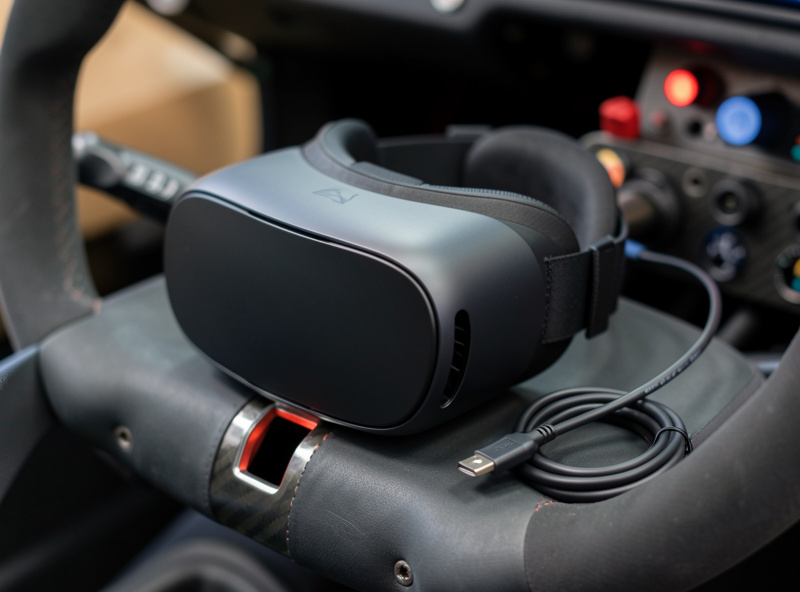
Bigscreen Beyond: The Comfort Pick
If you race long stints, weight on your face is the enemy, and the Bigscreen Beyond answers it directly — it is a custom-fit micro-OLED headset that weighs a fraction of a typical unit. The OLED panels give true blacks that make night races and dark cockpits look right, and the low mass means a two-hour endurance run does not leave your neck aching. It is PCVR-only and needs a face scan to build the custom gasket, so it is a commitment rather than a casual buy.
For the racer who has settled into VR and knows they want it for the long haul, the comfort and contrast are worth the trade-offs. It will not replace a do-everything Quest for someone still deciding, but as a dedicated cockpit headset it is one of the most pleasant ways to spend a race distance in VR.
Pimax Crystal: The Clarity Chase
When the goal is reading distant cars and apex markers as sharply as possible, the Pimax Crystal class of high-resolution PCVR headset is the answer — at a price in both money and GPU load. These headsets push the highest pixel counts on this list and reward a strong card with clarity nothing else here matches. The catch is the same as always: that resolution has to be rendered, and a mismatched GPU just means you run it at lower supersampling and lose the advantage you paid for.
This is a headset for someone whose PC is already strong, who has decided VR is their primary display, and who wants every pixel they can get. If your card is midrange, the clarity ceiling is academic — you will be turning the resolution down to hold frames anyway.
How To Actually Choose — Match the Headset to the GPU
The decision order that saves people money is GPU first, headset second. A 4070-class card is a sensible floor for comfortable VR sim racing and pairs naturally with a Quest 3. Step up to a 4080-class or higher and the high-resolution headsets become viable. Buying a Crystal-tier headset to run on a midrange card is the most common and most expensive mistake in VR sim racing — you end up with a unit you cannot feed.
Be honest about your priorities too. If comfort over long races matters most, weight beats pixels and the Beyond wins. If versatility and value matter most, the Quest 3. If clarity is everything and your card can deliver it, the Crystal. The full PC side of this — where the bottleneck actually sits — is in the VR performance requirements guide, and the broader buying logic carries over from the GPU matching guide.
| Headset | Panel | Best For | Watch Out For |
|---|---|---|---|
| Meta Quest 3 | LCD, pancake lenses | First headset, versatility, value | Grey blacks, needs encode overhead |
| Bigscreen Beyond | Micro-OLED | Comfort, long stints, true blacks | PCVR-only, custom-fit commitment |
| Pimax Crystal | High-res QLED | Maximum clarity, strong GPUs | Heavy GPU load, heavier on face |
| Used Reverb G2 | LCD, Fresnel | Budget PCVR, tinkerers | Fussy sweet spot, discontinued |
What I Run Now, and the Headset I Regret Buying
My daily VR headset is a Quest 3 on a wired Link cable, because versatility matters more to me than chasing the last ten percent of clarity, and a 4070-class card feeds it comfortably. When I want a long endurance evening I reach for the lighter OLED unit — three hours in, the gap between roughly 500g and a sub-150g headset is the gap between finishing comfortable and finishing with a stiff neck. Those two headsets cover the large majority of how I actually race.
The headset I regret was the high-resolution one I bought too early. I was running a midrange card at the time and convinced myself I would “grow into” the resolution. Instead I spent months running it at low supersampling just to hold frames — throwing away the exact clarity that justified the price — until I finally upgraded the GPU much later. If I had spent that money on the card first and a Quest 3 second, I would have had a better experience for less, sooner. That is the whole lesson of this guide in one purchase: match the headset to the card you own today, not the one you might buy.
One thing the spec sheets never tell you: the first time you run a true-black OLED panel in a night race, the dark just looks right — no grey wash over the cockpit, headlights with real punch against it. Go back to an LCD afterward and you notice the milky blacks immediately. It reads as a small thing on paper and a large one at 11pm with the field’s tail lights stretched out ahead of you.
Where VR Fits Against Triples
Before you spend on a headset, be clear about why you want VR over a flat setup — the depth and head movement are the whole point, and if those do not matter to you, triples are sharper and easier to live with. I break that decision down fully in VR vs triple screens for sim racing. If you have decided on VR, the rest of the cluster covers getting it working: the iRacing VR setup guide, the motion sickness guide for your first sessions, and adjusting VR settings once the headset is on. This article is one spoke of the broader VR sim racing guide.
Frequently Asked Questions
What is the best VR headset for sim racing in 2026?
There is no single best headset. The Meta Quest 3 is the most versatile starting point, the Bigscreen Beyond wins on comfort and OLED blacks for long stints, and the Pimax Crystal delivers the most clarity if your GPU can feed it. Choose based on your graphics card and priorities.
Is the Meta Quest 3 good for sim racing?
Yes, the Quest 3 is the best starting point for most sim racers. Its pancake lenses give edge-to-edge clarity, it runs PCVR over Link cable or wirelessly, and it doubles as a standalone headset. The main weakness is the LCD panel’s grey blacks in dark cockpits and night races.
Do I need an expensive GPU for a VR headset?
You need a GPU matched to the headset. A 4070-class card is a sensible floor for a Quest 3, while high-resolution headsets like the Pimax Crystal need a 4080-class or higher. Buying a high-res headset for a midrange card wastes money because you will run it at low supersampling.
Is the Bigscreen Beyond worth it for racing?
For dedicated long-stint VR racers, yes. It is a custom-fit micro-OLED headset that weighs a fraction of typical units, so long endurance runs do not strain your neck, and the OLED blacks look right in dark cockpits. It is PCVR-only and needs a face scan, so it is a commitment.
Should I buy a wireless or wired VR headset for sim racing?
For racing, wired is more consistent. A Link cable gives a fixed high bitrate with no radio variability, which matters when the headset pans constantly for an hour. Wireless works on a dedicated 6GHz band but risks compression smears during congestion at the worst moment.