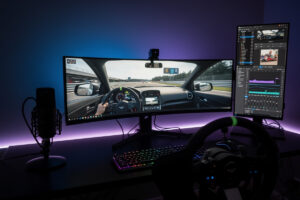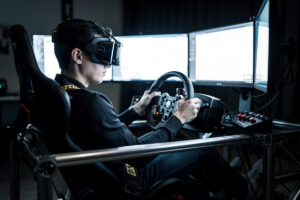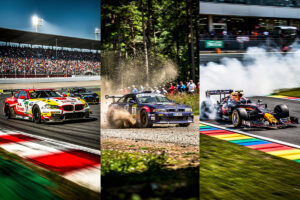
I have run all five sim racing disciplines on the same welded steel-tube rig — same direct-drive base, same load-cell pedal box, same triple-monitor FOV — and each discipline demands fundamentally different skills from the driver. Road racing (GT3, touring cars, prototypes) claims roughly 60% of sim racers and rewards corner-technique variety. Oval racing (NASCAR-style superspeedways and short tracks) produces the closest side-by-side competition in sim racing and teaches pack awareness that transfers to every discipline. Rally builds the highest car-control ceiling. Drifting rewires your brain around slide management, and open wheel forces a precision nobody talks about until they try it.
Most sim racers start in road racing because every major sim puts you there by default. On my rig, I spent the first year exclusively in GT3s on iRacing and ACC before discovering — the hard way — that my natural driving style suits oval better. The aggression, the constant traffic reading, the tire-management chess in a long run: that clicked where road racing felt like work. The point is not that one discipline is superior but that your discipline choice shapes everything from the wheelbase torque setting you use to which sim you install, and most sim racers never deliberately choose — they default. Trying each discipline for 10-20 hours is worth more than 200 hours of grinding a single discipline on autopilot.
Road Racing: The Bread and Butter That Builds Every Skill
Road racing on circuits with hairpins, chicanes, fast sweepers, and elevation changes is where every sim racer starts — and for 60% of the community it is also where they stay. GT3 cars dominate the discipline (Porsche 911 GT3 R, Ferrari 296 GT3, BMW M4 GT3), with GT4, touring cars, and prototypes filling the ladder below and above. iRacing and ACC handle road racing better than anything else, and the competitive depth is unmatched — the Porsche TAG Heuer Esports Supercup, the most prestigious professional sim series, is a road championship run on iRacing. For a full breakdown of road racing, from GT3 to multiclass, see our road racing discipline guide.
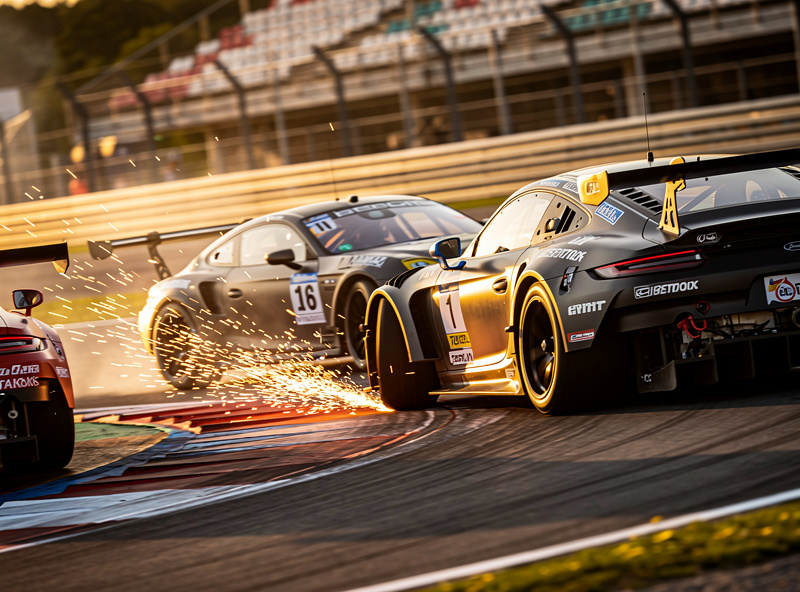
What makes road racing the right foundation is variety: every corner on every circuit demands a different technique. Trail braking into Monza’s first chicane is nothing like flat-out commitment through Eau Rouge or the late-apex patience required at a fast sweeper. This variety builds a broad skill set that transfers to every other discipline. On my rig, the FFB detail I need for a GT3 car trail-braking into a hairpin — feeling the front tires scrub as weight transfers forward — is the same FFB sensitivity that makes rally surface changes readable and oval tire degradation detectable. The wheelbase is the translator between the sim’s physics engine and your hands, and a direct-drive base renders these details with a fidelity that belt-driven bases smear. Our complete FFB tuning guide covers per-title profiles. Road racing teaches you to listen to the wheel; every other discipline is about how you apply that listening.
Car diversity is the other strength. GT3 cars offer forgiving handling with enough power to demand respect — on my direct-drive base I run slightly lower torque for GT3 than for open wheel because the cars communicate differently. GT4 cars are slower but expose bad habits that GT3’s downforce masks. Touring cars (TCR) provide door-to-door contact racing with front-wheel-drive physics that feel alien if you have only driven rear-wheel-drive. Prototypes (LMDh, LMP2) add downforce so high that cornering speeds rewrite your braking-point instincts. Which car class matches your driving style is something only seat time reveals — our wheel recommendations guide covers which wheelbase class handles GT3 best, and our best sim racing games comparison breaks down which sims excel for which car class.
Oval Racing: Where Racecraft Beats Raw Speed
Oval racing on banked tracks like Daytona, Talladega, and Charlotte drops you into a 20-40 car pack at 180-200 mph where inches of separation determine survival. Drafting, blocking, side-drafting, and pack-positioning strategy replace the corner-technique focus of road racing. iRacing’s NASCAR ecosystem — Cup, Xfinity, and Truck Series — runs the most structured oval competition in sim racing, and the community is tighter than any road series I have been part of; several eNASCAR champions have gone on to real NASCAR Truck Series drives. For the full oval racing landscape, read our oval racing guide. The core skill in oval is not speed — speed comes from the draft equalizing everyone — it is racecraft in traffic. At superspeedways the entire field runs within 0.5 seconds of each other. Races are decided by positioning: when to push, when to drop back, when to make it three-wide, and when to protect the bottom lane. Reading 20-40 cars simultaneously is a fundamentally different mental challenge from road racing, and the habit of scanning mirrors and predicting moves transfers directly to road racing’s first-lap chaos.
Tire management is the hidden skill in oval that separates good racers from great ones. Oval turns load the right-front and right-rear tires asymmetrically — the car only turns left, so the right-side tires do most of the cornering work. Over a long run the right-front overheats, grip falls off, and the car pushes wide. Managing that degradation through smooth inputs and occasional line adjustments is the difference between leading lap 150 and finishing lap 200 in the wall. In a 200-lap NASCAR race, the driver who manages tires best in the first 150 laps typically wins in the final 50. On my load-cell pedal box, the brake modulation required for oval tire management is subtler than road racing braking — more about releasing smoothly than hitting a peak pressure number.
Oval tracks come in three types. Short tracks (0.5-0.75 miles, Bristol and Martinsville) are road-racing-like in their braking demands and corner-exit drive. Intermediate ovals (1.0-1.5 miles, Charlotte and Atlanta) are aerodynamic-balance tracks where tire management matters most. Superspeedways (2.0-2.66 miles, Daytona and Talladega) are pack-racing chess matches controlled by drafting strategy. Each type needs a different setup philosophy — and a different FFB profile on your wheelbase, because the sustained cornering load on a banked oval gives the base a constant force offset that road racing never produces.
Rally: The Discipline That Builds the Highest Car-Control Ceiling
Rally sim racing pits you against the clock on point-to-point stages through gravel, snow, and tarmac with no opponent visible on track. The discipline demands ultimate car control: sliding through gravel hairpins at 80 mph, cresting blind jumps at 100 mph, and maintaining concentration through 10-15 minute stages where one mistake ends your run. Richard Burns Rally and EA Sports WRC are the primary rally sims — see our full rally sim racing guide for the deep comparison. The car control requirements in rally exceed every other discipline, and the skill transfer to road racing is real. Road racing teaches you to find the limit of grip; rally teaches you to exceed it deliberately and control the resulting slide. Gravel and snow stages require constant opposite-lock correction, throttle-steered slides, and left-foot braking to rotate the car around tight corners. On my rig, rally driving uses the full torque range of my direct-drive base more aggressively than any other discipline because the wheel is constantly feeding surface changes — loose gravel, grip returning, a rut pulling the front tire — and you process all of it at 100 mph.
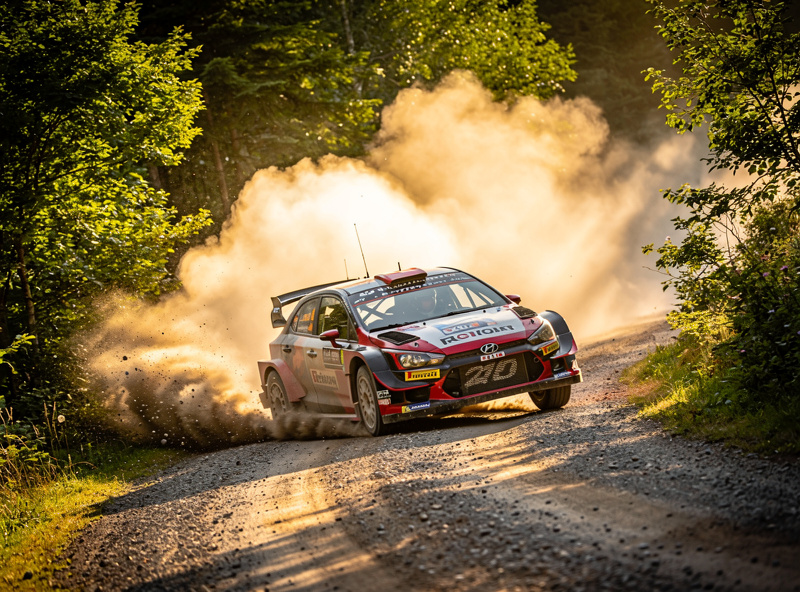
Pacenotes are the unique rally skill. A co-driver calls corner severity, distance, and surface changes in real time — “left four tightens over crest” — and you translate that into a mental image 200 meters ahead. Learning to process pacenotes at speed takes 20-30 hours but becomes instinctive after 50-100 hours. Once pacenotes become automatic, every rally stage becomes a flow-state experience that no circuit-racing discipline replicates. Richard Burns Rally, a 2004 game, remains the gold standard for rally physics in 2026 because of the RallySimFans mod community — the gravel and snow surface model is still more detailed than any modern rally sim. Our Richard Burns Rally deep dive explains why this 20-year-old game is still the competitive rally standard. EA Sports WRC offers official WRC licensing and modern graphics but is considered less realistic in tire and surface physics by the competitive rally community.
Drifting: Breaking Grip Deliberately and Controlling the Slide
Drifting in sim racing is about sustained sideways control — maintaining a slide through corners at maximum angle while hitting clipping points and transitions with precision. Unlike every other discipline where the fastest line wins, drifting is judged on style, angle, speed, and proximity. Assetto Corsa is the dominant drifting sim thanks to its modding community and realistic weight-transfer physics. Our drifting discipline guide covers the full car roster, track selection, and server scene. The technique is counterintuitive: every other discipline teaches you to maximize grip, but drifting teaches you to break grip intentionally with a clutch kick or handbrake pull, then modulate throttle and countersteer to hold the slide. Mastering these inputs takes 50-100 hours of dedicated practice — drifting has the highest initial learning curve of any discipline.
On my rig, drifting is the discipline that puts the most mechanical stress through the quick-release and wheel rim. The rapid countersteer inputs during a slide transition — snapping the wheel from full left lock to full right lock — test every bolt on the wheel-side mount and every bracket I printed for the button box. If you are going to drift seriously, a handbrake add-on is non-negotiable: trying to initiate slides with a button or paddle is a frustration tax that will cost you 50 hours. Our shifter and handbrake guide covers the add-on options at every budget.
Competitive drifting uses a judging system modeled on real-world Formula Drift: a lead car sets pace and line while a chase car follows as close as possible, matching angle and speed. Judges score proximity (how close the chase car stays), angle (how far sideways each car slides), and line (how well clipping points are hit). This creates a cooperative-competitive dynamic unique to drifting — you need your opponent to perform well for your chase run to score high. Tandem drifting on public Assetto Corsa servers is the social hub of the discipline, and it is the one form of sim racing where style and creativity genuinely matter more than lap time.
Open Wheel: Precision, Downforce, and the Aero Death Spiral
Open wheel racing in formula cars — from Formula Ford to Formula 1 — demands the highest precision and aerodynamic understanding in sim racing. These cars generate enough downforce to corner at speeds impossible in GT cars, but exceeding the aero limit triggers an immediate and unrecoverable spin: the car slides slightly, aerodynamic grip reduces, which causes more sliding, which reduces grip further, and within half a second you are facing backward. iRacing and Automobilista 2 handle open wheel best. Our open wheel discipline guide covers the full car ladder and competitive scene. The technique is fundamentally different from GT racing. In a GT3 car you can slide the rear slightly and recover with a throttle lift. In a high-downforce formula car, any slide starts a death spiral — the only defense is precision: hitting every apex within 10 cm, applying throttle progressively, and never provoking the car beyond its aero window. On my direct-drive base I run significantly higher torque for open wheel than for GT cars because the wheel needs to communicate aerodynamic load — the force builds through a corner as downforce increases, then vanishes instantly at the stall point — and that detail is lost at lower torque settings. Our FFB tuning guide walks through per-car profiles that make aero feel legible through the wheel.
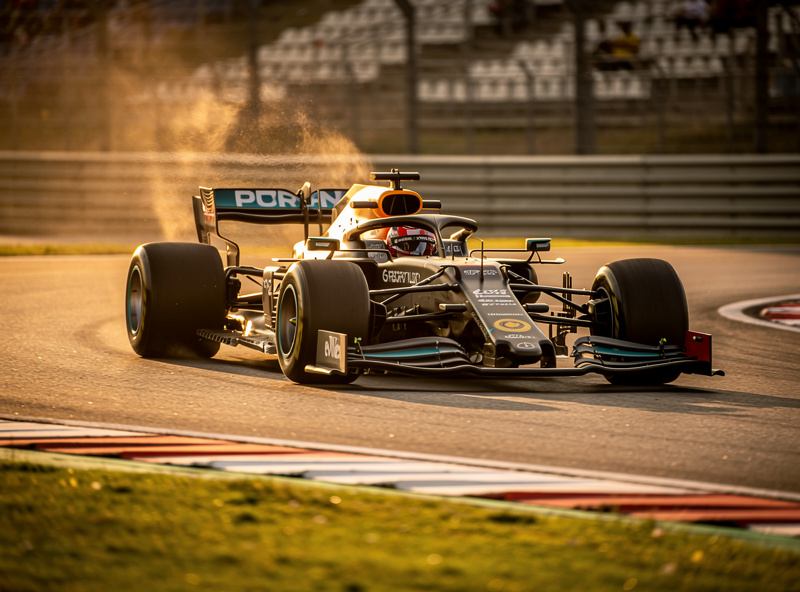
The car ladder mirrors real-world motorsport: Formula Ford (low power, no downforce, teaches basics), Formula 4 (moderate downforce, accessible), Formula 3 (high downforce, competitive), Formula 2 (near-F1 performance), and Formula 1 (maximum everything). Most sim racers enter through Formula 3 or Formula 4 — fast enough to feel exciting, forgiving enough to survive learning mistakes. iRacing runs official open wheel series at every level: Formula Vee (beginner), F4, F3, Super Formula, and the Grand Prix Series (F1 equivalent). The progression from Formula Vee to Grand Prix takes 12-24 months of consistent racing and license advancement. The open wheel community is smaller than GT but more dedicated — league attendance rates of 90% versus 70-80% for GT leagues. Our iRacing beginner guide covers the license progression path in detail.
Karting: The Discipline That Exposes Every Bad Habit
Karting sim racing strips away aerodynamics, traction control, and ABS to deliver the purest form of wheel-to-wheel competition. Karts weigh 150-200 kg, produce 15-50 hp depending on class, and respond to every input instantly — there is no electronic safety net, no downforce to mask mistakes, and no power steering to hide poor hand technique. KartKraft is the dedicated karting sim with laser-scanned tracks and the most detailed kart physics available; iRacing also fields kart series on both dirt and road. The driving technique in karts is raw and immediate: without power steering, every steering input requires physical effort, and the kart responds to weight transfer more than any other race car. Learning to drive karts fast on a sim teaches car control fundamentals in a way that jumping straight into a GT3 car cannot — because the kart forces you to feel weight transfer through the FFB rather than relying on downforce to save you.
On my rig, karting is where I send new sim racers for their first 20 hours. It is also where experienced racers go to diagnose bad habits — if you are over-braking, the kart punishes you with instant understeer. If you are early on throttle, the kart spins. There is no masking. Many professional racing drivers, including F1 world champions, started in karts and continue karting for training. In sim racing, karting serves the same function: sim racers who spend 20-30 hours in karts before transitioning to GT or formula cars develop smoother inputs and better spatial awareness than those who start directly in faster cars. Our driving techniques guide connects karting fundamentals to every other discipline.
How Disciplines Interconnect
Skills transfer across disciplines in ways that surprise most sim racers who have only tried one. Oval racing teaches pack awareness and drafting judgment that directly improves road racing’s first-lap survival rate. Rally car-control skills — left-foot braking, opposite lock, throttle-steered rotation — make wet road racing easier because you are comfortable with slides instead of panicking at the first loss of grip. Drifting’s weight-transfer and throttle-modulation emphasis improves corner-exit technique across every discipline. And open wheel’s precision requirement makes GT racing feel forgiving by comparison; after a season in F3, jumping into a GT3 car feels like the car has an extra half-second of forgiveness built into every corner.
The best sim racers I know cross-train deliberately. Spending 10-20% of practice time in a secondary discipline develops skills your primary discipline does not emphasize. A GT3 road racer who spends one evening per week in rally develops better wet-surface car control. An oval racer who runs open wheel once a week develops smoother throttle inputs that reduce tire wear in long oval stints. Cross-training prevents skill plateaus by exposing weaknesses that focused practice hides — it is the same principle as a powerlifter running yoga once a week to find mobility gaps that bench press never reveals.
Hardware demands also shift by discipline, and this is where cross-training gets expensive if you are not deliberate about your rig build. Oval racing benefits from a wide FOV to read the pack — triple monitors or VR are the standard in competitive oval because you need to see cars three-wide at your door. Rally benefits from high FFB detail to feel surface changes through the steering column — a direct-drive base earns its cost here more than anywhere else on my rig, because belt-driven bases smear the fast surface detail you need for gravel-stage pace. Drifting demands a handbrake ($50-150 for a USB add-on) for slide initiation and a wheel rim that can survive rapid countersteering. Open wheel benefits from a formula-style rim with more buttons for in-car adjustments (brake bias, ERS modes, differential settings). Our complete rig building guide covers how to plan a cockpit that handles multiple disciplines without buying duplicate gear.
What Each Discipline Costs to Get Competitive
Software cost varies more across disciplines than most newcomers expect, and it changes which discipline makes sense for a tight budget. Road racing and oval both run through iRacing, which is subscription-based ($13/month or $110/year) plus per-car and per-track content on top — expect $150-250 in your first year if you race broadly rather than sticking to one series. ACC is the cheaper road-racing entry at $40 one-time with free LFM competitive racing layered on top, no subscription at all. Rally is the outlier on the cheap end: Richard Burns Rally is a 20-year-old game you can find for a few dollars or already own, and the RallySimFans mod content that keeps it current is free. EA Sports WRC runs closer to $50 at full price but goes on sale often enough that patience gets you the same game for a fraction of that. Drifting rides on Assetto Corsa, which is around $20 at full price and routinely discounted to $5 or less — the cheapest entry point into any discipline on this list, mods included. Karting through KartKraft sits in the same range as ACC, in the $20-25 band, or free if you’re running iRacing’s kart series on a subscription you already pay for.
Hardware cost, on the other hand, is close to flat across disciplines once you have a wheelbase and pedal set — the discipline-specific spend is in add-ons, not the core rig. Oval and open wheel push you toward triples or VR sooner because pack visibility and apex precision both reward wider FOV. Rally and drifting push you toward a handbrake ($50-150) and a wheel rim that can take rapid countersteer abuse. None of that changes what the core setup costs to get in the door — it changes what you buy next, six months in, once you know which discipline actually kept you logging laps.
The cheapest realistic way to sample all five without committing to a single subscription: install Assetto Corsa first (cheap, moddable, covers drifting and a huge back catalog of road and rally-adjacent content through mods), add ACC for a proper GT3 taste with zero recurring cost, and hold off on the iRacing subscription until you already know you want oval or the deepest official road-racing ladder. That order gets you through four of the five disciplines — road, drift, and a rough approximation of rally through AC’s mod scene, plus karting if you track down the right mod — for under $70 total before you spend a cent on iRacing or a dedicated rally title. Add Richard Burns Rally once you know rally is worth pursuing properly, and you’ve sampled the entire discipline map for less than the price of a single load-cell pedal set.
The mistake I see newcomers make constantly is buying the subscription before doing the sampling. They read that iRacing is the serious platform, subscribe on day one, and lock themselves into official-series scheduling before they know whether oval or road racing actually suits how they want to spend an evening. A subscription creates sunk-cost pressure to keep racing a discipline that isn’t clicking, purely because the meter is running. Sampling cheap or free first removes that pressure entirely — you can walk away from Assetto Corsa’s drift servers after a weekend with zero financial regret, something you cannot say once you’ve committed to a season of official iRacing racing you don’t actually enjoy.
Choosing Your Discipline
Your discipline choice should match your personality and what keeps you logging laps at 10 PM on a Tuesday, not what the esports scene is currently running. Road racing suits drivers who enjoy technical variety and constant skill-stack building. Oval racing suits social drivers who love pack racing, community, and the chess of drafting strategy. Rally suits solo drivers who want the highest car-control ceiling and do not need an opponent on track to find competition. Drifting suits creative drivers who value style and flow over lap-time improvement. Open wheel suits precision-focused drivers who find satisfaction in hitting every apex within 10 cm and enjoy aerodynamic complexity.
Most sim racers eventually try all five — the sims are already installed, the hardware is already bolted to the rig — but specializing in one discipline for 6-12 months develops deeper skill and more meaningful competition than splitting time evenly across all five. The 10,000-hour rule is real in sim racing: mastering a single discipline takes years of focused practice, and the drivers who switch disciplines every month stay generalists who are competitive nowhere. The advice I give anyone who asks: pick the one that sounds most fun right now, commit to it for six months, then decide whether it is home or whether another discipline genuinely calls. Your lap times will tell you the answer. And start with a rig that is rigid enough to not flex under braking — a wobbly desk mount kills consistency in every discipline. Our cockpit and stand guide covers the options at every budget, from wheel stands to the kind of welded steel frame that stays put under 200 kg of pedal pressure.
Discipline Comparison
| Discipline | Primary Sim | Key Skill | Competition Style | Community Size | Best For |
|---|---|---|---|---|---|
| Road Racing | iRacing / ACC | Corner technique | Circuit racing | Largest (60%) | Technical variety |
| Oval Racing | iRacing | Pack management | Superspeedway drafting | Medium (15%) | Close-quarters action |
| Rally | RBR / EA WRC | Car control | Time trial (stages) | Medium (12%) | Solo challenge |
| Drifting | Assetto Corsa | Slide control | Judged tandem | Small (8%) | Creative expression |
| Open Wheel | iRacing / AMS2 | Aero precision | Circuit racing | Small (5%) | Precision and speed |
Frequently Asked Questions
What is the most popular sim racing discipline?
Road racing (GT3, touring cars, prototypes) is the most popular with approximately 60% of all sim racers. iRacing and ACC host the majority of road racing competition. The discipline offers the widest variety of cars, tracks, and competitive formats across all skill levels.
What sim racing discipline is best for beginners?
Road racing is the best starting point because every major sim includes road racing content, the skills transfer to other disciplines, and the largest competitive community means more opponents at every skill level. Start with GT4 or GT3 cars on popular tracks like Spa or Monza.
Is oval racing realistic in sim racing?
Yes. iRacing’s oval physics are considered highly realistic by real NASCAR drivers who use the platform for practice. The drafting, side-drafting, and tire wear simulation closely matches real oval racing. Several eNASCAR/iRacing champions have been recruited for real NASCAR Truck Series drives.
What is the best sim for rally racing?
Richard Burns Rally (2004) with the RallySimFans mod remains the gold standard for rally physics in 2026, especially on gravel and snow. EA Sports WRC offers official WRC licensing and modern graphics. For competitive rally, RBR is the community standard; for casual rally, EA WRC is more accessible.
Can you drift with a sim racing wheel?
Yes, and it is significantly more realistic than drifting with a controller. A direct drive wheel provides the most realistic force feedback during slides, but a belt-driven wheel like the Thrustmaster T300 works well for learning. Assetto Corsa is the dominant drifting sim with thousands of mod cars and tracks.
Do I need different hardware for different sim racing disciplines?
You can race every discipline on a single rig, but specializing in one discipline changes what hardware matters most. Oval racers benefit from triple monitors or VR for pack visibility. Rally drivers need a direct-drive base for fast surface detail through FFB. Drifters need a handbrake add-on ($50-150). Open wheel racers benefit from a formula-style rim with more buttons for in-car adjustments.
How long does it take to learn a new sim racing discipline?
Expect 10-20 hours to become competent enough to finish races, 50-100 hours to be competitive in mid-split lobbies, and 500+ hours for genuine mastery. The skills that carry over from your primary discipline accelerate the timeline — an oval racer learning road racing picks up corner technique faster than a complete beginner, but the new discipline’s unique skills still need dedicated practice.
Related Guides
- Road Racing in Sim Racing: GT, Touring Cars, and Prototypes
- Oval Racing in Sim Racing: NASCAR, Pack Racing, and Short Tracks
- Rally Sim Racing Guide: RBR, WRC, and Stage Driving
- Sim Racing Drifting Guide: Cars, Techniques, and Servers
- Open Wheel Sim Racing Guide: Formula Cars from F4 to F1
Further Reading
- What Is Sim Racing? A Complete Introduction to the Hobby
- Best Sim Racing Games 2026: Every Simulator Ranked
- Sim Racing Driving Techniques — How to Actually Get Faster
- Sim Racing Setup: The Complete Guide to Building Your Rig
- Richard Burns Rally: Why This 20-Year-Old Game Is Still King