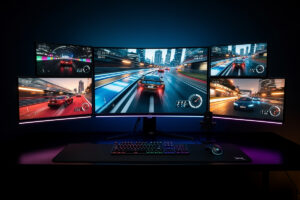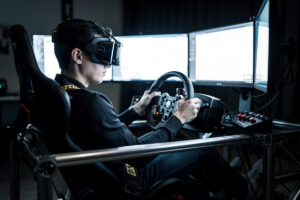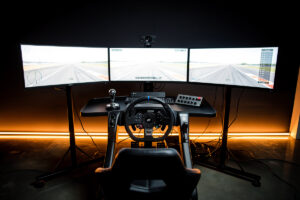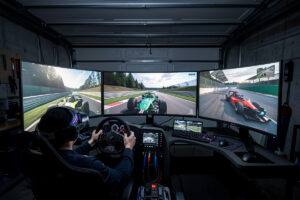
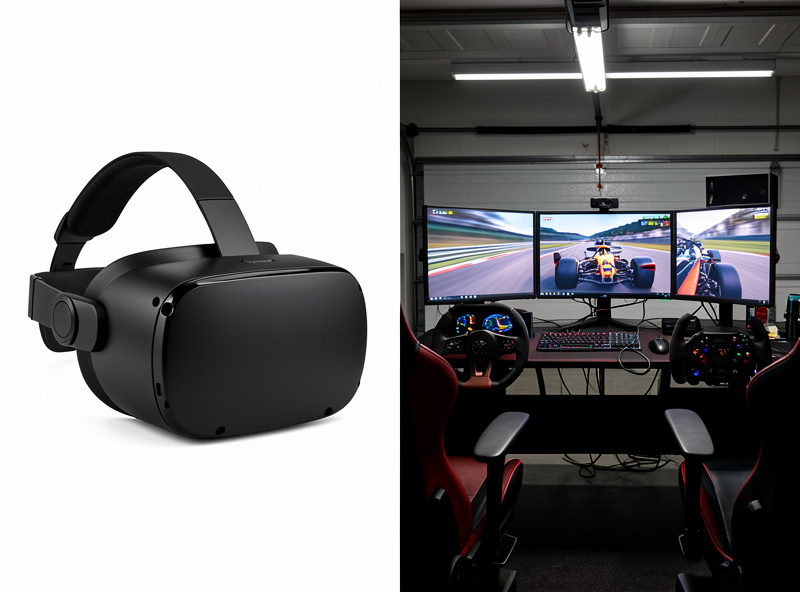
VR versus triple screens comes down to a single trade: VR gives you true depth and 1:1 head movement, while triples give you a sharper, brighter, fatigue-free wall of image you can stare at for hours. Neither is universally better. On my rig I run triples as the daily — three 27-inch 1440p panels angled to a calculated 55-degree-per-screen FOV — and bolt a Quest 3 on for endurance and rally, because they solve genuinely different problems, and pretending one wins outright is how reviewers get this wrong.
I have raced iRacing and ACC both ways on the same welded cockpit, same wheelbase, same pedals — the only variable changed is the display. That side-by-side is the only honest way to compare them, because the feel of the car underneath stays constant and you can judge purely what each display does for you. Here is what actually separates them.
What VR Does That Triples Cannot
VR’s two unbeatable advantages are stereoscopic depth and head tracking. Depth means you judge a braking zone by genuine distance perception rather than a memorized reference point on a flat panel, which shortens the learning curve on an unfamiliar track. Head movement means you look into a corner by turning your head — on a long sweeper or a blind crest, seeing the apex before the car points at it is worth real time.
There is also presence: the sense that you are sitting in the car rather than looking at it. A flat screen, however wide, is always a window you look through. VR removes the window. For close racing, judging a gap to the car alongside you, and feeling car rotation in slow corners, that presence is the single most immersive thing a home rig can do — and it is the reason people who go VR rarely go back to flat for those sessions.
What Triples Do That VR Cannot
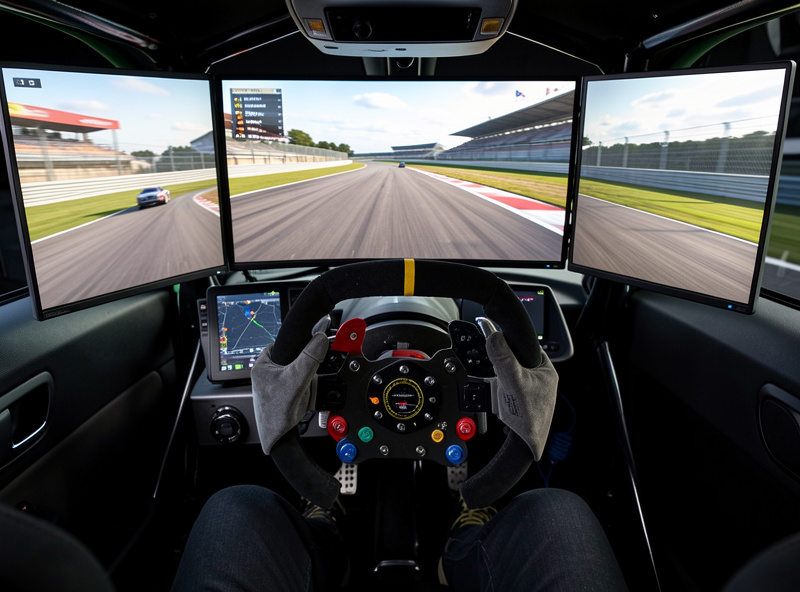
Triples win on clarity, brightness, and comfort — three things that matter more over a race distance than any spec sheet admits. A good triple-monitor setup shows razor-sharp text, readable distant cars, and a bright, vivid image with none of the screen-door or compression artifacts VR fights. You can read your dash, your mirrors, and a braking marker 300 meters away without squinting.
Comfort is the quiet decider. Nothing on your face, no weight on your neck, no heat build-up, and zero motion sickness means you can run a four-hour endurance race or a full league night without fatigue. You can also glance at a second monitor, sip a drink, and see your own hands. For the racer who logs serious hours, triples are simply easier to live with — which is why they remain the default for most competitive home rigs. The setup side is covered in triple monitor vs ultrawide and the all-important FOV calculator guide.
My Setup, and the Mistake That Cost Me Months of VR
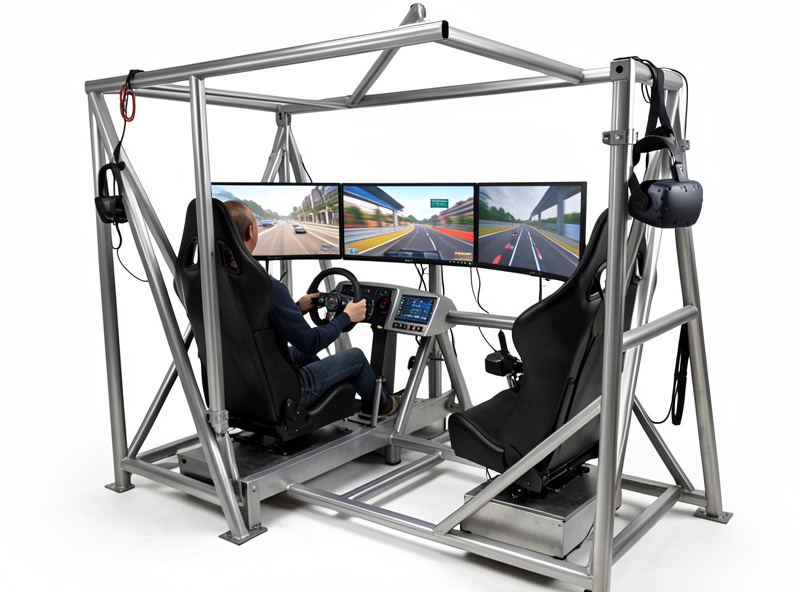
Both displays hang off the same core: a direct-drive base, a load-cell pedal set, and the welded steel frame that does not flex no matter which display I bolt on. The triples sit in a printed bracket on a dedicated stand; the Quest 3 lives on a hook on the rig, so swapping takes about a minute. Because the car underneath never changes, every comparison I make is genuinely like-for-like — the wheel, the pedals, and the physics are identical, so the only thing being judged is the display.
The mistake that cost me months: when I first got the headset I tried to make it my only display and forced every session through it, convinced immersion alone would make me faster. It did not. My consistency dropped over long stints because I could not read distant braking markers as precisely, and the eye strain meant I cut sessions short — so I actually drove less. I was answering a “best display” question as if it had one answer. The moment I went back to triples for league nights and kept VR for endurance and rally, both my lap consistency and my seat time recovered.
One concrete example sticks with me: learning the Nordschleife. In VR I could feel the crests and judge the blind brows by genuine depth in a way the flat wall never gave me, and I found a clean rhythm in a couple of evenings. But the night before a four-hour endurance race I qualified and ran the whole stint on triples — because three hours in, a sharp, comfortable image with no neck ache is worth more than presence. Same track, two displays, two right answers depending on the job in front of me.
That experience is also why I distrust the flat “VR is the future, triples are obsolete” take. The two have not converged: headset clarity keeps climbing but still trails a good 1440p triple wall for reading distant cars and dash text, while triples still cannot manufacture stereoscopic depth. Until one display genuinely does both jobs, the practitioner move is to own the trade-off rather than evangelize a side.
The Honest Comparison Table
| Factor | VR | Triple Screens |
|---|---|---|
| Depth perception | True stereoscopic depth | Flat, learned references |
| Head movement | 1:1, look into apexes | Fixed viewpoint |
| Image sharpness | Lower pixel density | Razor sharp |
| Brightness | Dimmer, panel-dependent | Bright and vivid |
| Long-session comfort | Weight, heat, possible sickness | Effortless for hours |
| PC demand | Roughly 2x a single monitor | High but more forgiving |
| Reading dash/markers | Harder at distance | Easy |
| Immersion/presence | Unmatched | Very good, not 1:1 |
The PC Cost Is Not Equal
VR is roughly twice the rendering job of a single monitor because it draws two eye buffers at high refresh against a hard frametime deadline. Triples are demanding too — you are pushing a very wide resolution — but they fail more gracefully: a frame dip on triples is a visible stutter, whereas in VR it triggers reprojection and the queasy swimming feeling. That means VR needs more GPU headroom and, crucially, more stable frametimes than triples to feel right.
Practically, a card that runs triples acceptably may still struggle in VR in the same sim. If you are weighing the two, factor the GPU cost into the VR column honestly — the headset is only half the spend. The full breakdown lives in the VR performance requirements guide, and the general card logic in the GPU matching guide and PC build guide.
Why I Run Both — and What I Reach For When
The dirty secret is that the answer for a lot of serious rigs is “both.” They share the same wheelbase, pedals, and PC, so adding a headset to a triple rig is just a display you swap in. I reach for triples for qualifying, league races, and any long stint where sharpness and comfort matter — and for the headset when I want maximum immersion: endurance runs, rally where seeing over the dash changes my line, and learning a new car where depth speeds up the braking calibration.
If you can only have one to start, choose by temperament. Want the most immersive, in-the-car experience and can tolerate the comfort trade and PC cost? VR. Want sharp, bright, comfortable, do-it-for-hours racing with no sickness risk? Triples. There is no wrong answer, only the one that matches how you race. This article is one spoke of the complete VR sim racing guide.
Frequently Asked Questions
Is VR or triple monitors better for sim racing?
Neither is universally better. VR gives true depth and 1:1 head movement for immersion and judging braking. Triples give sharper, brighter image and effortless comfort over long sessions with no motion sickness. Many serious rigs run both since they share the same wheelbase and PC.
Are triple monitors sharper than VR?
Yes. Triple monitors have far higher pixel density than current VR headsets, so distant cars, braking markers, and dash text are noticeably sharper and brighter. VR trades that clarity for depth perception and head movement that flat screens physically cannot provide.
Does VR cause motion sickness that triples avoid?
VR can cause motion sickness, especially in your first sessions or with unstable frametime, because your eyes see motion your inner ear does not feel. Triple monitors never cause this. Most people adapt to VR over short sessions, but triples remain the comfortable choice for long races.
Is VR harder on your PC than triple screens?
Yes. VR is roughly twice the rendering load of a single monitor and demands stable frametimes, since a dropped frame triggers reprojection and a queasy feeling. Triples push a very wide resolution but fail more gracefully, so VR generally needs more GPU headroom to feel right.
Can I switch between VR and triple monitors on one rig?
Yes. VR and triples share the same wheelbase, pedals, and PC, so a headset is just a different display you swap in. Many racers keep triples for qualifying and long stints and reach for VR for endurance immersion or learning a new car where depth helps.
Which is better for beginners, VR or triples?
Triples are easier to start with: no sickness risk, simpler to set up, and you can see your hands and button box. VR offers more immersion but adds a setup and adaptation curve. Beginners who prioritize comfort and clarity usually find triples the gentler entry point.