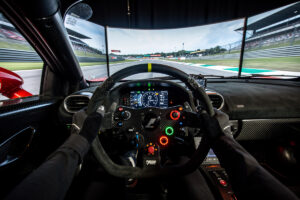
I run iRacing and ACC on a welded steel rig with a mid-torque direct-drive base and load-cell pedals — and the first question anyone who sits in it asks is whether this is a game or something different. A car simulator models the physics a real car lives under: tire grip at each contact patch, weight transfer through every braking zone, suspension geometry through camber and toe, and aerodynamic downforce that changes with speed and ride height. That data doesn’t just paint a pretty picture — it rides a direct-drive motor shaft into your hands as force feedback you can steer by, and the sims I’m about to describe are the ones I bolt my hardware to week after week.
What separates a simulator from a racing game matters because it determines whether the gear you buy actually talks to you. This is the lens I use: does the software make a direct-drive wheelbase worth bolting on, or is it just a vibration overlay running under a pretty replay? Everything below — the sims, the comparisons, the recommendations — comes off the rig I welded and the bases I’ve run head-to-head on it.
What Makes a Car Simulator Different from a Racing Game
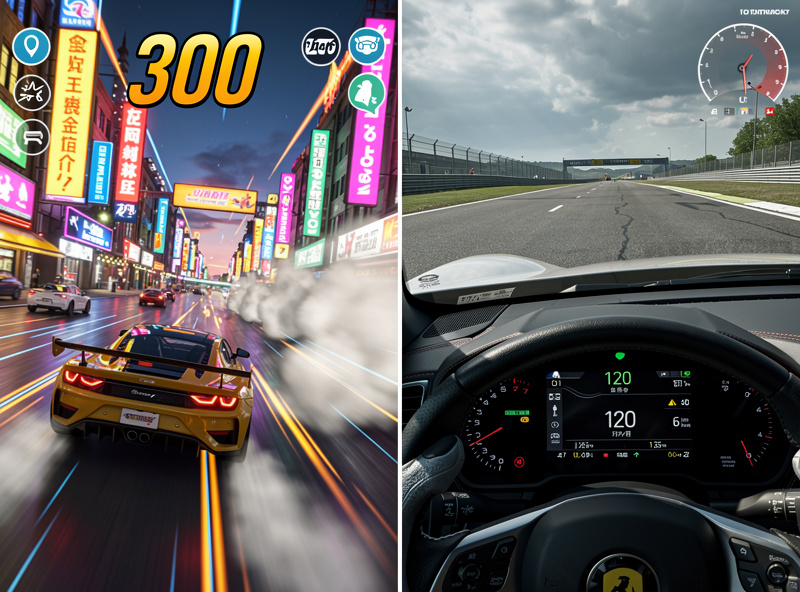
On my rig the difference between a simulator and an arcade racer is immediate: one is talking to my hands, the other is playing a movie.
A simulator calculates what each individual tire is doing. It models grip as a function of temperature, wear, load, and surface compound. It simulates weight transfer shifting that grip from tire to tire under braking and cornering, so the front-left loads up differently than the rear-right and your wheel tells you exactly when one is about to let go. Aerodynamic downforce varies with speed and ride height. Suspension geometry — camber, toe, caster — alters the contact patch shape and steering feel in ways you can measure on a telemetry trace. These calculations run hundreds of times per second, and on a direct-drive base the output is the raw torque signal you steer against.
Arcade racers skip most of that. Cars follow predetermined handling curves — steering input maps directly to yaw rate without modeling the chain of events between tire, suspension, and tarmac that actually creates the turn. The force feedback in an arcade title is vibration layered after the fact, not the car’s physics pipeline pushed through a motor. Skills you build in an arcade racer don’t transfer to sim racing or real driving because the underlying mechanics that produce lap time were never being modeled in the first place.
This is why your sim racing setup hardware only earns its keep in a true simulator. A direct-drive base on a rigid rig in iRacing transmits telemetry-grade force feedback — tire slip, understeer onset, surface texture. That same base on an arcade title is an expensive rumbler motor outputting cues that look dramatic but carry zero vehicle data. The sim determines whether your hardware is instrumentation or decoration.
The Simulators I Keep Installed on PC
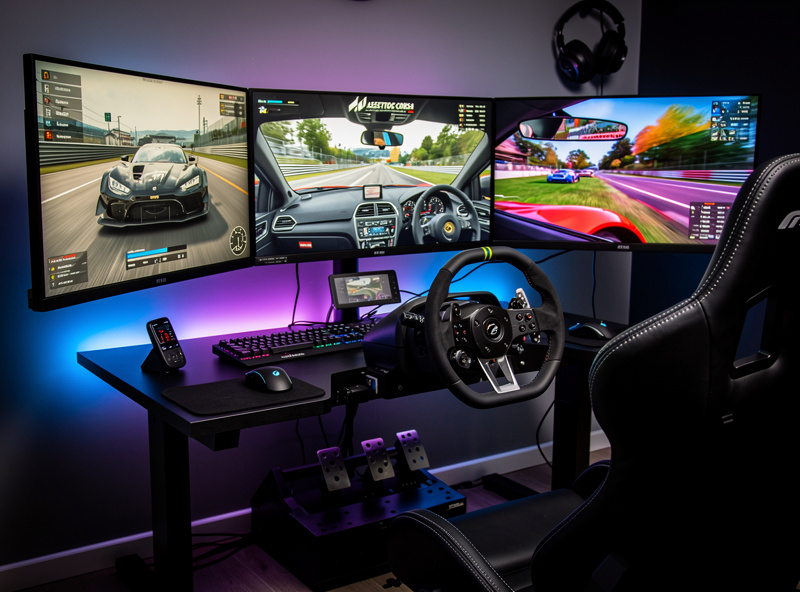
PC is where the serious physics engines live, and these are the ones that earn a permanent spot on my SSD. I’ve run every one of them on bases ranging from entry-level direct-drive up through the Simagic Alpha and Fanatec ClubSport DD class — the FFB impressions below are off my own hardware, not a spec sheet.
iRacing is my daily driver for competitive racing. The subscription model ($13/month) plus individual car and track purchases builds a structured environment with official seasons, skill-based matchmaking, and real stewarding. Their laser-scanned tracks reproduce surface detail down to individual bumps — you feel the dip into Turn 1 at Spa through the wheel before you see it. The physics engine is particularly strong on oval racing and sports car competition. The cost is real: a competitive library with popular tracks and cars in multiple series pushes north of $500 beyond the subscription. But if you want a 24/7 ranked matchmaking system where pace actually matters, nothing else comes close.
Assetto Corsa Competizione is where I go when I want the best tire model currently shipping in a consumer simulator. The Kunos physics engine models tire temperature buildup lap by lap, pressure changes that shift grip balance, and degradation across stint lengths — the data you see in ACC’s dash matches what the FFB tells your hands. It’s focused entirely on GT3 and GT4 racing, which is a strength if that’s your discipline and a limitation if you want open-wheelers or rally. ACC costs $40 with DLC packs for additional tracks and cars. Competition lives in organized leagues (LFM being the standout) rather than iRacing’s official structure.
Assetto Corsa (the original) earns its keep through sheer versatility. The base game dips below $10 during sales, and Content Manager opens access to thousands of community-built cars and tracks. Physics quality varies between mods — the best approach official content fidelity, the worst are hollow shells — but the modding scene has kept this sim alive for a decade because nothing else offers the same breadth. It’s the sim I reach for when I want to try something no commercial developer ships.
Richard Burns Rally is the anomaly that refuses to die. Released in 2004, it still delivers the most convincing loose-surface physics of any rally sim. The weight transfer during slides, the throttle modulation required for gravel versus tarmac — RBR models rally driving at a level the modern WRC titles still approach as a target. Community patches and the RallySimFans plugin keep it running on modern hardware with updated visuals, and the FFB through a direct-drive base in RBR is genuinely informative, not just heavy.
BeamNG.drive takes a completely different approach by modeling soft-body vehicle physics — individual body panels, suspension arms, and frame members all deform on impact. It’s a physics sandbox more than a competitive racing platform, and for crash behavior nothing else in the consumer space comes close. The open-world maps and scenario editor produce hours of exploration beyond any circuit-racing loop. It’s the sim I fire up when I want to understand what happens when you really push past the limit in a way no sanitized damage model captures.
Automobilista 2 covers Brazilian motorsport alongside international GT and formula categories. The physics engine — inherited from the Madness Engine and heavily reworked by Reiza Studios — delivers strong force feedback and tire behavior that rewards smooth inputs. AMS2’s weather simulation and time-of-day transitions are the best in the current sim landscape, and the FFB communicates surface changes through puddles and drying lines that most sims abstract away.
Console Car Simulators: What You Trade and What You Get
I do the majority of my racing on PC, but I’ve spent enough time with the console titles to know exactly where the compromises live. These are genuine simulations — they just sit inside a walled garden of hardware compatibility and simplified physics depth.
Gran Turismo 7 on PlayStation offers the most complete console simulation package available. The physics engine improved substantially with the current generation — weight transfer and tire modeling now reward the same smooth-input habits that produce lap time in iRacing and ACC. The career structure, license tests, and online Sport Mode create genuine progression. The 550-plus car collection across 41 track locations broadens the appeal beyond pure racing, and disabling the assists reveals a sim that punches above its console weight class.
Forza Motorsport rebuilt its physics engine for the 2023 Xbox release, adding tire wear, fuel consumption, and handling characteristics that feel substantially more connected than the Horizon series. The Builder’s Cup career and featured multiplayer events provide a competitive structure. It’s the sim Xbox owners reach for when they want depth without migrating to PC.
F1 25 by Codemasters delivers the full Formula 1 season — licensed cars, drivers, circuits, kept current with the season’s content updates — with handling that rewards precision and consistency. It’s not modeling tire physics at ACC depth, but it nails the F1 driving rhythm: managing ERS deployment, tire temps, and braking points across a full race distance. The career mode and team-management layer add substance beyond the hotlap.
The console hardware ceiling is real and worth understanding. Only officially licensed wheels from Logitech, Thrustmaster, and Fanatec work on PlayStation and Xbox. Direct-drive brands like Moza, Simucube, and Simagic lack console support entirely — you are capped at belt-driven wheels or entry-level Fanatec direct-drive units. This limit alone is why anyone serious about force feedback eventually ends up on PC.
Starting Out Without Spending Hundreds
A convincing simulation does not require a four-figure hardware budget. Several sims deliver real physics at near-zero entry cost, and I’ve put time into every one of them because the physics engine — not the price tag — is what matters.
Free options worth your time: RaceRoom Racing Experience provides free base content with a physics engine that trades blows with paid simulators — additional cars and tracks are purchase-only, but the free tier is fully functional. rFactor 2’s free demo gives you a window into the physics engine that powers high-level competition. Neither is a stripped-down demo; both are the real engine with a limited content library.
Assetto Corsa dips below $10 during Steam sales and, combined with free mods from RaceDepartment and the broader community, unlocks hundreds of cars and tracks for less than a single iRacing track purchase. It is the best value-per-content proposition in simulation, period.
BeamNG.drive at $25 provides essentially infinite replayability through soft-body physics and an active modding community. The emergent crash and deformation behavior creates situations no scripted racing sim produces. One word of advice if you go this route: run it on a wired connection. My sim PC sits on an Ethernet drop straight to the router — Wi-Fi adds latency that you can feel, and in any sim that models real-time physics, every millisecond matters.
Our complete simulator ranking compares every major title across physics quality, content depth, multiplayer stability, and value — with FFB impressions off my own hardware.
Car Simulator vs Arcade Racing: Key Differences
| Feature | Car Simulator | Arcade Racer |
|---|---|---|
| Physics model | Tire, suspension, aero simulation | Simplified handling curves |
| Force feedback value | Transmits real vehicle data | Vibration effects only |
| Damage model | Performance-affecting damage | Cosmetic or none |
| Tire behavior | Temperature, wear, compound differences | Identical grip at all times |
| Learning curve | Hours of practice required | Minutes to start racing |
| Hardware benefit | Direct drive wheels provide real advantage | Any controller works equally |
| Examples | iRacing, ACC, rFactor 2 | NFS, Forza Horizon, Burnout |
The boundary softens with titles like Gran Turismo and Forza Motorsport — both simulate genuine physics while layering assists and accessibility features that make them playable on a controller. Disable every assist in GT7 and you have a handling model that communicates weight transfer and tire behavior through the wheel; keep them on and it feels closer to an arcade experience. The simulator-versus-game question is less about the title and more about what you ask it to model.
Matching a Simulator to What You’re Building
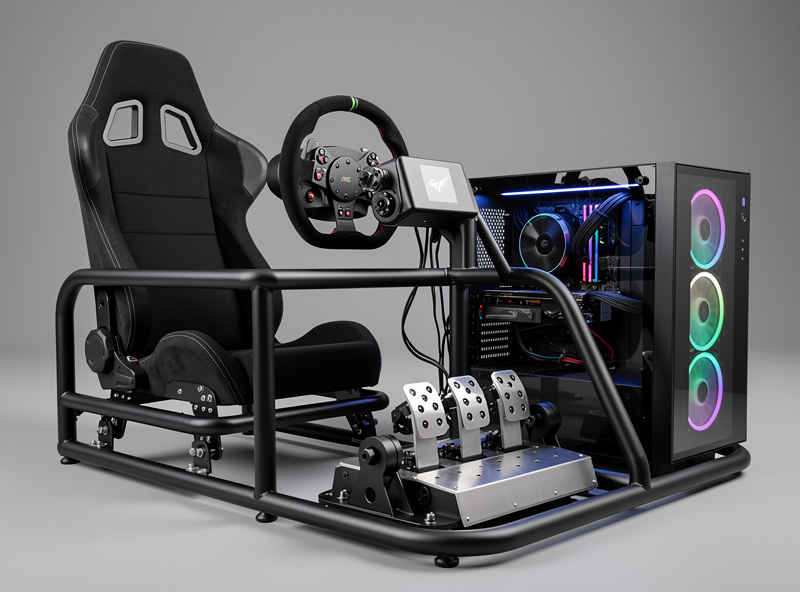
The right simulator depends on what your rig looks like and what you want out of the seat time — not on which one wins a spec-sheet comparison.
If competitive matchmaking against similarly-rated drivers is your target, iRacing is the clear choice. The subscription adds up over time, but the structured ladder of licenses, official series, and stewarded races creates the most consistent competitive environment in sim racing. On my rig, iRacing is the sim I measure lap-time progress in because the feedback is honest enough to show me exactly where I’m losing time.
If GT racing at the highest physics fidelity is your focus, ACC delivers. The tire model is the reference in the consumer space, and the league ecosystem — especially through Low Fuel Motorsport on PC — provides close, clean racing without a subscription. When I bolt on the GT rim and load-cell pedals, ACC is the sim that rewards the smallest input refinements with measurable lap-time gains.
If variety and value drive your decision, original Assetto Corsa plus mods opens every motorsport discipline for under $10. The mod quality varies — use RaceDepartment ratings and community reviews to filter the good from the hollow — but at this price point no other sim offers the same breadth. I keep AC installed permanently because it’s the sim I fire up when I want to drive something no commercial developer has shipped.
If you race on console, Gran Turismo 7 (PlayStation) or Forza Motorsport (Xbox) provide the best simulation available within platform limits. Both work well with the wheels and pedals the console ecosystem supports — Logitech, Thrustmaster, and Fanatec’s console-compatible units. Accept the hardware ceiling going in: you will not bolt a Simucube or Moza base to a PlayStation.
If you want to understand car control without competitive pressure, BeamNG.drive’s sandbox environment lets you experiment with vehicle physics, crash behavior, and open-world driving at your own pace — including the soft-body deformation that teaches you what actually breaks when you push past the limit.
For a full setup recommendation — wheel, pedals, cockpit, and the network connection that keeps your inputs ahead of the server — see our sim racing setup guide. One thing I’ve learned across four wheelbases and three pedal sets: the rig is the paper the sim writes on. A wobbly desk eats force feedback detail before it reaches your hands, no matter which simulator you’re running.
Keep Building
- Best Sim Racing Games 2026: Every Simulator Ranked
- iRacing Beginner’s Guide: Setup, Subscriptions, and First Races
- Assetto Corsa Competizione Setup Guide
- Gran Turismo 7 vs Forza Motorsport
- Best Free Sim Racing Games
Frequently Asked Questions
What is the most realistic car simulator?
Assetto Corsa Competizione delivers the most realistic tire physics of any consumer simulator for GT racing, with temperature buildup, pressure changes, and degradation modeled lap by lap. iRacing leads for oval and multi-discipline racing with laser-scanned tracks. BeamNG.drive offers the most realistic crash and soft-body deformation physics of any sim.
Can you learn to drive with a car simulator?
Yes. Car simulators teach racing line awareness, braking technique, throttle modulation, and car control during slides — all skills that transfer to real driving. Professional esports drivers and real-world racers use simulators daily for race preparation, track familiarization, and setup practice.
What is the best car simulator for beginners?
Gran Turismo 7 on PlayStation and Forza Motorsport on Xbox are the strongest starting points because their adjustable assists let you add simulation depth gradually. On PC, Assetto Corsa with mods offers the best value at under $10 — but expect to configure settings and install Content Manager before you’re on track.
How much does a car simulator setup cost?
A basic setup with a Logitech G923 wheel mounted to a desk costs $300-$500 including the game. A mid-range setup with a direct-drive wheelbase and load-cell pedals on a rigid cockpit lands at $1,000-$1,500. Motion-rig owners report full-motion platforms starting above $5,000 and climbing rapidly with degrees of freedom.
Is a car simulator the same as a racing game?
No. A car simulator models real vehicle physics — tire behavior, suspension geometry, weight transfer, aerodynamics — and uses that data to produce force feedback. A racing game simplifies handling for accessibility and adds vibration effects after the fact. Quality force feedback hardware provides genuine information in a simulator but becomes an expensive decoration in an arcade racer.
What car simulator do professional drivers use?
Professional racing drivers primarily use iRacing for competitive online practice and Assetto Corsa for vehicle familiarization and track learning. Formula 1 teams run custom rFactor Pro installations. GT drivers frequently practice in Assetto Corsa Competizione to learn tracks and test setups before real-world race weekends.