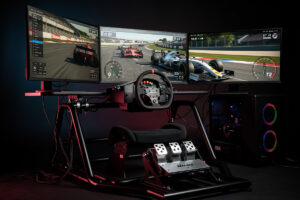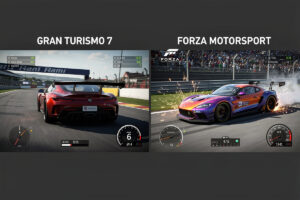
On the rig I welded, I’ve run Gran Turismo 7 on a PS5 and Forza Motorsport on a PC — through the same mid-torque direct-drive wheelbase and the same load-cell pedal box. They are not the same experience. GT7 offers 41 track locations and feels built around the DualSense controller first, while Forza ships 500+ cars and delivers the stronger force-feedback conversation on a wheel. Choosing between them depends more on the hardware you own than on car count.
This comparison covers physics, content volume, online systems, graphics, and controller-versus-wheel feel — all drawn from running both titles on the same rig, same wheelbase, same pedal set.
Physics and Handling Model Comparison
GT7 uses a proprietary physics engine refined since the original 1997 game, producing weighty, momentum-based handling that rewards smooth inputs. Forza Motorsport (2023) rebuilt its physics from scratch, adding tire thermal modeling and suspension geometry simulation that produces sharper, more responsive handling at the limit of grip. On my direct-drive base, the difference translates directly into the force-feedback conversation — GT7 communicates weight transfer as a slow-building resistance curve, while Forza delivers faster, more granular surface chatter and snap-transition cues.
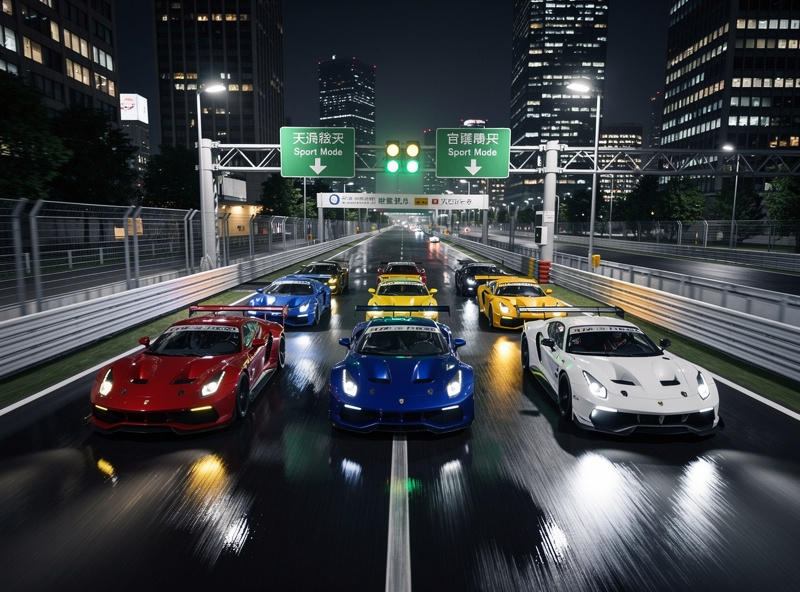
GT7’s handling feels planted and predictable. Cars rotate gradually on trail-brake, and the limit of grip arrives progressively. This makes GT7 excellent for learning car control fundamentals — you can sense when a car is about to slide and correct before it happens. The penalty for overdriving is typically understeer rather than snap oversteer, making it forgiving for beginners. If you’re building your first sim racing setup and deciding which title to train on, GT7’s gentler learning curve rewards seat time without punishing every mistake.
Forza’s rebuilt physics model introduces tire temperature zones (inner, middle, outer tread) and surface-specific grip levels. At the limit, Forza’s cars are more reactive — snap oversteer catches happen faster, and correcting a slide requires quicker steering inputs. The improved tire model makes Forza more realistic in certain scenarios (cold tire behavior, surface transitions), but the harsher breakaway characteristics frustrate players who prefer GT7’s smoother dynamics. On my telemetry overlay, Forza’s FFB signal shows more high-frequency detail than GT7 at the same wheelbase torque setting — useful information for catching slides, but also more fatiguing over a long session. Both games fall short of dedicated simulators like iRacing or ACC in raw physics fidelity, which is why the full sim racing spectrum separates true simulators from simcade titles.
Car Count, Track Variety, and Content Depth
GT7 offers 550+ cars spanning 1950s classics to modern hypercars with an emphasis on Japanese and European manufacturers. Forza Motorsport includes 500+ cars with stronger American muscle and truck representation. Both games feature extensive car customization, though Forza’s upgrade system allows more dramatic performance modifications. When I ran the full sim racing game landscape, GT7 and Forza sat apart from the dedicated simulators precisely because of this breadth — neither iRacing nor ACC gives you 450 cars and a Café Mode tutorial.
| Feature | Gran Turismo 7 | Forza Motorsport (2023) |
|---|---|---|
| Total Cars | 550+ | 500+ |
| Track Locations | 41 | 30 |
| Track Layouts | 90+ | 40+ |
| Fictional Circuits | Yes (Deep Forest, Trial Mountain) | Yes (Maple Valley, Eagle Rock) |
| Real Circuits | Spa, Monza, Nürburgring, Suzuka | Spa, Nürburgring, Watkins Glen, VIR |
| Weather | Dynamic rain, day/night | Dynamic rain, day/night |
| Car Customization | Performance parts, widebody kits | Full upgrade tree, conversions |
| License Tests | Yes (extensive career) | No (Builders Cup career) |
| Free Content Updates | Monthly car/track additions | Monthly car additions |
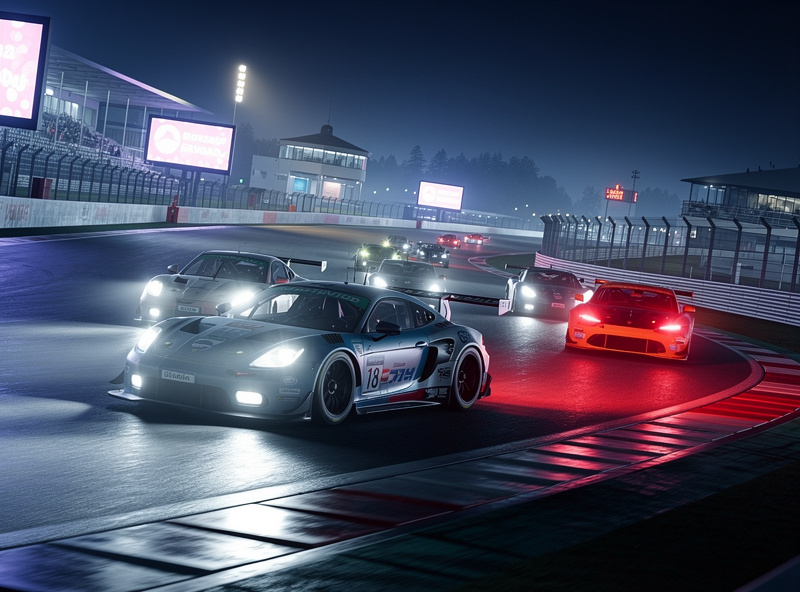
GT7 wins on track variety with 41 locations and 90+ layouts including beloved fictional circuits like Deep Forest Raceway, Trial Mountain, and Special Stage Route X. Forza launched with 20 locations and grew to 30 through free post-launch updates — including Fujimi Kaido, added to mark the franchise’s 20th anniversary — but GT7 still leads on total layouts. GT7’s Café Menu career mode provides structured progression through car history — a unique educational element absent from Forza.
Online Multiplayer: Sport Mode vs Forza Multiplayer
GT7’s Sport Mode uses scheduled races with matchmaking based on Driver Rating (DR) and Sportsmanship Rating (SR). Forza’s multiplayer features open lobbies with Car Class restrictions and Rivals time attack leaderboards. GT7’s structured approach produces cleaner racing; Forza’s open system offers more flexibility. Both are a step removed from iRacing’s stewarded protest system — but GT7’s SR gating is the closest a console simcade gets to enforcing clean driving.
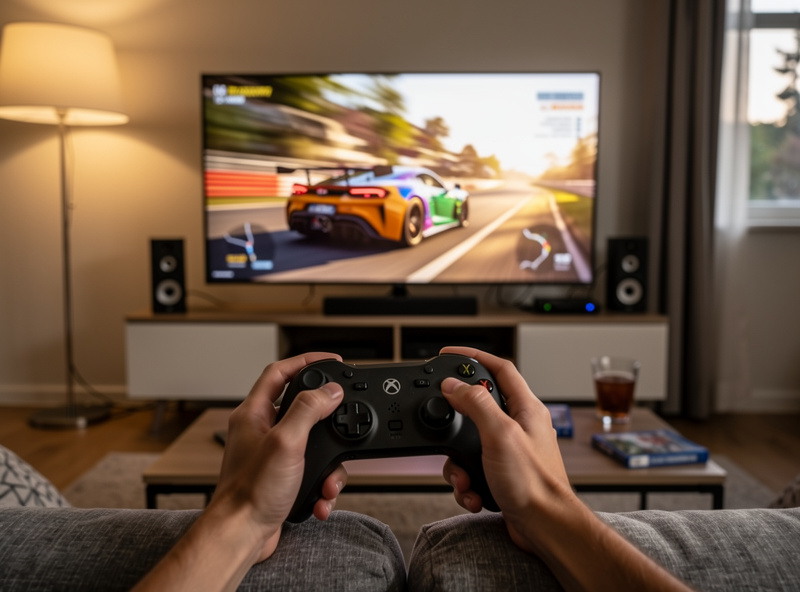
Sport Mode runs three daily race events that rotate weekly. Each race has a fixed car class, tire compound, and fuel/tire wear settings. You qualify individually, then race in splits matched by DR. The SR system tracks contact incidents — rammers lose SR and are eventually grouped with other dirty drivers. This system, borrowed from iRacing’s philosophy, creates noticeably cleaner racing once you escape the lowest SR tiers.
Forza Motorsport’s multiplayer features Featured Multiplayer (scheduled races similar to Sport Mode), Open Class racing (any car in the specified class), and Private Multiplayer (custom lobbies). Featured Multiplayer uses a skill-based matchmaking system, but lacks GT7’s explicit SR punishment. Player reports and safety ratings exist but have less visible impact on matchmaking. Forza’s advantage is PC crossplay — Xbox and PC players compete together, doubling the available player pool. GT7 is PlayStation-exclusive, limiting online population to Sony’s ecosystem. If you’re weighing PS5 vs PC for sim racing, the online player-count math alone pushes toward PC with Forza.
Graphics and Performance on Current Hardware
GT7 targets 4K at 60fps on PS5 with ray-traced replays. Forza Motorsport targets 4K at 60fps on Xbox Series X and supports higher frame rates on PC. Both games look excellent, but GT7’s art direction and lighting are widely considered more visually cohesive — on my ultrawide monitor, GT7’s sunrise render at Trial Mountain is the single most convincing lighting I’ve seen in any racing title.
GT7’s visual strength is its lighting engine and sky rendering. Sunset races at Dragon Trail or dawn at Spa produce screenshots that rival photorealism. Car models include detailed interior cockpits with accurate gauge clusters and material finishes. The ray-traced replay mode drops to 30fps but delivers stunning reflections and shadows.
Forza Motorsport’s PC version scales dramatically — it runs at 1080p/60fps on GTX 1060 hardware and reaches 4K/120fps with RTX 4080+ GPUs. The PC version supports DLSS and FSR upscaling, ultrawide monitors, and uncapped frame rates. This scalability makes Forza accessible to a wider range of hardware than GT7’s fixed PS5 configuration. However, Forza’s Xbox Series S version suffers from reduced car counts on track (fewer AI opponents) and lower resolution textures.
Controller vs Wheel: Which Game Works Better?
GT7 was designed around the DualSense controller, and its haptic feedback triggers communicate tire-grip transition and surface texture through fingertip resistance. I’ve bolted a Fanatec CSL DD and a Simagic Alpha Mini to this rig, and neither wheelbase can replicate the specific tactile layer the DualSense adds — cold tires versus warm tires, tarmac versus gravel, all felt through the trigger before the screen shows it. Forza Motorsport supports controllers well but delivers its best experience with a force-feedback wheel on PC, where the FFB detail exceeds what either game offers on controller. If you are setting up either title specifically for a wheel, the Gran Turismo 7 wheel settings and force feedback tuning guide walk through reducing clipping and getting honest FFB on your base.
The DualSense controller communicates grip levels through trigger resistance — you can feel the difference between cold tires and warm tires, tarmac and gravel, through your fingertips. This haptic layer adds a dimension of feedback absent from every other racing game on controller. No wheel can replicate this, which is why many GT7 veterans prefer controller even when a wheel is available.
Forza’s wheel support on PC is excellent with compatible hardware — Logitech, Thrustmaster, Fanatec, Moza. The FFB communicates weight transfer, understeer, and surface changes with clarity that GT7’s wheel implementation lacks. On my mid-torque base running at roughly 8 Nm, Forza’s FFB signal shows cleaner weight-transfer ramps and less built-in filtering than GT7. When comparing how much wheelbase torque you need, the answer for simcade titles lands lower than for iRacing — 5 to 8 Nm is plenty because neither game puts out the sustained high-frequency detail a 12+ Nm base can exploit. On controller, Forza plays well but doesn’t have GT7’s haptic advantage. The verdict: GT7 is the better controller game; Forza is the better wheel game. If you play exclusively on controller, GT7 feels more immersive. If you own a dedicated wheel, Forza extracts more performance and feedback from the hardware.
Which Simcade Should You Choose?
Choose Gran Turismo 7 if you’re on PlayStation, prefer controller racing, want the most tracks, and value structured career progression. Choose Forza Motorsport if you’re on PC or Xbox, own a wheel, want more cars, and prefer crossplay online competition. If you’re migrating gear from console to PC sim racing, Forza on PC is the natural landing pad — your wheelbase and pedals carry over, and the FFB detail improves measurably.
Neither game is a true simulator — both use simplified tire models and physics approximations compared to iRacing or Assetto Corsa. But both deliver engaging racing experiences that teach genuine car control. GT7’s strengths are its art direction, track variety, controller experience, and Café mode that educates players about automotive history. Forza’s strengths are its PC scalability, wheel feedback, car count, and upgrade customization depth.
The best choice depends entirely on your platform and peripherals. PS5 owner with a controller: GT7. PC owner with a wheel: Forza. Xbox owner: Forza (GT7 isn’t available). Cross-platform player with both: GT7 for controller sessions and casual racing, Forza for competitive wheel racing. Both games receive regular free content updates and maintain active online communities.
Frequently Asked Questions
Is Gran Turismo 7 better than Forza Motorsport?
Neither is objectively better — GT7 excels at controller feel, track variety (41 locations vs 30), and visual polish. Forza excels at wheel feedback, PC scalability, and crossplay, while GT7 actually leads on total car count (550+ vs 500+). Your platform and peripherals determine the better choice.
Can you play Gran Turismo 7 on PC?
No, Gran Turismo 7 is a PlayStation exclusive available only on PS4 and PS5. Forza Motorsport is available on Xbox Series X/S and PC. There are no plans to bring GT7 to PC platforms.
Which game has better online racing?
GT7’s Sport Mode with Driver Rating and Sportsmanship Rating produces cleaner competitive racing. Forza’s multiplayer offers more flexibility with open lobbies and crossplay, but lacks GT7’s structured safety rating system for matchmaking.
Do you need a wheel for Gran Turismo 7?
No, GT7 is specifically designed around the DualSense controller and its haptic feedback triggers. The controller experience communicates grip levels through trigger resistance in ways that wheels cannot replicate. Many competitive GT7 players use controllers.
Which game is more realistic?
Forza Motorsport’s rebuilt tire model with thermal zones and surface-specific grip is more technically detailed. GT7’s physics feel more intuitive and progressive. Both are significantly less realistic than dedicated simulators like iRacing or Assetto Corsa Competizione.
Is Gran Turismo 7 or Forza better for beginners?
Both are excellent for beginners. GT7’s Café mode provides structured progression teaching car history and driving fundamentals. Forza’s assisted driving modes offer more granular difficulty adjustment. GT7 edges ahead for pure beginners due to its gentler learning curve and controller-first design.
Related Articles
- Best Sim Racing Games 2026
- What Is Sim Racing?
- How to Plan Your First Sim Racing Setup
- Best Sim Racing Wheels 2026
- Best Sim Racing Pedals 2026