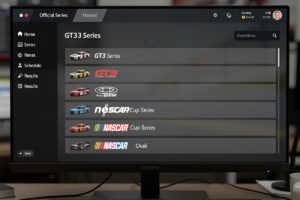
Assetto Corsa Competizione features 30 GT3 cars and 11 GT4 cars across 24 track layouts, with competitive online racing powered by Low Fuel Motorsport (LFM) matchmaking. Across the direct-drive bases I’ve bolted onto the rig, ACC delivers the most consistent tire-to-FFB translation of any sim I run — but only if the setup is right. Basic car setup starts with tire pressure (26.0–27.5 psi hot), brake bias (54–58%), traction control (TC 3–5), and ABS (4–6) to establish a stable baseline.
This guide covers ACC’s car roster, competitive matchmaking, essential setup parameters, the five tracks you must master first, which GT3 cars suit beginner and intermediate drivers, and how I dial in force feedback on my own rig. If you want the full-sim overview — physics model, BOP system, rating progression, and how ACC stacks against iRacing — the complete ACC GT3 guide covers the big picture.
ACC’s GT3 and GT4 Car Roster Explained
ACC’s 30 GT3 cars come from 14 manufacturers: Aston Martin, Audi, BMW, Ferrari, Ford, Honda, Lamborghini, McLaren, Mercedes-AMG, Nissan, Porsche, Reiter Engineering, Bentley, and Emil Frey. Each car follows SRO GT3 homologation rules but handles distinctly — the Porsche 911 GT3 R is rear-engine and loose on entry, while the Audi R8 LMS Evo II is mid-engine and forgiving through corners. On my rig, the difference between a Porsche and a Ferrari through Eau Rouge shows up as a completely different steering-weight profile — the Porsche fights you at turn-in where the Ferrari settles in and asks for throttle.
The 11 GT4 cars arrive via the GT4 DLC pack and include the Aston Martin Vantage, BMW M4, Chevrolet Camaro, Alpine A110, Porsche 718 Cayman, and McLaren 570S, among others. GT4 cars produce roughly 400–500 horsepower versus 500–600 in GT3, with less downforce and narrower tires. GT4 racing is noticeably slower and more accessible — many beginners find it an ideal stepping stone before jumping to GT3. If you’re still deciding which car to commit to, the best ACC cars for beginners guide walks through every GT3 and GT4 option with lap-time comparisons and handling profiles.
Every car has three physics variants: the standard model, a 2020 or 2022 update (depending on the manufacturer’s real-world homologation changes), and the Evo variant where applicable. Always choose the newest version — Kunos updates physics, BOP (Balance of Performance), and tire models with each variant release. Older variants remain available for historical compatibility but are objectively inferior for competitive racing.
LFM Matchmaking: Competitive Online Racing Without iRacing’s Cost
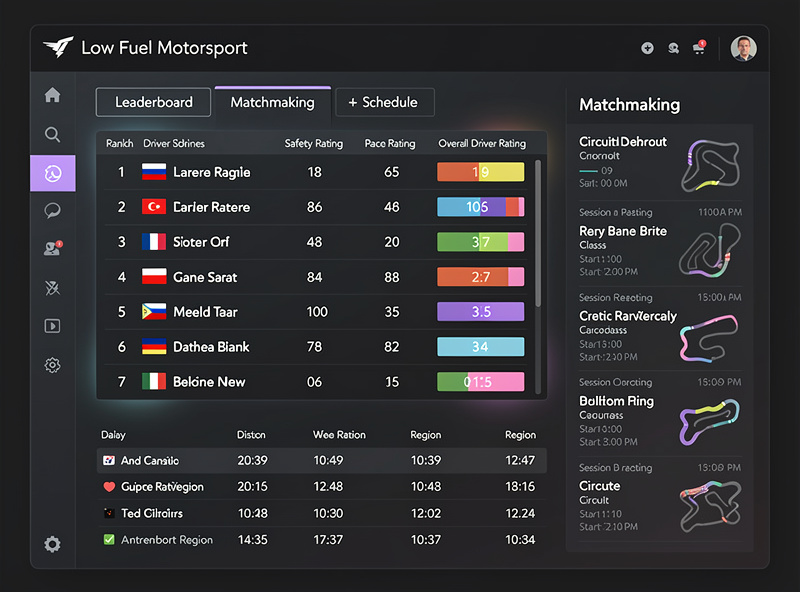
Low Fuel Motorsport (LFM) is a free third-party matchmaking system for ACC that provides iRacing-style ranked racing. LFM tracks ELO rating and Safety Rating for every registered driver, creating balanced splits with 20–50 racers per server. Races run hourly across multiple series. I’ve run LFM alongside iRacing on the same direct-drive base for months — the matchmaking quality holds up, and the zero-subscription model means the financial barrier to competitive GT3 racing is effectively gone. For a deeper walkthrough of registration, qualifying laps, series tiers, and the Safety Rating system, the ACC LFM guide covers the full experience.
For a walkthrough of how to find and filter community servers, how LFM lobbies work, and what to expect on a first rated race, the ACC community server racing guide covers everything from registration to race-day etiquette.

LFM registration is straightforward: create an account at lowfuelmotorsport.com, link your Steam profile, complete 3 valid hotstlap sessions to establish your initial ELO rating, then join scheduled races. The Safety Rating system penalizes contact and off-track excursions, similar to iRacing’s SR. Drivers with low Safety Rating are restricted from premium series until they improve their rating.
The LFM community has grown to over 200,000 registered drivers, making it the largest ACC competitive platform. Series include Sprint (20-minute races), Endurance (60-minute races with mandatory pit stops), and GT4-only championships. Compared to ACC’s built-in multiplayer (which suffers from unregulated public lobbies), LFM delivers consistently clean, competitive racing without any subscription fee. For a breakdown of every way to race — public lobbies, competition servers, LFM, and private leagues — the ACC multiplayer guide compares each option with what to expect on a first race night.
Basic Car Setup Parameters and Starting Values
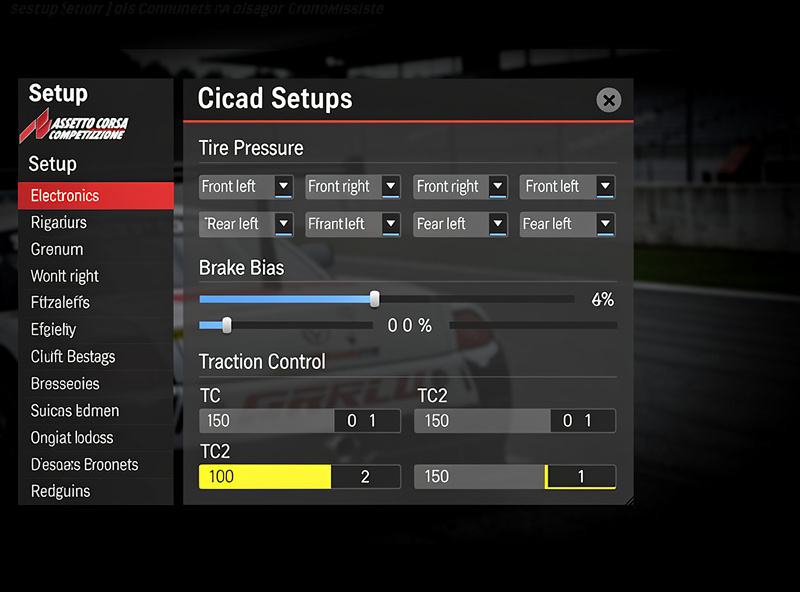
Tire pressure is the single most important setup parameter in ACC. Target 26.0–27.5 psi when hot (after 3–4 laps). Lower pressures increase the contact patch but risk overheating; higher pressures reduce grip but improve consistency. Check pressures in the setup screen’s tire info panel after a practice stint. On my rig, I run a dedicated practice session before any rated race purely to dial tire pressures — the difference between 26.0 and 27.5 psi hot on a load-cell brake pedal through a heavy braking zone changes the braking point by half a car length.
Brake bias controls front-to-rear brake force distribution. Typical starting values are 54–58% for most GT3 cars. Moving bias forward (higher number) reduces rear instability under braking but increases front lockup risk. Porsche 911 drivers often run 50–52% due to the rear-engine weight distribution, while front-engine cars like the Aston Martin prefer 58–60%.
Traction Control (TC) limits wheelspin on corner exit. Start at TC 3–5 for most cars. Lower TC values (1–2) allow more wheelspin and faster corner exit if you have throttle control, but they punish overzealous throttle application with immediate spins. TC 2 on the Ferrari 488 GT3 Evo is raceable; TC 2 on the Porsche 911 is a recipe for disaster. ABS prevents wheel lockup under braking — start at 4–6 and adjust based on lockup frequency. Lower ABS values improve braking performance but demand precise pedal control.
Additional baseline adjustments: set ride height as low as possible without bottoming (monitor sparks and listen for scraping), use medium-downforce aero for most tracks, and set steering ratio to 14–16:1 for GT3 cars. Advanced setup parameters like damper settings, anti-roll bars, and differential preload require telemetry analysis — leave them at default until your lap times plateau within 1–2 seconds of alien pace.
How I Tune ACC Force Feedback on My Rig
ACC’s FFB model translates what the front tires are doing straight to your hands — but only if the gain isn’t clipping. On the direct-drive bases I’ve bolted onto the welded rig, I set in-game gain to 70–75% and let the wheelbase driver handle the rest. Crank gain to 100% and you’ll lose all detail through fast sweepers because the motor is maxed out before the tires even reach peak load.
I run minimum force at 0% on direct-drive — that setting exists for belt and gear wheels that need help overcoming internal friction, not for a DD base that registers fractional Nm. Road effects I keep between 10–20%. Higher values add curb rumble and surface texture at the cost of masking the subtle front-end washout that tells you you’re understeering. On my rig, anything above 25% road effects makes it harder to feel the moment the fronts let go, which is the single most important FFB signal in ACC.
Dynamic damping I leave at 50–60%. This parameter controls how much weight builds in the wheel as downforce increases — useful at Spa and Silverstone where aero load changes the steering feel corner to corner. Steering lock should match your car: 480° for most GT3 cars, 540° for GT4. Mismatched lock makes the in-game wheel rotate at a different rate than your physical rim, which ruins the visual feedback for catching slides. On my setup I confirm lock in the wheelbase software before every session, the same way I verify brake calibration on the load-cell pedals — a 2-minute pre-race habit that prevents an entire evening of fighting the car.
Top 5 Tracks Every ACC Driver Must Learn
Spa-Francorchamps, Monza, Silverstone, Nürburgring GP, and Watkins Glen appear in nearly every ACC league and LFM series season. Mastering these five tracks gives you competitive access to roughly 70% of scheduled races. If you want a full track-by-track breakdown — braking markers, corner sequences, difficulty ranking, and which setup philosophy each circuit rewards — the ACC track guide covers every circuit in the sim.
Spa-Francorchamps (7.004 km): The most popular ACC track. Key corners include Eau Rouge/Raidillon (flat or nearly flat in GT3 depending on setup), Blanchimont (committed flat-out left-hander), and the Bus Stop chicane (late apex, hard braking from 260+ km/h). The long Kemmel straight rewards low-drag setups.
Monza (5.793 km): A power circuit with four heavy braking zones. The Variante del Rettifilo (Turn 1) and the two Lesmos are the primary overtaking zones. Low-downforce setups dominate here. The Parabolica demands confidence — carry speed through the long right-hander or lose 0.5 seconds on the main straight.
Silverstone (5.891 km): A high-downforce circuit rewarding precise car positioning through Copse, Maggots/Becketts, and Stowe. The fast sweeps punish understeer and reward trail-braking. Run maximum downforce here.
Nürburgring GP (5.137 km): Technical and narrow with elevation changes. The NGK chicane and the Mercedes Arena complex demand precision over aggression. Tire management is critical — the abrasive surface eats rear tires in long stints.
Watkins Glen (5.553 km): Fast and flowing with the famous Bus Stop and the high-speed esses. The boot section adds elevation changes that unsettle poorly balanced cars. Medium-downforce setups work best.
Best GT3 Cars for Beginners and Intermediates
The Ferrari 488 GT3 Evo 2020, Audi R8 LMS Evo II, and BMW M4 GT3 are the three most forgiving GT3 cars for beginners due to their stable handling, predictable throttle response, and competitive baseline setups across most tracks. I’ve put laps into all three on the direct-drive base, and the Ferrari has been my go-to recommendation when someone new climbs into the rig — it telegraphs exactly what the rear tires are doing through the wheel and the seat, so you learn limit feel instead of just surviving the lap.
Ferrari 488 GT3 Evo: Mid-engine, extremely stable under braking, and predictable on corner exit. The Ferrari is the default recommendation for new ACC drivers because its handling characteristics encourage smooth driving. Weaknesses include slightly lower straight-line speed and a tendency to understeer in slow corners.
Audi R8 LMS Evo II: Another mid-engine platform with excellent balance. The Audi rotates well on trail-brake and has strong traction out of corners. It requires slightly more setup work than the Ferrari but rewards precision with faster lap times at high-speed circuits.
BMW M4 GT3: Front-engine with strong straight-line speed and stable braking. The BMW suits drivers who prefer understeer to oversteer. Its main weakness is slower cornering speed through technical sections, but this is offset by exceptional tire longevity — a significant advantage in endurance racing.
Avoid the Porsche 911 GT3 R, Lamborghini Huracán Evo, and Nissan GT-R as a beginner. These cars have extreme handling characteristics (rear-engine oversteer, aggressive turn-in, heavy weight) that punish mistakes heavily. Once you can consistently lap within 1.5 seconds of your best time on multiple tracks, these challenging cars become rewarding — but they teach bad habits to drivers still learning fundamentals.
Frequently Asked Questions
Is Assetto Corsa Competizione good for beginners?
Yes, ACC is excellent for beginners thanks to forgiving GT3 cars like the Ferrari 488, comprehensive driving assists, and the free LFM matchmaking system that provides competitive online racing without a subscription fee.
What is the best car in ACC for new drivers?
The Ferrari 488 GT3 Evo 2020 is the most recommended beginner car due to its stable mid-engine layout, predictable throttle response, and competitive baseline setups that work across nearly every track in the game.
How many tracks does Assetto Corsa Competizione have?
ACC includes 24 track layouts across circuits like Spa, Monza, Silverstone, Nürburgring, Watkins Glen, Suzuka, and Bathurst. Additional tracks arrive through DLC packs including the GT World Challenge America and British GT packs.
Is LFM free to use?
Yes, Low Fuel Motorsport (LFM) is completely free. You register on their website, link your Steam account, complete qualifying laps to set your initial rating, then join scheduled races through their matchmaking system at no cost.
What tire pressure should I use in ACC?
Target 26.0-27.5 psi when hot (after 3-4 laps of racing). Start at 26.5 psi cold for most tracks and adjust based on ambient temperature. Higher track temperatures require lower starting pressures to prevent overheating.
Do I need a steering wheel to play ACC?
ACC supports controllers but is significantly better with a force feedback wheel. The precise car control needed for competitive GT3 racing is extremely difficult on a controller. A budget wheel like the Logitech G29 transforms the experience completely.
Related Articles
- Assetto Corsa Competizione: The Complete GT3 Guide — cars, tracks, physics, and multiplayer overview
- Best Cars in ACC for Beginners: GT3 and GT4 Picks — picking your first car and avoiding the ones that punish new drivers
- ACC LFM Guide: Competitive Racing on Low Fuel Motorsport — registration, qualifying, series tiers, and Safety Rating
- ACC Track Guide: Every Circuit Ranked by Difficulty — braking markers, corner sequences, and setup philosophy per track
- ACC Multiplayer Guide: Public, LFM, and Private Servers — every way to race in ACC compared
- Best Sim Racing Wheels 2026 — wheelbases and pedal sets that deliver honest force feedback