Frame flex in a sim rig almost always traces to three sources: an unbraced wheel-deck upright that bends like a cantilever, a pedal deck that isn’t triangulated back to the main frame, and the whole rig rocking on soft feet or carpet. Fix those three with diagonal bracing and a solid floor interface and you’ll kill 90% of the movement — often more than doubling stiffness for the price of two short tubes. Triangulation beats mass every time.
Here’s the thing most people get wrong: they feel flex, assume the frame is too weak, and throw money at thicker tube or a heavier rig. But flex isn’t usually a strength problem, it’s a geometry problem. A straight tube in bending is soft; the same tube braced into a triangle is enormously stiffer, because a triangle can’t change shape without changing a member’s length, and steel really doesn’t want to stretch. Once you see flex as missing triangles rather than missing steel, it becomes cheap and fast to fix. Let me walk through diagnosing exactly where your flex lives and bracing it out.
How Do You Find Where a Rig Actually Flexes?
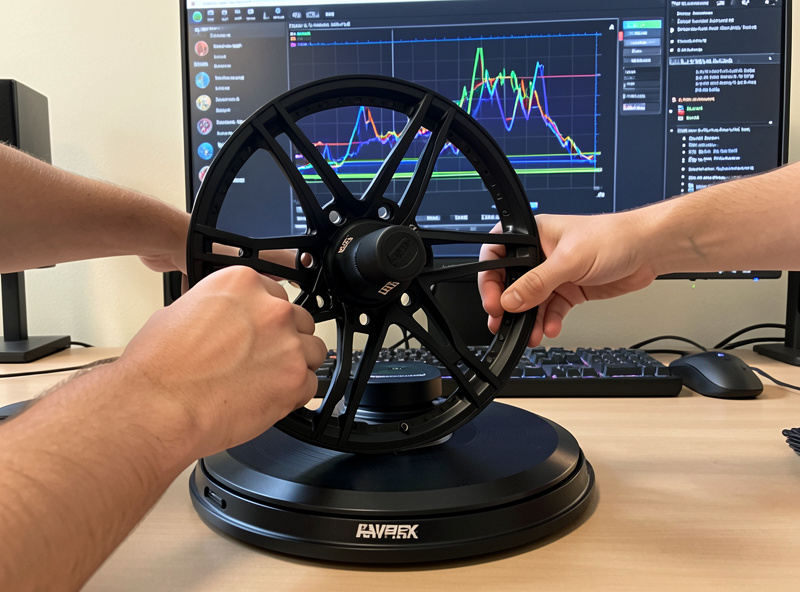
Lock the wheelbase, grip the rim at nine and three, and twist it hard against the base’s holding torque while watching the wheel center on a telemetry overlay — then put a hand on each suspect joint and tube to feel which one moves. The flex you feel at the wheel originates somewhere specific, and this crude test walks you straight to it.
I do this every time I change something on the frame. With the base powered and holding center, I load the rim the way a hard corner would and watch whether the center indicator creeps on my telemetry overlay — if it moves, something in the structure is deflecting. Then I chase it by touch: a hand flat on the wheel-deck upright, on the base adapter, on each frame corner, feeling for the one that flexes under the load. Nine times out of ten it’s not a joint at all, it’s a tube bending — usually the upright that carries the wheel deck, cantilevered forward with nothing triangulating it. The overlay turns a vague “feels flexy” into a specific “that upright is bending 3 mm,” which is the difference between guessing and fixing. This is the same diagnostic mindset behind the whole welded steel rig build: measure it, don’t feel your way blindly.
Where Does Frame Flex Usually Come From?
Here are the usual suspects, ranked by how often they’re the culprit on rigs I’ve diagnosed, with the fix for each. Most rigs have two or three of these at once.
| Flex source | What you feel | The fix |
|---|---|---|
| Unbraced wheel-deck upright | Wheel center wanders under load | Diagonal brace upright to main rail |
| Pedal deck not triangulated | Deck flexes under hard braking | Diagonal brace deck back to frame |
| Rig rocking on carpet/feet | Whole rig sways, feels loose | Wide feet, floor bar, or base plate |
| Base adapter too thin/small | Movement right at the wheelbase | Thicker plate, more bolts, gusset |
| Long unsupported monitor arm | Screen shakes, not the wheel | Brace or shorten the arm |
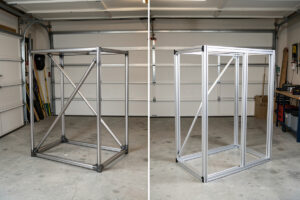
Notice how many fixes are the word “brace.” That’s not a coincidence — the answer to almost all of these is adding a triangle where there’s currently a straight line or an open rectangle. An open rectangular frame racks into a parallelogram under load; a single diagonal across it turns it into two triangles and stops the racking cold. The Engineering ToolBox data on section stiffness and the basic truss principle both back this up, but you’ll feel it the moment you clamp a diagonal in place and load the rig again.
Why Does a Diagonal Brace Beat a Thicker Tube?
Because bracing changes the load from bending to tension and compression, and steel is vastly stiffer in tension than in bending. A cantilevered upright resists your load only by its own bending stiffness, which is limited. Add a diagonal and that same load becomes a push-pull along the brace, where steel barely deflects at all. You get far more stiffness per gram from geometry than from wall thickness.
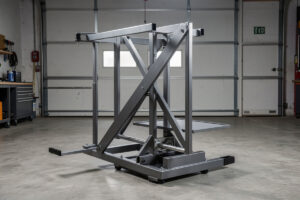
On my rig, the last of the wheel wander came from the wheel-deck upright bending — the tube itself, not any joint. I added a single diagonal brace from the top of the upright back down to the main rail, and the improvement was dramatic: more than I’d have gotten from doubling the upright’s wall thickness, at a fraction of the weight and cost. That’s the whole argument for why you should chase geometry before mass, and it’s why I keep telling people the sizing in choosing steel tube size and wall thickness matters less than where you put your braces. A well-triangulated 40×40×2 frame is stiffer than a poorly braced 50×50×3 one that weighs half again as much. If you’re still designing, model the braces in from the start — my CAD design guide shows how to place them before you cut.
How Do You Add Bracing to an Already-Welded Rig?
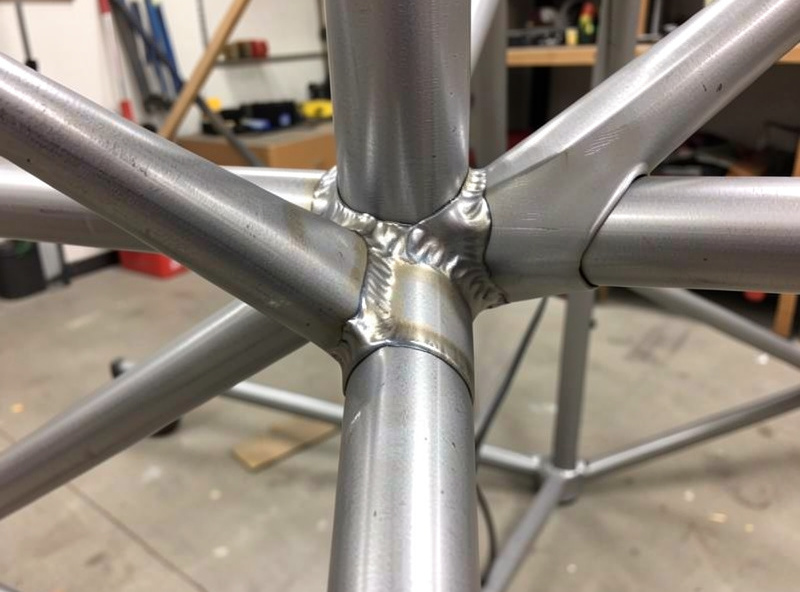
You retrofit braces exactly the way you’d design them in: find the flexing member, cut a diagonal tube to span from it back to a rigid part of the frame, clamp it in place, confirm it kills the flex, then weld it. Because you’re adding to a finished frame, you can test-fit with clamps and load the rig before committing a single weld.
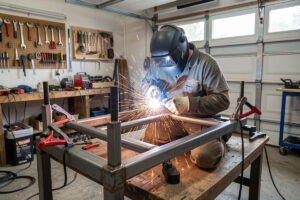
This is the beauty of steel: adding a brace to an existing frame is a 20-minute job. I cut a length of 30×30 or 40×40 tube to bridge the gap, notch or miter its ends to sit flush, clamp it across the flexing area, and re-run the twist test. If the wheel center stops creeping, the brace goes exactly there and I weld it — following the same tack-then-balance approach from my MIG welding walkthrough so I don’t warp the frame adding it. If you can’t or won’t weld the retrofit, a bolted brace with a gusset plate at each end gets you most of the way, using the bolt-joint discipline from bolt-on vs welded sim rig joints. The sound of a braced frame is different, by the way — an unbraced rig gives a hollow flexy “bong” when you rap it; a well-triangulated one rings tight and dead.
What About Flex From the Floor?
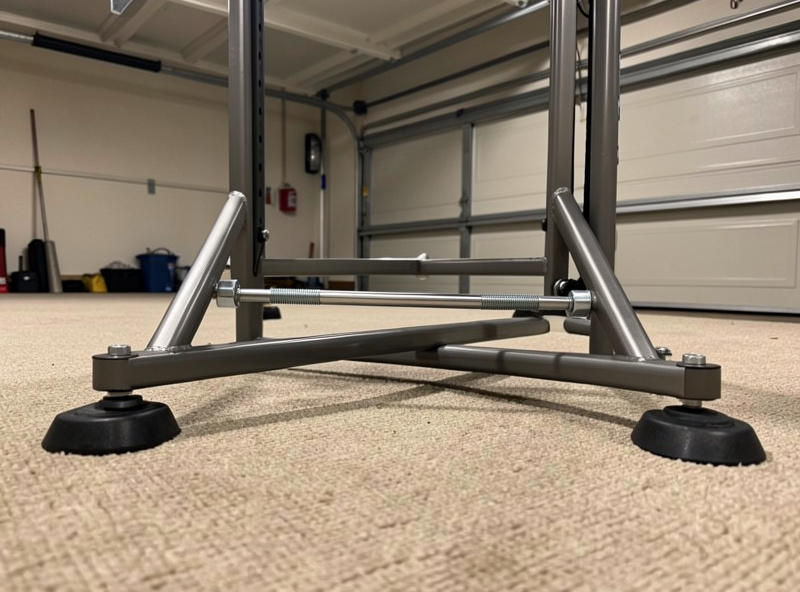
A perfectly stiff frame can still feel loose if it rocks on the floor. Soft carpet, adjustable feet at full extension, or a narrow footprint all let the whole rig sway, and that sway reads as flex in your hands even though the frame isn’t bending. Widen the stance, add a bar across the front feet, or set the rig on a plywood base plate.
I chased “frame flex” for an evening once that turned out to be entirely the rig rocking on thick carpet — the frame was solid, the floor interface wasn’t. A plywood base plate under the whole rig spread the load and stopped the rocking instantly. Wide feet or a floor bar tying the front feet together do the same job by broadening the base. Rigidity is a system that runs from your hands all the way to the floor, and the weakest link anywhere in that chain is what you feel. Get the frame stiff, the joints tight, and the feet planted, and only then does the base torque and the FFB tuning tell you the truth about the car — which is the whole point of building stiff in the first place.
Frequently Asked Questions
How do I find where my sim rig flexes?
Lock the wheelbase, grip the rim at nine and three, and twist it hard against the base’s holding torque while watching the wheel center on a telemetry overlay. If the center creeps, something is deflecting. Then put a hand on each upright, joint, and tube to feel which one moves. Usually it is a cantilevered tube bending, not a joint slipping.
Why does a diagonal brace stiffen a rig more than thicker tube?
Because bracing converts the load from bending to tension and compression, and steel is far stiffer in tension than in bending. A cantilevered tube resists load only by its limited bending stiffness, while a diagonal turns that load into a push-pull along the brace where steel barely deflects. Geometry gives more stiffness per gram than wall thickness.
Can I add bracing to a rig I already welded?
Yes, easily. Cut a diagonal tube to span from the flexing member back to a rigid part of the frame, clamp it, re-run the twist test to confirm it kills the flex, then weld it in following a tack-then-balance sequence so you do not warp the frame. If you cannot weld, a bolted brace with gusset plates at each end gets most of the way.
Why does my stiff frame still feel flexy?
Often it is the floor, not the frame. Soft carpet, adjustable feet at full extension, or a narrow footprint let the whole rig rock, and that sway reads as flex in your hands. Widen the stance, tie the front feet together with a bar, or set the rig on a plywood base plate to spread the load and stop the rocking.
Where should I put braces on a sim rig?
Wherever a straight tube cantilevers or an open rectangle can rack into a parallelogram. The most common spots are the wheel-deck upright braced back to the main rail, the pedal deck triangulated back to the frame, and a diagonal across any large open bay. Adding a triangle where there is currently a straight line is the core move.