For raw rigidity per dollar, welded steel tube beats 80/20 aluminum profile — steel is roughly three times stiffer than aluminum for the same section, and welded joints can’t slip the way bolted T-slot joints can. But aluminum wins on convenience, reconfigurability, and needing zero welding skill. I’ve built and raced both, and the honest answer is that it depends on whether you own a welder.
This is the comparison I get asked about most, usually by someone standing over a folding rig that’s flexing under a new direct-drive base. They’ve read that “80/20 is the gold standard” and they’ve also read that “welded steel is the only real way,” and both camps talk past each other. So I built both, bolted the same base and pedals to each, and pushed on them until I could feel exactly where the difference lives. Here’s what actually separates them.
Which Is Actually Stiffer, Steel or Aluminum?
Steel, by a wide margin, and it’s not close in the material itself. Steel’s Young’s modulus is about 200 GPa; aluminum’s is about 69 GPa — roughly a third. That means a steel tube resists bending and twisting about three times harder than an identical aluminum section under the same load. On a sim rig, that’s the difference between a wheel deck that stays put and one that deflects under a hard trail-brake.
But raw material stiffness isn’t the whole story, because a sim rig is a system of tubes and joints, not one bar. Where aluminum profile claws back ground is section size: an 80/20 extrusion is bulky — a 40×40 mm profile has a lot of aluminum arranged efficiently around its perimeter, so the finished profile is stiffer than the thin-walled aluminum modulus alone suggests. That’s why a well-built aluminum rig still feels solid. The gap in practice is narrower than three-to-one, but it’s real, and you feel it exactly where you don’t want compliance: at the wheel, under load. The ASTM A500 mild-steel tube I build with and the 6063-T5 alloy most T-slot extrusion uses are both fine engineering materials; steel just brings more stiffness to the fight.
Why Do Bolted Aluminum Joints Give Up First?
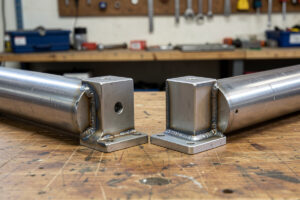
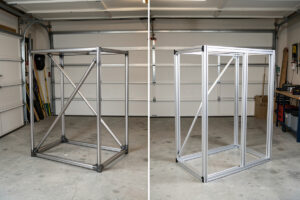
The joints, not the tubes, are where an aluminum rig loses to steel. A welded steel corner is metallurgically continuous — the two tubes become one piece. An 80/20 joint is two extrusions clamped by a gusset bracket and T-nuts, and clamped friction can slip. Under the reversing load of a direct-drive base, that micro-slip is exactly the compliance you feel as wheel wander.
I tested this the boring, repeatable way: base locked, rim twisted against it by hand, watching the wheel center on my telemetry overlay. On the welded steel frame the center didn’t budge. On the aluminum rig — a good one, properly gusseted — I could see a small but real movement that traced straight back to the front upright joints, not the tube. Re-torquing the T-nuts reduced it but never killed it, because you’re fighting friction, and friction under a reversing load always eventually gives a little. That’s the core of the argument, and it’s the same reason the whole welded steel rig build guide leans on welded joints for the load path and bolts only the parts you adjust.
Steel vs Aluminum Sim Rig: The Honest Comparison
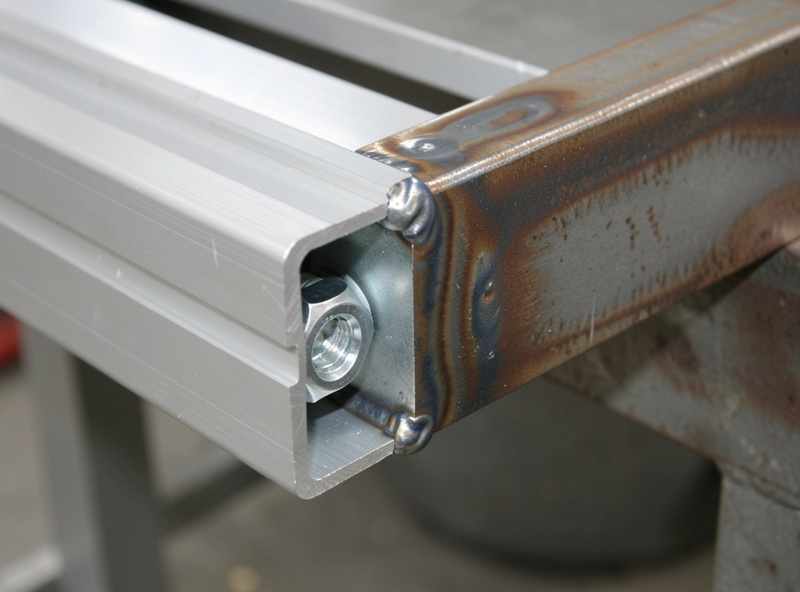
Here’s the side-by-side from living with both. Neither is wrong — they optimize for different owners. If you value a stiff, cheap, permanent rig and you can weld, steel. If you value reconfigurability and clean assembly with no shop, aluminum.
| Factor | Welded steel tube | 80/20 aluminum profile |
|---|---|---|
| Material stiffness | ~200 GPa (3x aluminum) | ~69 GPa |
| Joint behavior | Welded, no slip | Bolted, can micro-slip |
| Frame cost (typical) | $150–$250 | $350–$500 |
| Tools required | MIG welder, grinder, saw | Hex keys only |
| Reconfigurable | No (permanent) | Yes (fully) |
| Weight | Heavier | Lighter |
| Corrosion | Rusts, must be finished | Anodized, none |
| Looks out of the box | Raw until painted | Clean, finished |
The row that decides it for most people is “tools required.” If you already own a MIG welder and an angle grinder, steel is cheaper and stiffer and there’s little reason not to. If buying a welder is part of the price, aluminum’s premium starts looking reasonable — and my full 80/20 aluminum profile sim rig build guide is written for exactly that reader.
Does the Difference Even Matter at Your Torque Level?
Below about 8 Nm, honestly, both frames are more than stiff enough and you’re unlikely to feel the difference on the wheel. The steel-vs-aluminum debate only becomes real once you’re running a mid-to-high-torque direct-drive base that can actually load the frame hard enough to find its compliance.
This is the part the “steel is the only way” crowd skips. If you’re on a gear-driven or belt base, or a mild direct-drive under 8 Nm, a decent aluminum rig — or even a good folding kit — will not flex enough to bother you, and the welding effort buys you nothing you can feel. The frame question scales with torque. I run mid-torque direct drive as my daily and I can feel the difference; a friend on an 8 Nm belt base genuinely can’t. Match the frame to the base, and figure out your real torque need first — my guide on how much wheelbase torque you actually need will keep you from over-building the frame for torque you’ll never run. And whichever frame you pick, where you mount the wheel matters just as much for feel, which is why I keep coming back to wheel mounting options.
Which One Should You Build?
Build steel if you own a welder, want maximum rigidity per dollar, and don’t need to rearrange the rig. Build aluminum if you have no shop, want to reconfigure freely, or just don’t want to weld. That’s the whole decision, stripped of tribalism.
My daily rig is welded steel because I had the welder, the space, and a stubborn wheel-wander problem the aluminum rig couldn’t fully cure at my torque level. But I kept the aluminum rig and still recommend it constantly, because for a lot of people the ability to bolt on a monitor arm, move the pedal deck 20 mm, or break it down for a move is worth more than the last few percent of stiffness. The mistake I see most is treating this as a moral question. It’s an engineering tradeoff: stiffness and cost on one side, convenience and reversibility on the other. Once you’ve picked, my monitor mounting and FOV guide works the same on either frame.
How I Actually Compared the Two Frames
I didn’t want a feelings test, because “it feels stiffer” is worthless — everyone’s new rig feels stiffer than their old one on day one. So I ran the same base, the same load-cell pedals, and the same rim on both frames back to back, and measured deflection the boring, repeatable way with the base locked and my telemetry overlay watching the wheel center.
The method is simple enough that anyone can copy it. Lock the wheelbase in software or with the base powered but the game paused so it holds center. Grip the rim at nine and three, and twist it against the base’s holding torque as hard as you’d ever load it in a corner. Watch whether the wheel center indicator on your overlay moves. On a truly rigid frame it doesn’t move at all — the base holds, the frame holds, and every bit of your input goes into the force reading. On a compliant frame the center creeps, and that creep is deflection somewhere in the structure. Then repeat with a hand on each suspect joint to feel where the movement originates. It’s crude, it’s firsthand, and it tells you far more than a spec sheet.
On the welded steel frame, nothing moved that I could detect on the overlay or feel with my hand. On the aluminum rig, the wheel center crept a hair and I could feel the front uprights working at their gusset brackets — not the extrusion bending, the joint clamping and releasing. I spent an evening re-torquing every T-nut on the aluminum rig and got the creep down but never to zero. That single evening is what convinced me the difference is real and lives in the joints, not the marketing. It’s also why, when I get a wheel-wander complaint, the first thing I ask isn’t “what base” but “what’s the frame, and are the joints welded or bolted.”
One caveat I’ll flag honestly: my aluminum rig used stock corner brackets, and the serious 80/20 builders will tell you that adding proper gusset plates and more fasteners per joint closes much of the gap. They’re right — you can make an aluminum rig extremely stiff with enough bracketing and money. At that point, though, you’ve spent your way past what a welded steel frame costs, which loops right back to the real question: do you own a welder, or not.
Frequently Asked Questions
Is a welded steel sim rig stiffer than 80/20 aluminum?
Yes. Steel is about three times stiffer than aluminum as a material, and welded joints cannot micro-slip the way bolted T-slot joints can under a reversing direct-drive load. A well-built aluminum rig is still very good, but its compliance lives at the bracketed joints, and you feel that at the wheel under hard braking.
At what torque does frame choice start to matter?
Roughly above 8 Nm. Below that, a decent aluminum or even a good folding rig is stiff enough that you will not feel the difference on the wheel. The steel-versus-aluminum question only becomes real once a mid-to-high-torque direct-drive base can load the frame hard enough to find its compliance.
Is aluminum profile worth the extra cost?
If you do not own a welder, often yes. A steel frame is cheaper in materials but assumes you already have a MIG welder and a grinder. Once you factor buying those tools, aluminum profile’s premium looks reasonable, and you gain full reconfigurability and a clean anodized finish with no rust risk.
Can I mix steel and aluminum in one rig?
You can, and people do, usually a welded steel main frame with bolt-on aluminum-profile accessory arms for monitors or a keyboard tray. The structural load path should stay in the stiffer steel; use aluminum for the light, adjustable bits where reconfigurability matters more than the last bit of rigidity.
Does aluminum profile rust or corrode?
No. T-slot aluminum extrusion is typically anodized and does not rust, which is one of its genuine advantages over raw steel. A welded steel frame will surface-rust within weeks if left bare in a humid room, so steel has to be primed and painted or powder-coated, while aluminum needs no finishing at all.
Further Reading
- Welded Steel Sim Racing Rig: The Complete Build Guide
- 80/20 Aluminum Profile Sim Rig: A Complete Build Guide
- How Much Wheelbase Torque Do You Actually Need in Nm?
- Steering Wheel Mounting Options for a Sim Rig
As an Amazon Associate I earn from qualifying purchases. If you’re going the aluminum route, the profile itself is the main buy — you can compare 4040 T-slot aluminum extrusion to price out a frame before committing.