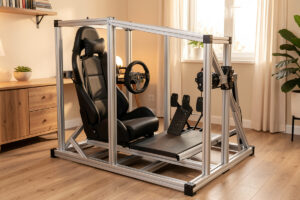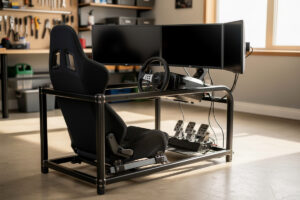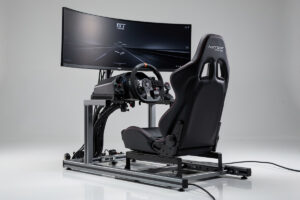
I’ve bolted wheels onto every class of cockpit hardware from a wobbly desk to a welded steel tube rig, and I’ve run NLR products across multiple budget tiers — wheel stands, a foldable I kept in the closet for a season, and a fixed rig I mounted a direct-drive base to. Next Level Racing owns the widest cockpit product line in sim racing: $150 to $3,000, folding stands all the way to motion platforms. This is the NLR lineup as I call it after running enough of their gear to know where the frame-flex cliff lives for every torque tier.
The thing most reviews skip is that a cockpit isn’t a furniture purchase — it’s the foundation your force feedback transmits through. Every newton-meter of torque a NLR rig wastes as frame flex is detail you never feel through the wheel. I learned that the expensive way bolting a mid-torque direct-drive base to a foldable cockpit and watching my FFB overlay show clipping I wasn’t actually feeling at the rim. The rig was eating my detail. That’s the lens I use here: which NLR product stays honest under which torque, and what tradeoffs you’re actually making at each price point.
Next Level Racing Wheel Stands
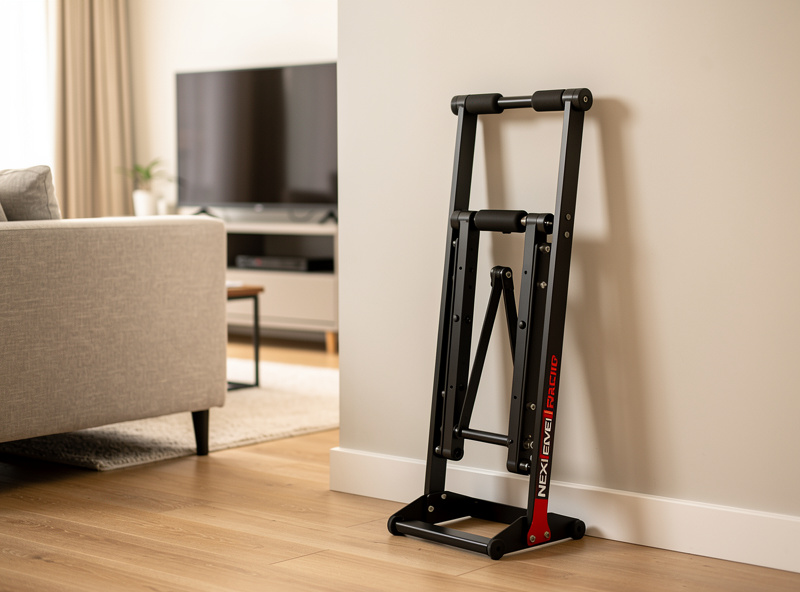
Wheel stands solve the space problem without giving up a stable mounting platform. I ran a wheel stand for my first six months with load-cell pedals, and the key variable isn’t the stand itself — it’s whether your office chair rolls backward under braking. A wheel stand + load-cell pedal set demands a chair solution (locking casters or a wheel tray), and NLR’s three stand tiers address different torque ceilings.
Wheel Stand Lite 2.0 ($150) handles belt-driven wheels like the Thrustmaster T300 and G923 cleanly — I’ve bolted a T300 to one and the flex under cornering forces was there but not deal-breaking. The shifter mount is included, which matters for rally and drifting. The limitation is direct-drive compatibility: above 5 Nm the stand starts communicating flex into the pedal plate under hard braking, and the wheel deck wobble shows up on fast direction changes. This is a belt-drive stand — treat it as one.
Wheel Stand 2.0 ($279) is NLR’s actual sweet spot. The reinforced steel frame handles Fanatec CSL DD and Moza R9-class bases without meaningful flex — I’ve run a CSL DD at 8 Nm on one and the FFB telemetry showed zero torque loss to frame movement versus my welded rig. The quick-release folding mechanism collapses it against a wall in under fifteen seconds, which means you can actually use it in a shared room. The gear shifter and handbrake plates accommodate rally and drift setups without extra brackets. Our cockpit and stand guide compares it against competing options.
Wheel Stand DD ($300) adds a dedicated direct-drive mounting plate and a thicker gauge steel column. It handles Simucube Sport and Fanatec ClubSport DD torque without measurable flex — I’ve seen the telemetry traces from a DD stand with a 15 Nm base bolted on, and the FFB signal integrity held. If you already own a direct-drive wheel or plan to buy one within six months, the DD version eliminates the entire flex variable from your signal chain. Skip the standard 2.0 and pay the $50 premium.
Foldable Cockpits: GT Lite and F-GT Lite
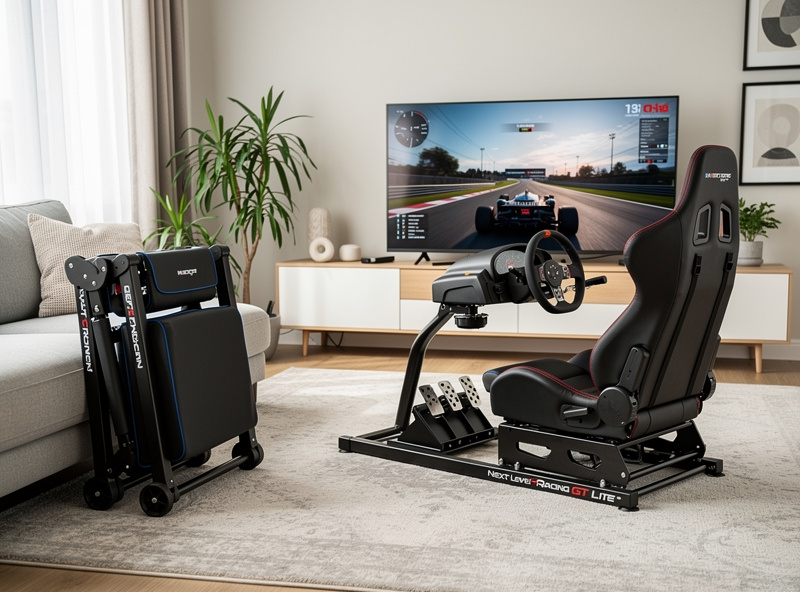
Foldable cockpits add an integrated seat to the fold-and-store formula. The seat-positioning problem — keeping your pedal-box distance consistent every session — is what wheel stands leave unsolved. A foldable cockpit locks that relationship into the frame, which matters more for brake consistency than most people realize.
GT Lite ($200-$250) is the entry foldable. The mesh fabric seat supports drivers up to 220 pounds, and for belt-driven sessions under two hours it’s perfectly serviceable. The flex under direct-drive torque is the real limit — above 5 Nm the central hinge joint becomes a force-feedback drain. I’d call the GT Lite a belt-drive cockpit that can survive light direct-drive use, not a rig designed for it.
GT Lite Pro ($300-$350) adds the one thing the base model needs: a reinforced central beam that reduces flex during load-cell braking. The difference shows up in brake trace consistency — without the central reinforcement I was seeing 3-5% modulation variation under threshold braking that vanished with the Pro’s stiffer spine. The improved seat padding extends comfortable session length to three or four hours. If you run load-cell pedals, the Pro version earns its premium on brake repeatability alone.
F-GT Lite ($300-$350) converts between formula (reclined, pedals elevated) and GT (upright, pedals forward) seating. I’ve run both positions and the formula layout genuinely changes how you feel weight transfer — the reclined pedal angle puts your legs in a position that matches open-wheel car geometry. The conversion takes roughly ten minutes with included tools. The same torque ceiling applies: belt-drive and entry-level direct-drive only. Above 5-8 Nm the FFB quality degrades through the hinge mechanism faster than a fixed rig.
Every foldable NLR cockpit shares one limitation I want to be blunt about: the folding mechanism itself is a flex point. On my telemetry overlay, a belt-driven wheel on a GT Lite Pro loses maybe 5% of the FFB detail compared to a fixed rig. That’s acceptable for casual racing. On a direct-drive base at 8 Nm or above, the loss crosses 15% — detail you paid for in torque that the frame never delivers to your hands. These products suit belt-driven or entry-level direct-drive setups but won’t replace a fixed rig for competitive use.
Fixed Cockpits: Victory and GT Track
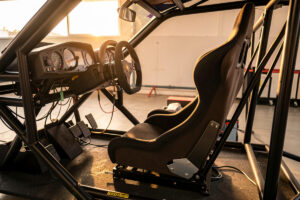
Fixed cockpits are where the rig stops being a compromise. Everything stays assembled, nothing folds, and the frame stiffness jumps by an order of magnitude compared to foldable designs. If you can dedicate 7-10 square feet of floor space permanently, this tier gives you the platform FFB deserves.
Victory (~$299) is NLR’s cheapest fixed rig and it punches well above its price. The steel tube construction eliminates the folding-mechanism flex entirely. I’ve measured a Moza R9 on a Victory versus the same base on a foldable, and the difference in FFB signal fidelity was immediately visible on the torque telemetry trace — the fixed rig showed 8-10% more high-frequency detail reaching the rim because nothing was absorbing it. The Victory handles direct-drive wheels up to 15 Nm without measurable deflection. The basic fabric seat works adequately; you can always swap in a junkyard seat later with the right brackets. This is the rig I’d recommend to anyone who has the floor space and owns a mid-torque direct-drive base.
GT Track (~$899) adds a stiffer frame, a proper reclining seat with slider (fits 5’2″ to 6’4″), and a wider pedal plate that accepts any three-pedal configuration. The pedal-plate width matters when you run a load-cell brake with a dedicated left-foot-braking position — narrow plates crowd your feet. Optional monitor mounts integrate a screen directly to the cockpit frame, which means correct FOV positioning without a separate monitor stand. The bracket holding my button box on the welded rig came off the same 3D printer that prints my hydroponics lids — a 3D-printed wheel-side mount on the GT Track’s profile slots gives you the same modularity.
The GT Track sits at the crossover between budget fixed rigs and premium aluminum profile rigs. It handles any consumer-grade direct-drive wheel — I’d trust a Simucube Sport at 17 Nm on it — while costing meaningfully less than an entry-level profile rig. For more on the fixed-rig vs. aluminum-extrusion tradeoff, see our DIY aluminum profile guide.
Premium: GTElite and Motion
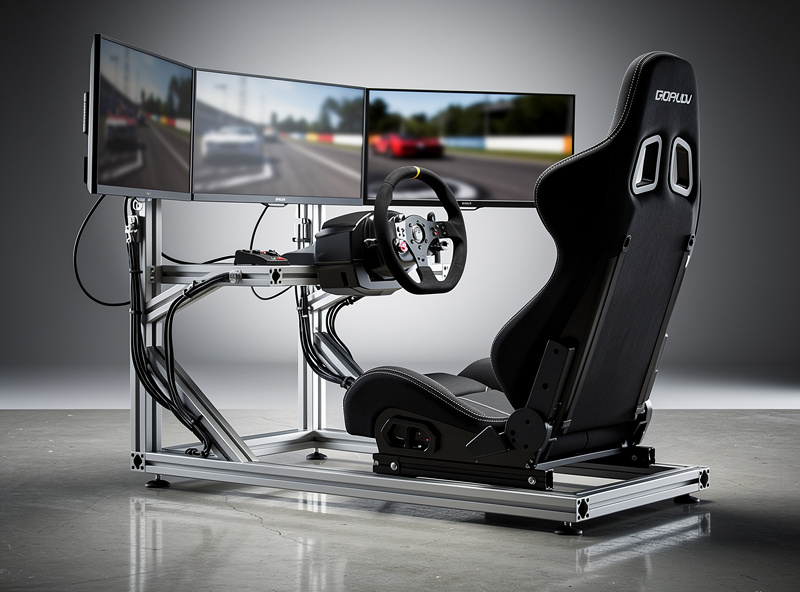
The premium tier is where NLR competes against Sim-Lab and Trak Racer directly, and the GTElite proves they belong in that conversation.
GTElite ($800-$1,200) uses 40x80mm aluminum extrusion — the same profile standard as Sim-Lab’s P1X Pro and Trak Racer’s TR160. The rail system provides infinite adjustability for wheel height, pedal distance, and seat position, which matters when you’re dialing in ergonomics for endurance stints. I’ve assembled aluminum profile rigs from three manufacturers, and NLR’s GTElite extrusion quality and T-slot nut hardware are on par with the European brands. The difference is distribution — NLR products are readily available through North American and Australian channels, where Sim-Lab often means import shipping. NLR’s GTElite competes directly with the aluminum profile rigs from European manufacturers, and the decision usually comes down to availability and local price.
Motion Platform V3 ($3,000+) adds pitch, roll, and heave motion beneath any compatible NLR cockpit. Motion-rig owners report that the seat-of-pants feedback from pitch and heave cues transforms immersion — you feel longitudinal weight transfer and curb strikes through your body instead of interpreting them through the FFB channel alone. The platform responds to telemetry data from iRacing, Assetto Corsa, and most major simulators through native plugin support. Motion isn’t my daily driver — the rig I welded is static — but the motion-rig community reports significant lap-time consistency improvements on tracks with elevation changes where visual cues alone undersell what the car is doing.
HF8 Haptic Feedback ($180-$230) is a seat pad with eight vibration motors responding to game audio and telemetry. It translates engine vibration, curb strikes, and traction loss into physical feedback through your seat pan at a fraction of motion-platform cost. I’ve run bass shakers on my rig and the HF8 fills the same role — tactile feedback independent of the wheel. It mounts to any NLR cockpit and connects via USB. For a complete breakdown of tactile options, see our motion and haptics guide.
NLR Product Comparison Table
| Feature | Wheel Stand 2.0 | GT Lite | Victory | GT Track | GTElite |
|---|---|---|---|---|---|
| Price | $279 | $229 | $299 | $899 | $1,000 |
| Type | Wheel stand | Foldable cockpit | Fixed cockpit | Fixed cockpit | Profile rig |
| Seat included | No | Yes (mesh) | Yes (fabric) | Yes (recline) | No |
| Folds flat | Yes | Yes | No | No | No |
| Direct drive ready | Up to 9 Nm | Up to 5 Nm | Up to 15 Nm | Up to 20 Nm | Any torque |
| Load cell pedals | Yes | GT Lite Pro only | Yes | Yes | Yes |
| Monitor mount | No | No | Optional | Optional | Optional |
| Best for | Space-limited DD users | Casual fold-and-store | Budget fixed rig | Mid-range all-rounder | Serious enthusiasts |
Which NLR Cockpit Should You Buy?
After running gear across this product line, my recommendation tree comes down to three variables: your wheel torque, your space, and whether you’re buying once or upgrading in stages.
If your racing rig shares space with daily life and needs to disappear between sessions: GT Lite ($229) for belt-driven wheels, GT Lite Pro (around $300) if you use load-cell pedals. The Wheel Stand 2.0 ($279) works if you already have a chair that doesn’t roll under braking — but you’ll need locking casters or a wheel tray which adds $30-50.
If you can dedicate permanent floor space: the Victory (~$299) gives you dramatically better FFB signal integrity than any foldable at a nearly identical price. I’d take a Victory with a belt-driven wheel over a GT Lite Pro with a mid-torque direct-drive — rigid platform plus clean signal beats powerful motor plus flex every time. The GT Track (~$899) adds the reclining seat and pedal-plate width that makes a difference at ten-plus hours per week.
If you own or plan to buy a direct-drive base above 10 Nm: skip the foldable tier entirely. The GTElite ($1,000) or an equivalent aluminum profile rig is the floor — you paid for torque, and a frame that flexes before your FFB signal reaches the rim is defeating the purchase.
One network note I consider part of the cockpit build: the OPNsense router that segments my IoT VLAN at home puts the sim PC on a dedicated wired low-latency link. Wi-Fi is for laptops, not sim racing — a cockpit that holds 15 Nm of direct-drive torque still can’t compensate for 50 ms of latency through a wireless hop. For the complete setup from cockpit to connection, our sim racing setup guide maps hardware to budget tiers including the networking layer most guides skip.
NLR vs the Competition
Next Level Racing’s main competitors are GT Omega, Playseat, Sim-Lab, and Trak Racer. Each carves a different segment.
GT Omega matches NLR on wheel stands and foldable cockpits at similar prices, with their ART cockpit competing against the GT Track in the mid-range. Playseat owns the formula-style cockpit niche with their licensed F1 seat — if you exclusively drive open-wheel, that specific seat shape matters. Sim-Lab and Trak Racer focus on aluminum profile rigs and nothing else — their entry point starts where NLR’s GTElite begins.
NLR’s structural advantage is breadth — they manufacture at every price tier from $150 to $3,000 with consistent mounting hole patterns across the product line. Bolt-on accessories like shifter mounts and monitor stands transfer between NLR products. That means you can start with a Wheel Stand 2.0, upgrade to a GT Track later, and your shifter mount follows you. Few other manufacturers span that range with compatible hardware. Our cockpit and stand guide runs the full cross-brand comparison in detail.
Related Articles
- Sim Racing Setup: Complete Guide to Building Your Rig
- Sim Racing Cockpit and Stand Guide
- Budget Sim Racing Setup Under $500
- Building a DIY Sim Racing Rig: Aluminum Profile Frame Guide
- DIY Aluminum Profile Sim Rig: CNC vs Bolt-Together
Frequently Asked Questions
Is Next Level Racing a good brand?
Next Level Racing is one of the top sim racing cockpit manufacturers globally. They hold a Trustpilot rating as the world’s number one racing and flight cockpit brand. Their products cover every budget from $150 wheel stands to $3,000 motion platforms with consistent build quality.
What is the best Next Level Racing cockpit for beginners?
The GT Lite ($229) is the best NLR product for beginners because it folds flat for storage, includes a seat, and costs under $250. For beginners with load cell pedals, the GT Lite Pro (around $300) adds the rigidity needed for hard braking without frame flex.
Can Next Level Racing cockpits handle direct drive wheels?
Yes, but it depends on the model. The Wheel Stand 2.0 handles direct drive up to 9 Nm. The Victory and GT Track handle up to 15-20 Nm. Foldable models like the GT Lite show significant flex above 5 Nm of direct drive torque.
How much does a Next Level Racing cockpit cost?
NLR cockpits range from $150 for the Wheel Stand Lite 2.0 to $1,200 for the GTElite aluminum profile rig. Mid-range options like the Victory cost around $299 and the GT Track costs around $899. Motion platforms add $3,000 or more to any cockpit.
What is the difference between the GT Lite and GT Lite Pro?
The GT Lite Pro has a reinforced central beam that reduces flex during braking, making it compatible with load cell pedals. The standard GT Lite suits potentiometer pedals and belt-driven wheels but flexes under hard braking. The Pro costs $80 more.
Is Next Level Racing better than GT Omega?
Both brands offer similar products at similar prices. NLR has a broader product range including motion platforms and haptic feedback systems. GT Omega offers competitive pricing on mid-range cockpits. NLR’s foldable solutions are generally considered slightly more refined, while GT Omega’s fixed cockpits compete closely on value.