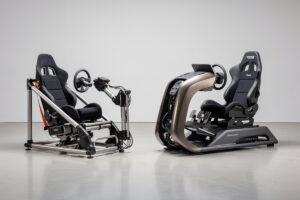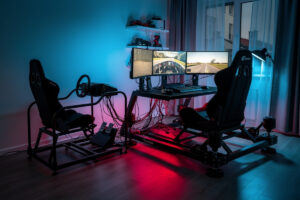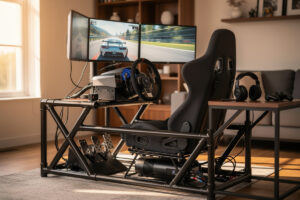
Sim racing motion is the layer that turns a rigid cockpit into something your body reads through its seat and feet, not just its hands. The practical hierarchy is simple: tactile transducers (bass shakers) cost the least and add the most per dollar, belt-tensioner systems fake sustained G-forces on the cheap, and true actuated platforms (2DOF up to 6DOF) physically pitch and roll the whole rig. I run a bass-shaker-equipped welded steel rig and have spent long sessions on owners’ actuated platforms, and the honest verdict is that most people get 80% of the immersion from the cheapest tier.
This guide maps the entire motion-and-haptics landscape the way I’d build it up myself: what each system actually does to the way you drive, where the money stops buying lap time and starts buying sensation, and the order I’d add it all in. Motion is the one part of my cockpit I treat as a genuine deep-cut edge rather than settled territory, so where I’m relaying what dedicated actuated-platform owners report rather than living it every day, I’ll say so plainly.
What Sim Racing Motion Actually Does
Sim racing motion feeds your vestibular system and skin the forces a real car generates: braking pitch, cornering roll, kerb strikes, wheel spin, and ABS pulses. It splits into two families — haptics (high-frequency vibration via transducers, no rig movement) and actuated motion (the rig physically tilts or heaves). Both feed off the same telemetry your sim already outputs.
The reason motion matters for driving and not just immersion is consistency. When you can feel the rear step out through your seat 50 milliseconds before the visual catches up, you catch the slide earlier. On my own rig, the single biggest correction-timing gain came from a tactile transducer under the seat, not from any wheelbase upgrade. Actuated platforms add a second, slower channel — sustained pitch and roll — that the body interprets as load transfer. That’s where motion stops being a gimmick and starts informing throttle and brake modulation.
Haptics vs Actuated Motion: The Core Split
Haptics and actuated motion solve different problems. Haptics deliver transient cues — vibration tied to RPM, road texture, lockups, and gear shifts — at frequencies from roughly 20 Hz up to a few hundred Hz. Actuated motion delivers sustained cues — the slow build of pitch under braking that a vibration motor physically cannot reproduce.
Most rigs should start with haptics. A pair of tactile transducers driven by a dedicated amp and tuned in software costs a fraction of any motion platform and bolts to a frame you already have. Actuated motion is the next tier, and it’s where the budget, the floor space, and the engineering all escalate hard. I cover both families in depth across the spoke guides, but the short version is: layer haptics first, then decide whether sustained G-cues are worth the platform.
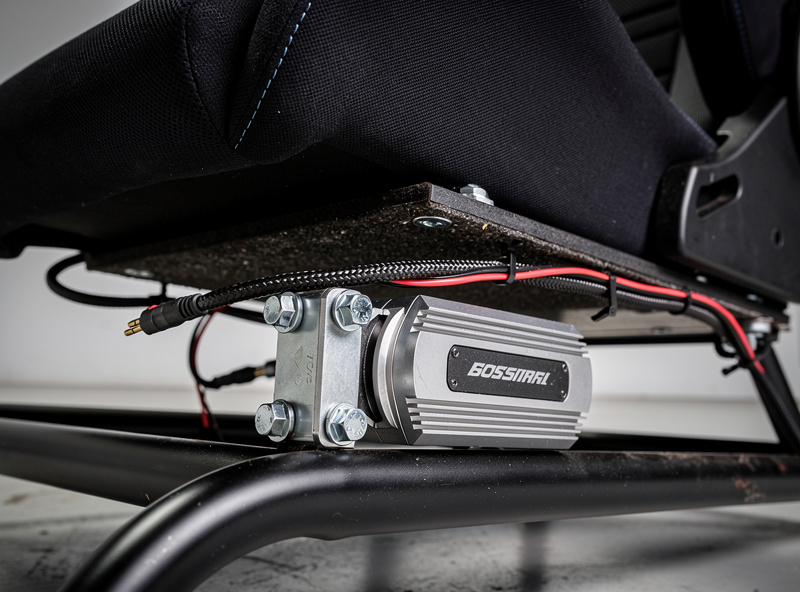
Tactile Transducers and Bass Shakers
A tactile transducer is a voice-coil device that converts an audio signal into physical vibration instead of sound. Bolted to the seat or pedal deck, it reproduces engine rumble, road surface, kerbs, and lockups straight from the sim. This is the highest-immersion-per-dollar upgrade in the entire hobby — typically under the price of a single rim.
The nuance most buyers miss is that transducers vary by frequency range. A large low-frequency unit hits chest-thumping rumble; smaller pucks reproduce sharp high-frequency detail like ABS pulses and tyre scrub. Serious haptic rigs run both, zoned to different parts of the cockpit. The gear distinction between low-frequency rumble units and high-frequency detail transducers is one half of the problem; the software that channels, mixes, and per-title-tunes those effects is the other. They’re separate problems: the hardware decides what’s possible, the software decides what you actually feel.
Actuated Motion Platforms: 2DOF to 6DOF
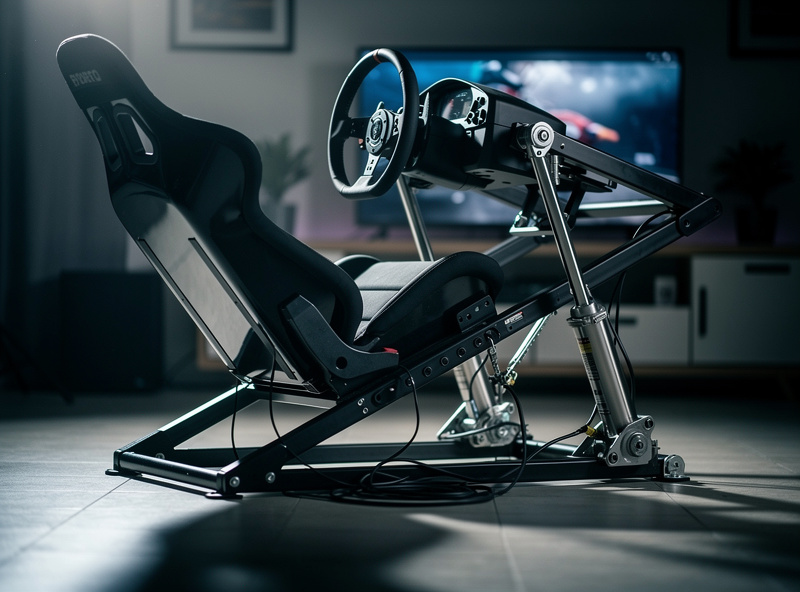
Actuated platforms move the rig on physical actuators. The “DOF” count is the number of independent axes: a 2DOF rig does pitch and roll, a 3DOF adds heave, and a 6DOF reproduces all three rotations plus all three translations. More axes means more faithful force reproduction — and a steep jump in cost, complexity, and tuning effort.
Here’s the practitioner reality, relayed from owners who run these daily: the leap from no motion to 2DOF is enormous, while the leap from 2DOF to 6DOF is real but subject to sharp diminishing returns for most drivers. A well-tuned 2DOF platform with good haptics layered on top satisfies the vast majority of home racers, and the gap between a well-tuned 2DOF and a 6DOF is far smaller than the price difference suggests. The two dominant consumer brands take meaningfully different approaches to the same axis counts — value-focused and DIY-friendly versus integrated and turnkey. Note that powering these actuators is its own engineering problem — covered separately in our motion platform power and inverter sizing deep-dive.
Belt-Tensioner and Traction-Loss Systems
Belt-tensioner systems sit between haptics and full motion. Instead of moving the whole rig, they pull a belt across your shoulders or chest to simulate braking and acceleration G-forces, and traction-loss units rotate the seat or front of the rig to mimic the rear breaking away. They’re cheaper and lighter than actuated platforms and deliver a surprisingly convincing sustained-force cue.
For a lot of drivers this is the sweet spot: more sustained-G realism than transducers alone, far less cost and floor space than a 2DOF platform. The tradeoff is that belt tension is a single-channel sensation — it can’t reproduce the independent pitch and roll an actuated rig does. For many drivers who already run transducers, a belt tensioner is the next meaningful step toward motion without committing to a platform.
Motion and Haptics Systems Compared
The table below ranks the families by what they reproduce, the floor space they demand, and where each one stops paying off. Treat it as the buying order I’d follow on a clean-sheet rig: start at the top, stop when the next tier stops being worth it for how you drive.
| System | What It Reproduces | Relative Cost | Floor Space | Best For |
|---|---|---|---|---|
| Tactile transducers | Transient vibration: RPM, road, kerbs, lockups | Lowest | None (bolts to rig) | Everyone — the first upgrade |
| Belt tensioner | Sustained braking/accel G-force | Low-Medium | Minimal | Sustained-G feel on a budget |
| Traction loss | Rear-rotation / oversteer cue | Medium | Moderate (rig swings) | Drift and rear-feel focus |
| 2DOF platform | Pitch and roll | High | Significant | Most home racers wanting true motion |
| 6DOF platform | Full pitch, roll, heave, surge, sway, yaw | Highest | Large dedicated space | Enthusiasts chasing maximum fidelity |
Building Motion on a Budget
You do not need a four-figure platform to feel the car. The cheapest credible path is one large tactile transducer under the seat plus a basic amp, tuned in free software — that alone transforms a static rig. From there, a second small puck for high-frequency detail and a belt tensioner add sustained-force realism for a fraction of an actuated platform.
The mistake I see most is people skipping haptics entirely and saving for a motion platform that then sits half-tuned because the budget ran out. Build the cheap layers first, run them for a month, and only then decide if you want actuated motion. A staged budget path — one seat transducer, free software tuning, a detail puck, then belt tension — is the route I’d point any beginner toward.
There’s also a clever middle path most people miss: you can drive a transducer for low-frequency rumble and add a single belt-tensioner for sustained braking force without ever touching an actuated platform. That two-system combination covers both the transient and the sustained channel for a fraction of a 2DOF rig’s cost, and on a frame you already own. It won’t pitch and roll the cockpit, but for the money it delivers a remarkable share of what motion is actually for — feeling the car load up and let go. I’d run that combination for a long time before concluding I needed actuators, and plenty of drivers never feel the need to go further.
The Realities of Living With an Actuated Platform
Before anyone commits to actuated motion, it’s worth being honest about what changes in the room, because the spec sheets never mention it. Owners consistently raise the same three realities: noise, space, and power. Electric actuators under load hum and click; in a shared house that matters, and it’s the reason some owners move their rig to a garage or basement. Floor space is the second: a platform needs swing clearance on every axis, so the footprint is meaningfully larger than the static rig it replaces.
The third reality is power and safety. A motion rig draws real current and moves a loaded cockpit with a person in it, so a solid frame, secure harness mounting, and proper electrical supply stop being optional — I treat the power side as seriously as I treat the welds on my own frame, and our motion platform power and inverter sizing guide exists precisely because people underestimate it. There’s also a build-versus-buy fork: DIY actuator kits driven by open-source controllers cost far less than turnkey platforms but demand fabrication and tuning effort, while prebuilt 2DOF and 3DOF units trade money for plug-and-play. Neither is wrong; the right call depends on whether you enjoy the building as much as the driving. For a workshop-minded racer, the DIY route is genuinely rewarding — but go in knowing it’s a project, not a purchase.
How Motion and Haptics Read Your Sim’s Telemetry
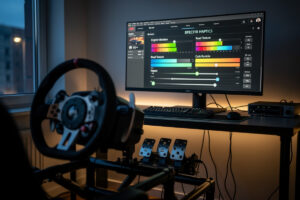
Every motion and haptic system works off the telemetry your sim already broadcasts — the same data stream a dashboard or overlay app reads. Engine RPM, wheel slip ratio, suspension travel, longitudinal and lateral G, ABS and traction-control activation, and gear state are all in there. A haptics app maps those values onto vibration channels; a motion controller maps the G and rotation values onto actuator positions.
What separates a convincing setup from a buzzing mess is the mapping, not the hardware. On my own rig the road-texture effect is driven off wheel-slip and surface data at low amplitude so it stays in the background, while the gear-shift and lockup effects are short, sharp, and loud so they cut through. The single most common error is running every effect at full gain — the channels mask each other and you feel one constant rumble instead of distinct cues. Good motion is built the way you mix audio: a quiet bed of constant effects with a few loud transients on top. This is exactly why the software guides matter as much as the gear guides; the telemetry is identical across systems, but the profile you build off it is where the realism lives.
The Motion Effects Actually Worth Mapping
Not every available effect earns a channel. After long sessions tuning my own haptics, a short list does the heavy lifting: road texture (constant, low) tells you grip is live; wheel lockup (sharp, front transducers) is the cue that makes trail-braking learnable; wheelspin (rear transducers) catches throttle-induced oversteer before the visual; kerb strikes (full-rig) confirm track limits; and gear shift (brief thump) adds rhythm without information overload.
For actuated platforms, owners consistently report that the two effects that justify the whole investment are braking pitch and cornering roll — the sustained cues a transducer physically cannot make. Heave (the platform dropping over crests and compressions) is the third most valued. Surge, sway, and yaw — the extra axes a 6DOF adds — are where the diminishing returns bite: real, but subtle enough that many drivers can’t reliably tell a well-tuned 3DOF from a 6DOF in a blind test. That single fact is the strongest argument for spending the motion budget on tuning and seat-time rather than chasing axis count.
Common Sim Racing Motion Mistakes
The expensive mistakes in motion are almost never the hardware choice — they’re the order and the tuning. The biggest one is buying an actuated platform before the rig is rigid: a platform amplifies frame flex instead of hiding it, so a wobbly cockpit feels worse with motion, not better. Sort rigidity first, always.
The second is over-driving the effects, which I covered above — full gain everywhere produces a numb constant buzz. The third is ignoring latency: if the motion cue lags the visual by more than a few frames, your brain flags the mismatch and the immersion collapses into mild nausea. That’s a network, frame-rate, and USB-polling problem as much as a motion problem. The fourth is neglecting the seat itself — a flexy seat absorbs transducer energy and a poorly mounted one rattles; firm mounting is what lets the vibration reach your body cleanly. Get these four right and a cheap transducer outperforms an expensive platform that’s been bolted on in the wrong order and left at default gains.
Where Motion Fits in the Upgrade Order
Motion is a late-stage upgrade for a reason. The order that actually makes you faster is rig rigidity, then pedals, then wheelbase, then rim — because a wobbly frame or a bad brake pedal limits you long before motion does. Haptics are the exception: a transducer is so cheap and high-impact that I’d add it early, even on a sub-$500 starter rig.
Actuated motion belongs after the core gear is sorted. Bolting a 6DOF platform under a gear-drive wheelbase on a flexy desk is spending in the wrong order. Get the fundamentals of the rig right, layer haptics, and treat actuated motion as the immersion ceiling — not a substitute for a stiff frame and honest force feedback. Powering it correctly matters too: a motion rig draws real current, which is why power and backup planning belong in the conversation.
Motion, Latency, and the Full System
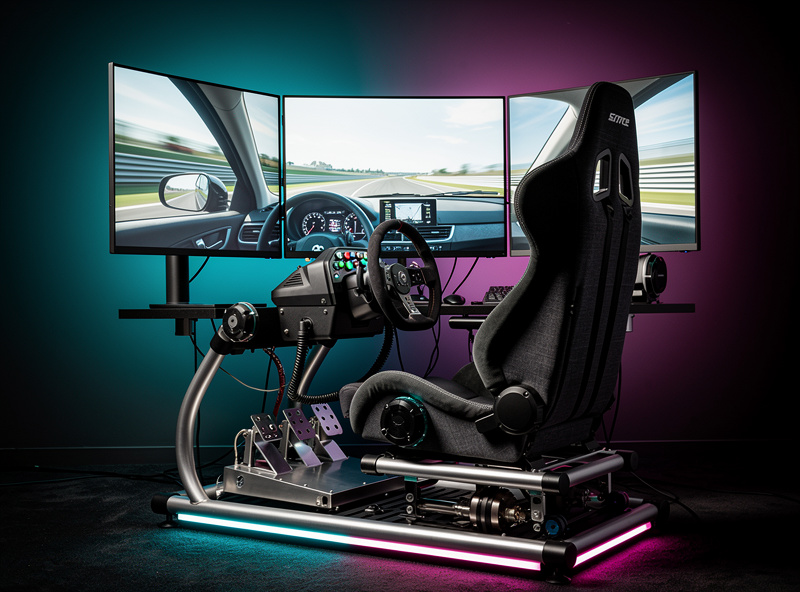
Motion only feels right when the rest of the stack is clean. If your network or input latency is high, the motion cue arrives late and the brain rejects it as wrong. The same goes for frame rate — a GPU that can’t hold steady frames makes motion feel stuttery rather than connected. Motion is a system-level upgrade, not a bolt-on.
It also pairs with honest force feedback and good telemetry-driven practice. The whole point of feeling the car through seat, belt, and wheel at once is redundancy: when three channels agree the rear is going, you react without thinking. Whether you run triples or VR, motion is the layer that makes the visuals feel earned.
Frequently Asked Questions
Do bass shakers actually make you faster in sim racing?
Indirectly, yes. A tactile transducer reproduces lockups, wheelspin, and kerb strikes through the seat, letting you react roughly 50 milliseconds earlier than visuals alone. On my rig it improved slide-catching consistency more than any wheelbase upgrade.
Is a 2DOF motion platform enough, or do I need 6DOF?
For most home racers, 2DOF plus good haptics is enough. Owners report the jump from no motion to 2DOF is huge, while 2DOF to 6DOF brings real but sharply diminishing returns at a much higher cost and floor-space demand.
What is the cheapest way to add motion to a sim rig?
One large tactile transducer under the seat plus a basic amp, tuned in free software. It bolts to an existing frame, needs no floor space, and delivers the highest immersion-per-dollar of any sim racing upgrade.
What is the difference between haptics and a motion platform?
Haptics use transducers to deliver high-frequency vibration cues without moving the rig. A motion platform physically tilts or heaves the whole cockpit on actuators to reproduce sustained forces like braking pitch that vibration cannot replicate.
Where does motion fit in the sim racing upgrade order?
Haptics come early because a transducer is cheap and high-impact. Actuated motion comes late, after rig rigidity, pedals, and wheelbase are sorted, since a flexy frame or bad brake pedal limits you long before motion does.
Do belt-tensioner systems work as well as motion platforms?
They reproduce sustained braking and acceleration G-force convincingly for far less cost and space, but as a single-channel cue they cannot reproduce the independent pitch and roll an actuated platform delivers. They sit between haptics and full motion.