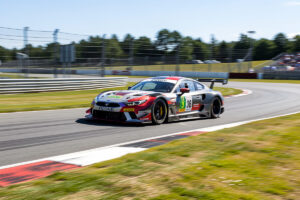
I’ve logged more hours comparing my telemetry traces to faster reference laps in VRS and Garage61 than I have turning practice laps in anger — and every plateau I’ve broken through on my rig has come from that analysis, not from grinding another hundred laps. Sim racing coaching costs $30-100 per hour and typically delivers 0.5-2 seconds of lap time improvement in the first session through telemetry analysis, driving technique correction, and mental approach refinement. The most effective coaching combines live session review — where a coach watches your inputs in real time — with post-session telemetry comparison against reference laps from faster drivers.
On my rig I run VRS, Garage61, and MoTeC side by side, and self-improvement through those tools can replicate 60-70% of what a coach provides, for free or close to it (Garage61’s other-driver comparison and VRS’s coaching overlays sit behind modest paid tiers, but the core self-analysis loop doesn’t require them). The remaining 30-40% — the ability to identify subtle habits, provide real-time feedback, and build a structured improvement plan — is where professional coaching justifies its cost. Whether you need a coach depends on whether you have plateaued despite consistent practice.
When to Consider Coaching
Coaches report that their sessions are most valuable when a driver has hit a plateau — practicing consistently for 3-6 months but lap times have stopped improving despite driving hundreds of laps. On my rig, I’ve seen this plateau hit at the transition from intermediate to advanced pace, where raw speed gains require technique changes that are difficult to identify through self-analysis alone.
Signs you would benefit from coaching: your lap time variance is under 0.5 seconds (you are consistent but not fast), you cannot identify where the faster drivers gain time despite watching their replays, your qualifying pace is close to the leaders but your race pace drops off significantly, or you struggle with specific corner types (chicanes, hairpins, fast sweepers) more than others.
Signs you do NOT need coaching yet: you are still spinning regularly (car control issue — practice more), your lap times vary by more than 1.5 seconds (consistency issue — practice stints), or you have been sim racing for less than 2 months (fundamentals are still forming — coaching investment is premature until you can complete clean laps consistently).
Telemetry Analysis: Free Self-Coaching
On my rig, telemetry is the most powerful free improvement tool I use — more impactful than any hardware upgrade short of load-cell pedals. By recording your inputs (throttle, brake, steering) and outputs (speed, position, lap time) and comparing them to faster reference laps, you can identify exactly where and how you lose time corner by corner. Three free tools cover all major sims: VRS, Garage61, and MoTeC i2 — and I run all three across my iRacing and ACC sessions.
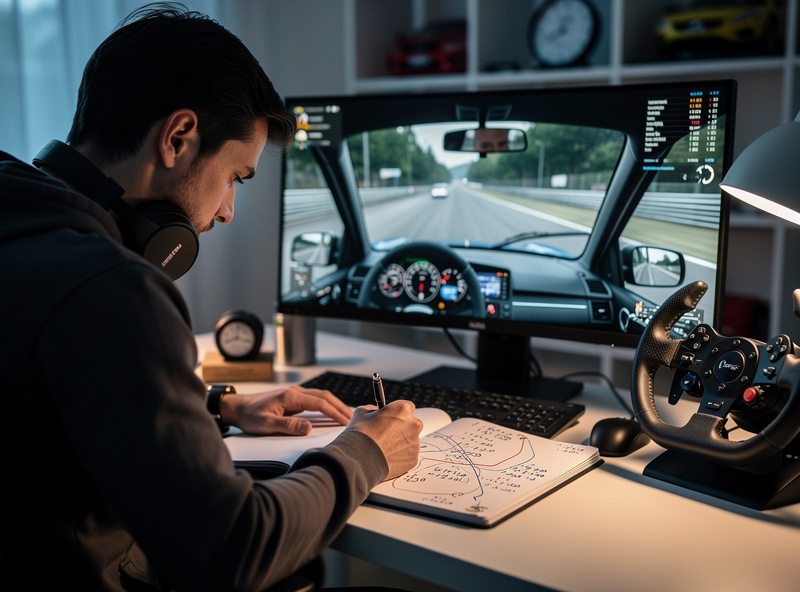
VRS (Virtual Racing School) automatically records every lap in iRacing and ACC and uploads them to a web dashboard where you can compare your telemetry to reference laps from fast drivers. The free tier includes access to reference laps for popular car/track combinations and a lap-by-lap comparison tool. The paid tier ($5/month) adds coaching overlays that highlight the biggest time losses in each corner with specific recommendations (e.g., “brake 5 meters later into Turn 3” or “apply throttle 10% earlier on corner exit”).
Garage61 records and shares laps across all major sims. Its free tier gives you your own lap history and line data; the community comparison feature — pulling another Garage61 user’s telemetry on the same car/track combination — sits behind its paid tier (from $7/month). I’ve found that studying a driver who is 0.5-1.0 seconds faster than me teaches more transferable techniques than comparing to alien-level reference laps, because the skill gap is smaller and the adjustments are achievable in a single practice session.
MoTeC i2 is a professional-grade telemetry tool used by real racing teams including Porsche, BMW, and Mercedes in GT3 competition. It is free to download and supports iRacing, ACC, and AMS2 via plugins. MoTeC provides the most detailed analysis — suspension travel, tire temperatures, fuel load effects, and aerodynamic downforce — but requires 2-3 hours of learning to use effectively. It is the right tool for drivers who have exhausted the simpler platforms.
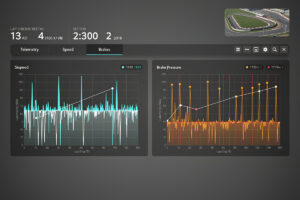
The three most important telemetry channels for improvement are: speed trace (shows where you are slow versus the reference), throttle application (shows how quickly and smoothly you apply throttle on corner exit), and brake pressure (shows your braking point, pressure curve, and release timing). On my telemetry overlay, I focus on these three channels before analyzing anything else — they account for 80% of the time difference between intermediate and advanced drivers.
Finding a Sim Racing Coach
Sim racing coaches are available through platforms like Coach Dave Academy, VRS, and private Discord communities. Rates range from $30/hour for independent coaches to $99-100/hour for platform-vetted coaches at VRS or Coach Dave Academy. A single session is usually sufficient to identify your biggest time loss; 3-5 sessions over 2-3 months creates a structured improvement plan.
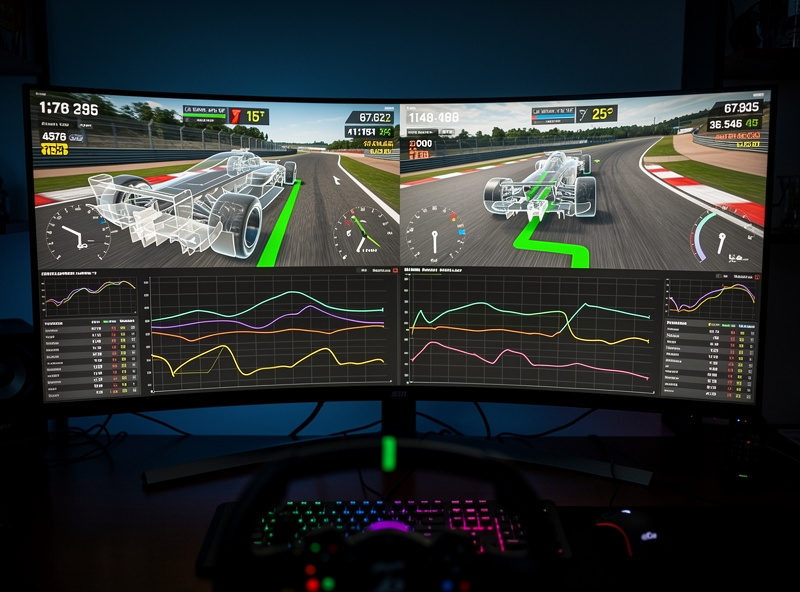
Coach Dave Academy offers coaching from professional sim racers who compete in SRO E-Sport and other top-level series. Sessions run 60-90 minutes via Discord screen share, where the coach watches your driving in real-time and provides immediate feedback. The $100/hour rate is at the premium end but guarantees a coach with verified competitive credentials; a cheaper $40 data/video-review tier exists if you don’t need a live session.
VRS coaching connects you with coaches rated by other students. The platform shows each coach’s competitive results, specializations (e.g., “GT3 racecraft,” “formula car technique”), and student reviews. VRS’s base coaching rate runs around $99/hour, with individual coaches free to set their own price above that floor. The advantage of VRS is accountability — coaches are rated after each session, maintaining quality standards.
Independent coaches advertise on Reddit (r/simracing), Discord communities, and YouTube. Rates are typically $30-50/hour. Verify credentials by checking the coach’s competitive results on the relevant platform (iRacing profile, ACC LFM profile) before booking. A coach who cannot demonstrate competitive results at a high level is not worth paying — you can get the same advice from free YouTube tutorials.
Structured Practice Routines
The way I structure my practice on the rig produces 2-3x faster improvement than random hotlapping — I learned this the hard way after wasting a full season chasing lap times without a plan. A structured 90-minute session divides into warmup (15 min), focused drill (30 min), race simulation (30 min), and analysis (15 min). Repeat the same routine 3-5 times per week with specific weekly improvement targets.
Warmup: drive 5-8 laps at 85-90% pace, focusing on smooth inputs and consistent braking points. The warmup is not about speed — it is about reestablishing the reference points that connect your eyes, brain, and hands to the track. After a warmup, your first flying lap will be within 0.5 seconds of your best.
Focused drill: practice one specific technique for 30 minutes. Options include: trail braking (maintaining light brake pressure through corner entry), throttle modulation (progressive application rather than on/off), late apex cornering (sacrificing entry for exit speed), or high-speed commitment (carrying more speed through fast corners). Choose the technique that telemetry shows is your biggest weakness.
Race simulation: drive a full race stint at sustainable pace. Run 15-20 laps for a sprint stint, 30-45 laps for an endurance stint. Measure your consistency — standard deviation of lap times. Target under 0.5 seconds for competitive league racing. Do not reset after mistakes; recover and continue. Real races do not have restarts, and learning to drive fast after a mistake is a critical racecraft skill.
Analysis: review your telemetry from the session using VRS, Garage61, or MoTeC. Compare your best lap to a reference. Identify the three corners where you lose the most time. Set those corners as your focused drill target for the next session. This create-analysis-improve loop is the core of structured development, and it’s the same loop I run after every practice stint on my rig.
Mental Approach and Consistency
On my rig, the mental game separates consistent racers from fast but unreliable ones every single race session. Three mental skills directly improve results: focus management (sustaining attention through long stints), emotional control (recovering from incidents without compounding errors), and pressure handling (performing in qualifying and final-lap battles).
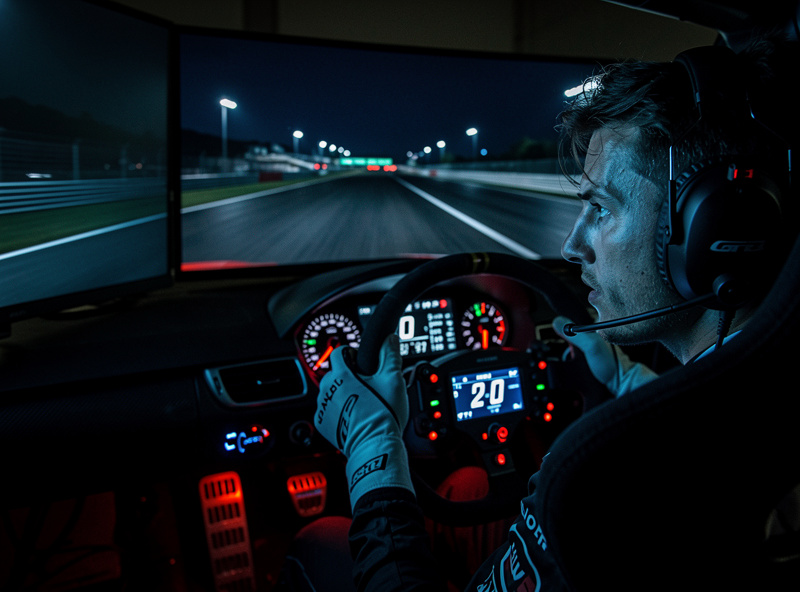
Focus management in endurance racing requires pacing your mental energy. Driving at 100% focus for 60+ minutes is impossible — your attention naturally drifts after 20-30 minutes. Professional endurance drivers use a technique called “micro-relaxation”: during long straights, consciously relax your grip on the wheel, take a deeper breath, and briefly release tension in your shoulders. This 2-3 second reset extends your focus window from 20 minutes to 45-60 minutes.
Emotional control after incidents is a learnable skill. After being hit by another driver or making a mistake, some drivers lose 0.5-1.0 seconds per lap for the next 5-10 laps because they drive aggressively to “make up” for the lost position. The correct response: take one deep breath, accept the position loss, and return to your normal pace immediately. The time you lose by driving angry after an incident always exceeds the time you lost from the incident itself.
Qualifying pressure affects most drivers. The knowledge that you have one or two laps to set your best time creates tension that tightens inputs and causes mistakes. The antidote is process focus: instead of thinking “I need a fast lap,” think “I will hit my braking point at the 100 board, trail brake to the apex, and apply throttle at the cone.” Focusing on specific, controllable actions rather than outcomes reduces performance anxiety and improves execution. I run the same process-focus checklist before a league qualifying lap on my own rig — naming the three reference points out loud in my head does more for a clean lap than any amount of wanting to go fast.
Coaching Options Compared
| Option | Cost | Format | Best For |
|---|---|---|---|
| VRS Free Tier | Free | Automated telemetry | Self-directed improvement |
| Garage61 | Free / $7+/mo | Own laps free, community comparison paid | Finding reference laps |
| MoTeC i2 | Free | Professional analysis | Advanced data nerds |
| VRS Coaching | $99+/hr | 1-on-1 live session | Targeted improvement |
| Coach Dave Academy | $100/hr | 1-on-1 live session | Professional-level coaching |
| YouTube Tutorials | Free | Video guides | Technique learning |
Frequently Asked Questions
Is sim racing coaching worth the money?
Yes, if you have plateaued after 3-6 months of consistent practice. A single $50-100 coaching session typically identifies 0.5-2 seconds of improvement through telemetry analysis and technique correction. VRS and Garage61’s free tiers deliver 60-70% of the value; the remaining 30% comes from real-time feedback and personalized plans.
How do I analyze my sim racing telemetry for free?
Use VRS (free tier, automatic recording for iRacing and ACC, with free reference-lap access) or Garage61 (free own-lap tracking for all sims; other-driver comparison needs its paid tier). Compare your speed trace, throttle application, and brake pressure to faster reference laps. Focus on the three corners where you lose the most time. These three channels account for 80% of time differences between intermediate and advanced drivers.
How much does sim racing coaching cost?
Independent coaches charge $30-50/hour via Discord and Reddit. VRS platform coaches start around $99/hour. Coach Dave Academy charges $100/hour for professional-level live coaching (a cheaper $40 data-review tier also exists). A single session is typically sufficient to identify your biggest improvement areas; 3-5 sessions create a structured development plan.
How do I break through a sim racing plateau?
First, use telemetry to identify exactly where you lose time versus faster drivers. Second, practice one specific technique (trail braking, throttle modulation, late apex) for dedicated 30-minute drills. Third, consider a coaching session if self-analysis does not reveal the issue. Most plateaus are caused by a single technique deficiency that, once corrected, unlocks 0.5-1.5 seconds.
What is the best free sim racing improvement tool?
VRS (Virtual Racing School) free tier provides automatic lap recording, telemetry comparison to reference laps, and lap-by-lap analysis for iRacing and ACC. Garage61 is a free alternative for all sims for your own lap history, with community comparison to other users’ laps unlocked on its paid tier. Both tools are used by professional sim racers for daily practice analysis.