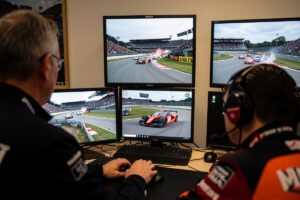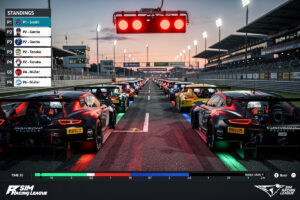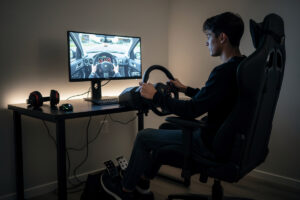
Getting started in sim racing esports requires a force feedback wheel, one installed sim, and 200-500 practice laps before entering your first competitive race. Choose iRacing for structured matchmaking across every discipline, or pick ACC with Low Fuel Motorsport for free competitive GT3 racing. The entire setup — hardware, software, and first month of competition — costs $650-750.
Most beginners delay entering competitive racing far too long, waiting until they feel “fast enough.” Across the years I’ve been bolting bases to my welded rig and running iRacing and ACC as my dailies, the single most consistent thing I’ve seen is this: competitive racing makes you faster faster than solo practice. Racing against real opponents teaches lines you’d never try alone, forces you to adapt to dirty air and draft effects, and develops the racecraft instincts that separate consistent mid-pack finishers from podium contenders. Enter your first race within 2-4 weeks of starting, regardless of your pace. The rest of the Sim Racing Esports guide maps the full competitive path from rookie to league regular.
Step 1: Choose Your Sim
Your first competitive sim should match your interests and budget. I’ve run all the major titles on my rig, and the path I’d point a newcomer toward depends on what discipline they want to race. iRacing ($13/month) offers the most structured competitive experience with hourly official races and a license progression system. ACC ($40 one-time) with Low Fuel Motorsport provides free competitive GT3 racing with ELO-based matchmaking. Gran Turismo 7 ($70) suits PlayStation users who want accessible daily ranked races. Pick one and commit — splitting time across multiple sims slows development far more than newcomers realize.
iRacing is the best choice for drivers who want variety — this is why it’s my daily driver. Its official series span GT3, GT4, formula cars, prototypes, oval racing, rallycross, and more. The license system (Rookie → A-Class) ensures new drivers learn clean racing habits before accessing faster cars. The iRating system creates balanced splits where you race against similarly skilled opponents from your first official race. The iRacing series guide breaks down every license level and which cars open at each tier. The downside is cost: expect to spend $150-250 on content in your first year beyond the subscription. Our iRacing beginner’s guide covers first-week setup in detail — subscription, UI, and the Rookie series you’ll enter first.
ACC with Low Fuel Motorsport is the best choice for budget-conscious GT3 enthusiasts. The base game costs $40 on Steam, LFM is free, and races run every hour with ELO-based splits. The physics model is the most detailed GT3 simulation available — I fire it up whenever I want to feel exactly what the tire is doing through my load cell pedal. The smaller community means closer competition in mid-split races compared to iRacing’s broader skill distribution. The ACC LFM guide walks through the license test, registration, and your first hourly race. The limitation is GT-only — if you want formula or oval racing, ACC cannot provide it.
Gran Turismo 7 is the best choice for casual-competitive entry. Daily races rotate three combinations each week, matchmaking is automatic, and the barrier to entry is a PlayStation 5 and the game itself. GT7’s penalty system enforces clean racing more aggressively than most PC sims, which helps new drivers learn respect for track limits and contact avoidance. The limitation is physics depth — GT7 is more simcade than pure sim, and the skills don’t transfer as cleanly to iRacing or ACC.
Step 2: Set Up Your Hardware
A competitive esports setup starts with a force feedback wheel mounted to a stable base, load cell pedals anchored to the floor, and a monitor positioned 50-60 cm from your eyes at eye level. Everything else — direct drive wheel bases, triple monitors, motion platforms — is optional at the beginner level. I’ve run gear-driven, belt-driven, and direct-drive bases back to back on the same rig, and at the entry tier the lap time you gain from practice dwarfs what you gain from a hardware upgrade. The upgrade order that actually works is rig rigidity → load cell pedals → wheelbase → rim — not the reverse.
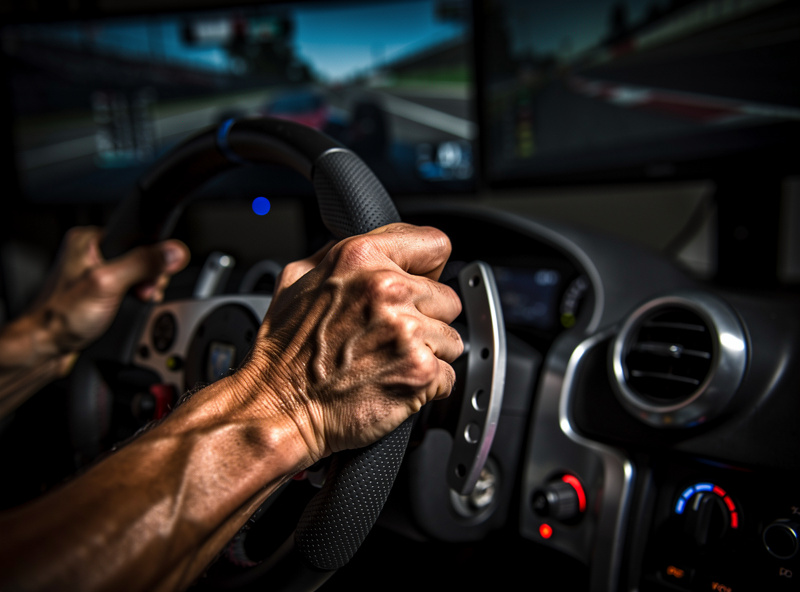
The minimum competitive wheel is the Thrustmaster T300 RS ($400) or Logitech G923 ($350). The T300 RS delivers 3.9 Nm of belt-driven torque — enough force feedback to feel curb strikes, tire slip, and weight transfer. The G923 uses a gear-driven mechanism with TrueForce haptics that transmit engine vibration and surface detail through the rim. Direct drive wheels ($500-1,500) provide more detail and faster slew rate — I run a mid-torque direct-drive base as my daily — but the performance difference versus a good belt-driven starter wheel is small at beginner level. You’ll gain more time from 500 practice laps than from an extra 5 Nm of torque. Our wheel buyer’s guide compares every major option across the torque tiers.
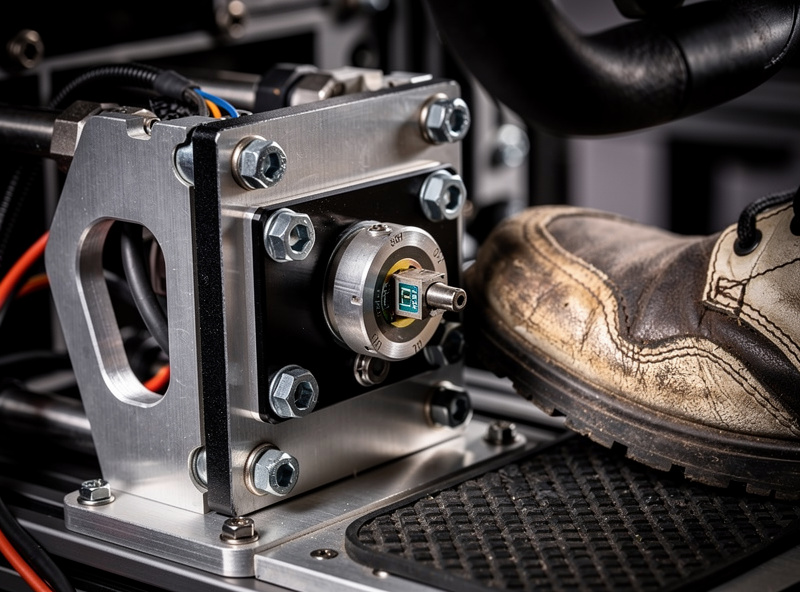
Load cell pedals are the single highest-impact upgrade for competitive consistency. On my pedal box, the switch from potentiometer to load cell tightened my lap-time standard deviation by 0.3-0.5 seconds the week I changed over — the brake zone suddenly had an identical pressure signature every lap. The Thrustmaster T-LCM ($249.99) and Fanatec CSL Elite V2 ($300) both use load cell brake sensors that measure pressure rather than pedal position. If your budget allows only one upgrade beyond the base wheel, choose load cell pedals over a better wheel base. I’d make that trade again in a heartbeat, and every serious racer I’ve talked to says the same. The pedal buyer’s guide compares load cell, hydraulic, and budget options across the price range.
Monitor positioning affects your FOV and reaction time. Mount the screen as close to your wheel base as possible — ideally 50-60 cm from your eyes. Use a monitor arm or wall mount if your desk does not allow this distance. I use a monitor arm on my rig to dial that distance precisely. A 27-inch 1440p 144Hz monitor at 60 cm distance delivers approximately 52° FOV at 144 fps — the practical standard for competitive single-screen racing.
Step 3: Build Consistent Lap Times
Consistency is the foundation of competitive success. On my telemetry overlay, the gap between a fast hotlap and a sustainable race pace is always wider than people think. Before entering any race, you must be able to complete 15-20 consecutive laps within 3% of your personal best time on your chosen car and track combination. For a track where the fastest lap is 2:00, your consistency target is completing laps between 2:00 and 2:03.6 without any major mistakes — no spins, no off-tracks, no wall contacts.
The path to consistency starts with learning one track deeply rather than spreading practice across many. Pick a popular track like Spa-Francorchamps, Monza, or Watkins Glen — these appear frequently in league schedules and official series. Drive the same car on the same track for 200-300 laps before attempting competitive racing. You will get bored during laps 100-200; that boredom is the muscle memory forming. Our consistency training guide gives you the drills that bank your pace into racecraft.
Measure your consistency with a simple metric: lap time standard deviation. Record your last 20 laps and calculate the standard deviation of your lap times. At the start, most drivers have 1.5-2.0 second standard deviations. League-level racers maintain 0.3-0.5 seconds. Professionals maintain 0.1-0.2 seconds. Track this number weekly — it is the single best predictor of competitive readiness.
Practice at race pace, not just hot laps. Hot lapping teaches you to find the fastest single lap, but racing demands you find the fastest sustainable pace across 15-30 laps while managing tire temperatures, fuel load, and traffic. Run full-length practice stints at 95% of your maximum pace. The 5% reserve gives you margin for error and allows you to focus on consistency rather than hero laps.
Step 4: Enter Your First Race
Your first competitive race should happen within 2-4 weeks of starting practice, not after months of preparation. Racing teaches skills that solo practice cannot: starting procedures, first-lap chaos management, overtaking techniques, defensive positioning, and the psychological pressure of fighting for position. Every race you delay is development time lost. The racecraft for beginners guide covers the skills you’ll start developing in that first race.
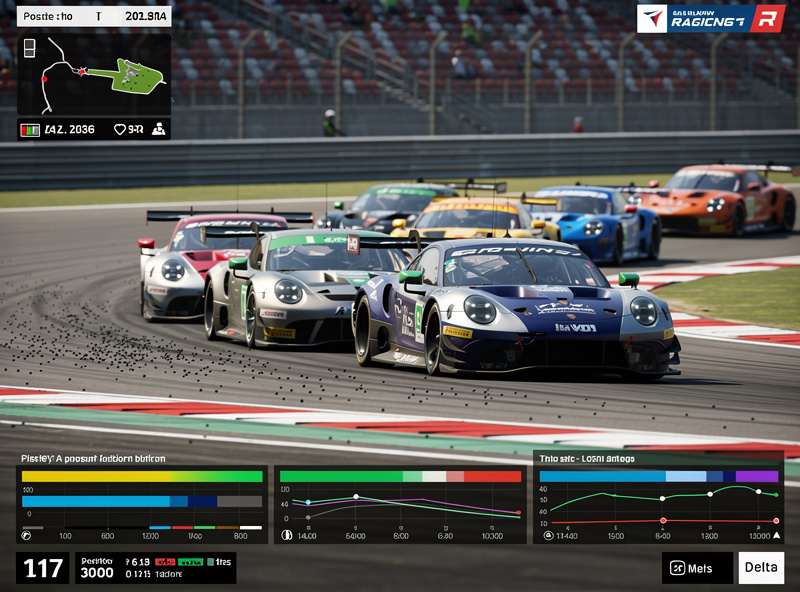
In iRacing, your first races are in the Rookie series — MX-5 Cup on road, Street Stock on oval. These series are designed for new drivers with simplified car setups and short race formats (8-12 laps). The competition is fierce despite the beginner classification because many experienced drivers use Rookie series for fun races. Finish in the top half by staying on track and avoiding incidents — Safety Rating matters more than position in your first races.
In ACC with LFM, register on the LFM website, complete the license test (a single clean lap within a target time on a specified track/car combination), and enter your first hourly race. The license test ensures you can complete one clean lap — not that you are fast. Races are 20-25 minutes with mandatory pit stops, and the ELO system matches you with similarly skilled drivers after 5-10 races of calibration.
In your first race, prioritize survival over speed. Start from the back of the grid if your sim allows it — avoid the first-lap incident zone where aggressive beginners crash into each other. Focus on finishing the race cleanly, even if you finish last. A clean last-place finish builds your safety rating and racecraft experience far more than a fast qualifying lap followed by a Turn 1 crash. Once you’ve run a few races, the sim racing leagues guide shows you how to find a regular community, which is where the real development begins.
Step 5: Analyze and Improve
Post-race analysis separates improving drivers from stagnant ones. After every race, save the replay and review three things: your fastest lap, your slowest lap, and any incidents or close calls. Identify where you lost time compared to the leaders — this is your improvement target for the next practice session. The coaching and improvement guide shows you how to structure practice sessions off your own replay data.
Telemetry tools accelerate improvement dramatically. VRS (Virtual Racing School) records your inputs and compares them to faster reference laps. Garage61’s free tier gives you your own line and pace history for review; its paid tier (from $7/month) unlocks telemetry comparison against other users on the same track/car combination. MoTeC’s i2 is a professional-grade telemetry tool used by real racing teams — it is free and works with iRacing, ACC, and other sims. Focus on three telemetry channels: speed trace, throttle application, and brake pressure.
Watch the leader’s replay from their cockpit perspective. Note their braking points, turn-in points, and gear selection through each corner. Compare their line to yours — often a faster driver takes a wider entry into corners, sacrificing entry speed for a faster exit. This technique, called “square-off,” gains time on corner exit that compounds down every following straight.
Set specific weekly improvement goals. Not “get faster” but “reduce my Turn 6 exit speed variance from 2.1 km/h to under 1.0 km/h.” Measurable goals create focused practice sessions. Random hotlapping without specific targets wastes time and creates the illusion of practice without the substance of improvement.
Common Beginner Mistakes
The most common mistake is entering competitive racing too late. Drivers who practice for 3-6 months before their first race have developed habits that work in isolation but fail in traffic. Racing early — even when slow — develops adaptive skills that solo practice cannot teach. Enter races within 2-4 weeks.
The second mistake is chasing speed over consistency. A driver who can run 2:18 at Spa once but averages 2:21 over 20 laps loses to a driver who consistently runs 2:19.5 every lap. Consistency comes from smooth inputs, correct racing lines, and repeatable braking points — not from late braking and aggressive throttle.
The third mistake is changing cars and tracks too frequently. Commit to one car class and 2-3 tracks for your first 3-6 months. Switching between GT3, formula, and touring cars prevents you from developing the deep car understanding needed for competitive pace. The car should feel like an extension of your body — that familiarity takes hundreds of laps with the same vehicle. I’ve seen it on my own telemetry: the moment I stop switching cars, my consistency standard deviation drops within a week.
The fourth mistake is racing angry or frustrated. After an incident caused by another driver — which will happen regularly — some drivers lose focus and make mistakes for the next 5-10 laps. Competitive esports requires emotional control. Take a breath after incidents, refocus on your line and braking points, and treat the next lap as a fresh start. The drivers who manage emotions consistently finish higher than drivers who are faster but volatile.
Getting Started Checklist
| Step | Action | Timeline | Cost |
|---|---|---|---|
| Hardware | Buy FFB wheel + load cell pedals | Week 1 | $600-700 |
| Software | Install iRacing or ACC | Week 1 | $13/mo or $40 |
| Practice | 500 laps on one track/car | Weeks 1-3 | Free |
| Consistency | Achieve sub-0.5s std deviation | Weeks 2-4 | Free |
| First Race | Enter Rookie/LFM race | Week 3-4 | Free |
| League Entry | Join a community league | Month 2 | $0-15/season |
| Analysis | Install VRS or Garage61 | Month 2 | Free |
| Upgrade Path | DD wheel, better monitors | Month 6+ | $500-2,000 |
Frequently Asked Questions
How long before I can race competitively in sim racing?
Most drivers are ready for their first competitive race within 2-4 weeks of starting practice. You do not need to be fast — you need to be consistent. Complete 15-20 laps within 3% of your best time without spins or major mistakes, then enter a race. League-level competitiveness typically develops in 6-12 months.
What is the cheapest way to start sim racing esports?
Buy a used Thrustmaster T300 ($200-250) and install ACC ($40). Register on Low Fuel Motorsport (free) for hourly competitive races. Total cost under $300. ACC with LFM provides the same competitive structure as iRacing at zero recurring cost.
Should I practice alone or race against others?
Do both, but enter competitive races within 2-4 weeks of starting. Racing teaches skills that solo practice cannot: traffic management, overtaking, defensive driving, and pressure handling. Practice sessions build car control; races build racecraft. Both are required for improvement.
How do I know if I am fast enough to compete?
You are ready when you can complete 15-20 consecutive laps within 3% of your personal best without major mistakes. Speed is not the barrier — consistency is. A consistent 2:20 driver beats an inconsistent 2:18 driver over a 20-lap race every time.
What is the best sim for beginners to esports?
ACC with Low Fuel Motorsport for budget GT3 racing ($40 one-time, free leagues). iRacing for structured progression and variety across disciplines ($13/month). Gran Turismo 7 for PlayStation users wanting accessible ranked racing ($70 one-time). Pick one and commit.