I run iRacing and ACC as my dailies on a welded steel rig — and the software you pick shapes everything from the force feedback you feel to the races you can join. iRacing leads structured online competition with laser-scanned tracks and a safety-rating system that actually filters out chaos, while Assetto Corsa Competizione owns GT racing outright, and rFactor 2 still sets the bar for tire physics and modding. Choosing the right platform comes down to your budget, preferred discipline, and whether you want competitive matchmaking or offline exploration. This guide compares every major simulator from the driver’s seat — what I’ve run, what I’d recommend, and where each platform earns its place.
Understanding Simulator Categories and Specializations
Not all simulators attempt the same thing. Some prioritize online competition structure, others emphasize specific racing disciplines, and some focus on modding communities that expand content indefinitely. Understanding these specializations helps you choose software matching your interests rather than defaulting to the most popular option.
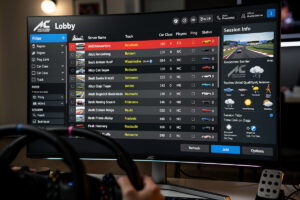
Online Racing Services: iRacing dominates this category with its subscription-based model, safety rating system, and structured competition across multiple racing series. The service hosts official races throughout the day, matching you against similarly skilled opponents. iRacing suits drivers seeking organized competition and esports aspirations. However, the ongoing subscription cost and per-car per-track purchases accumulate into significant long-term investment — I’ve got a few hundred dollars sunk into just the road-racing content I run regularly.
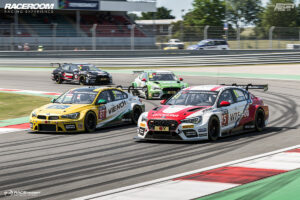
GT Specialists: Assetto Corsa Competizione focuses exclusively on GT3 and GT4 racing, delivering unmatched depth within this specific category. The SRO licensing provides every car and track from the real-world GT World Challenge series. Weather systems, tire management, and fuel strategy create realistic endurance racing scenarios. If GT racing specifically interests you rather than variety, Competizione represents the definitive choice — and it’s the sim where I spend the most time outside of iRacing’s official schedule.
Modding Platforms: Original Assetto Corsa, rFactor 2, and Automobilista 2 support extensive community-created content. Modders add cars, tracks, and even physics adjustments that expand possibilities beyond official content. These platforms suit enthusiasts wanting to drive specific historic cars or obscure tracks unavailable elsewhere. However, mod quality varies dramatically, requiring community research to find worthwhile additions.
Console Hybrids: Gran Turismo 7 and Forza Motorsport blend accessibility with simulation physics. These titles prioritize content quantity and polished presentation over hardcore simulation depth. They serve as entry points for console players curious about simulation without the intimidation of PC-focused titles. Competitive structures exist but lack the depth and seriousness of iRacing or dedicated PC simulators.
The sim racing software landscape has grown considerably since 2023, with new physics updates and platform launches arriving regularly. Each simulator attracts a distinct community with different priorities, from casual hotlapping to organized esports leagues. Understanding these differences before purchasing saves money and frustration — because switching platforms often means leaving behind purchased content and starting over from zero. The right simulator depends on your platform, your primary interest, and whether you prefer structured competition or open-ended exploration. Discover more about choosing your first simulator in our guide introducing sim racing.
iRacing: The Competitive Standard
iRacing has established itself as the premier online racing destination through continuous investment in laser-scanning technology, official partnerships, and structured competition systems. It’s the sim where I run my most focused practice hours — the structured scheduling and safety-rating pressure keep me honest.
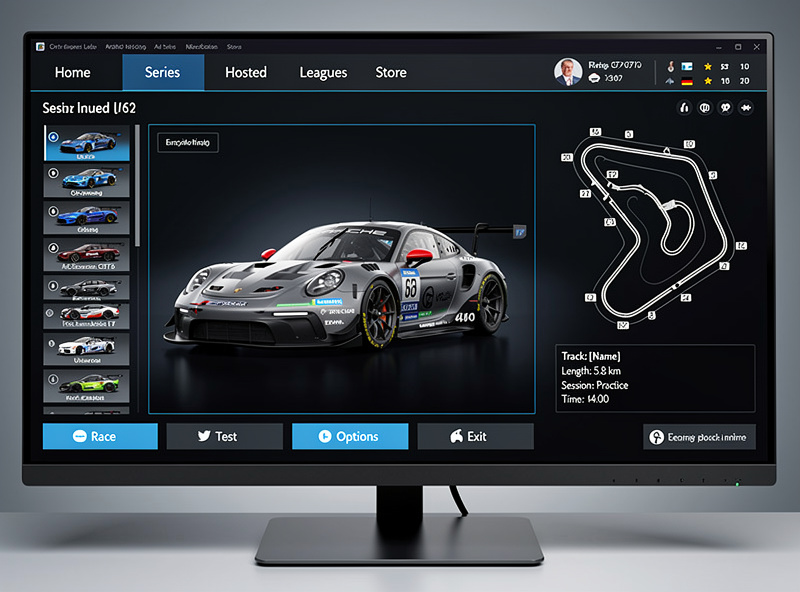
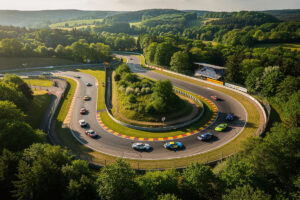
The laser-scanned tracks reproduce real circuits with millimeter accuracy, capturing surface irregularities, curb shapes, and reference points that mirror reality. This accuracy matters because real-world drivers use iRacing to learn tracks before racing them physically, requiring perfect correlation between virtual and real lap experiences.
The safety rating and license system ensures competitive racing by separating drivers based on incident history and demonstrated skill. New drivers begin in rookie series with simple cars and short races, progressing through D, C, B, and A licenses as they prove competency. This structure filters out chaotic public lobby behavior, creating races where participants respect each other and drive seriously.
Official series mirror real-world championships including NASCAR Cup Series, IndyCar, IMSA, and various GT categories. Participating in these series means competing on the same tracks, in the same cars, under similar conditions as professional drivers. The official nature attracts serious competitors and enables meaningful comparisons between sim racers and professionals.
The subscription model costs approximately thirteen dollars monthly with discounts for longer commitments. Additional cars and tracks run roughly twelve dollars per car and up to fifteen dollars per track, with volume discounts once you own a few. This pricing creates substantial ongoing investment, though the cost reflects continuous development, server infrastructure, and anti-cheat systems maintaining competitive integrity. Most active iRacing users invest $400-$800 in content over two years, though the base subscription with included content provides months of racing before additional purchases become necessary.
Assetto Corsa Competizione: The GT Authority
While iRacing spreads across many disciplines, Assetto Corsa Competizione specializes exclusively in GT racing — and the focus pays off in authenticity that generalist simulators can’t match. When I want to feel a GT3 car’s weight transfer through my load-cell pedals, ACC is where I load in.
The Kunos Simulazioni engine delivers exceptional vehicle dynamics that capture GT car behavior accurately. These cars feature aerodynamic sensitivity, tire degradation over stints, and fuel consumption requiring strategic pit stops. The physics communicate through force feedback with exceptional clarity, letting drivers feel tire slip angles, weight transfer, and suspension compression intuitively.
The official SRO licensing includes every GT3 and GT4 car from manufacturers including Mercedes-AMG, Ferrari, Porsche, BMW, Audi, and McLaren. Each car receives detailed modeling of unique characteristics, from Ferrari engine placement affecting handling to Porsche rear-weight bias influencing traction. Tracks include Spa, Monza, Nurburgring, and other legendary circuits from the GT World Challenge calendar.
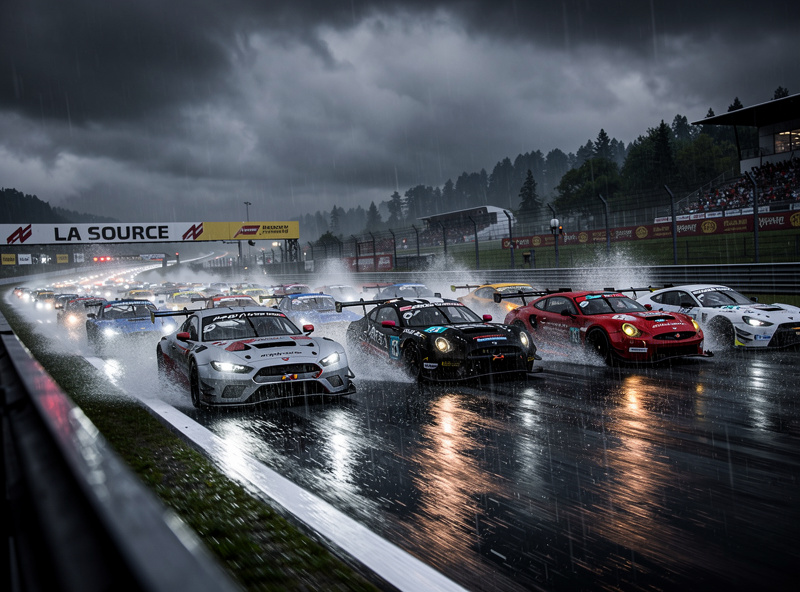
Weather systems transform races dynamically. Rain begins gradually, creating wet patches that evolve into standing water. Track temperature affects tire behavior, rubber buildup changes grip levels, and visibility challenges drivers during transitions. These variables create authentic endurance racing scenarios where strategy matters as much as raw speed.
Competitive formats include official Kunos championships, community leagues, and the popular Low Fuel Motorsport platform organizing ranked races throughout the day. The competition lacks iRacing’s formal structure but provides serious racing against skilled opponents. The base game costs $40 with DLC packs adding additional car and track combinations for $10-$15 each.
rFactor 2 and Automobilista 2: Physics-First Platforms
Studio 397’s rFactor 2 and Reiza Studios’ Automobilista 2 share underlying engine technology emphasizing advanced tire physics and real-road dynamics. I load these up when I want to feel how different a car’s tire model changes the entire FFB character — the contrast against my daily sims sharpens what I understand about the other platforms.
rFactor 2 pioneered “real-road” technology modeling how rubber accumulates on racing lines, how grip evolves as temperatures change, and how marbles collect off-line. These dynamics force strategy adjustments during endurance races as track conditions evolve. The tire model calculates deformation, temperature distribution across the contact patch, and wear characteristics with exceptional sophistication.
The platform supports extensive modding, with community-created content expanding possibilities beyond official releases. Historic Formula cars, obscure tracks, and experimental vehicles emerge regularly from dedicated modders. However, mod quality varies significantly, requiring research to identify worthwhile additions.
Automobilista 2 leverages similar physics technology but focuses on content variety rather than modding. The car list spans multiple eras and categories, from historic touring cars to modern Stock Cars. The Reiza Studios team emphasizes polished presentation and force feedback quality, making Automobilista 2 particularly appealing for drivers prioritizing driving feel over competitive structures.
Both platforms suit endurance racing enthusiasts and those seeking specific content unavailable in more restrictive simulators. Learn about optimizing your hardware for these demanding physics engines in our force feedback configuration guide.
Companion Tools and Telemetry Software
I keep SimHub running on a secondary display beside my triples during every session. The sims generate the data — but the companion tools are what turn it into something I can act on. Beyond the simulators themselves, third-party tools enhance the experience through overlays, telemetry analysis, and automation.
Crew Chief Applications: Voice-controlled spotters provide real-time information about fuel levels, tire temperatures, competitors behind you, and strategic advice. Applications like Crew Chief — which I run on every race — or SimHub’s spotter feature reduce cognitive load during races, letting you focus on driving while receiving crucial information audibly. In a 45-minute GT3 stint, not having to glance at fuel levels mentally saves focus for braking points.
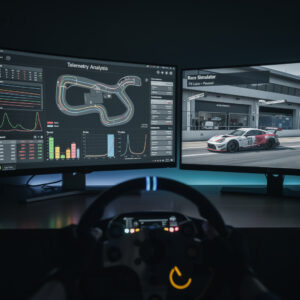
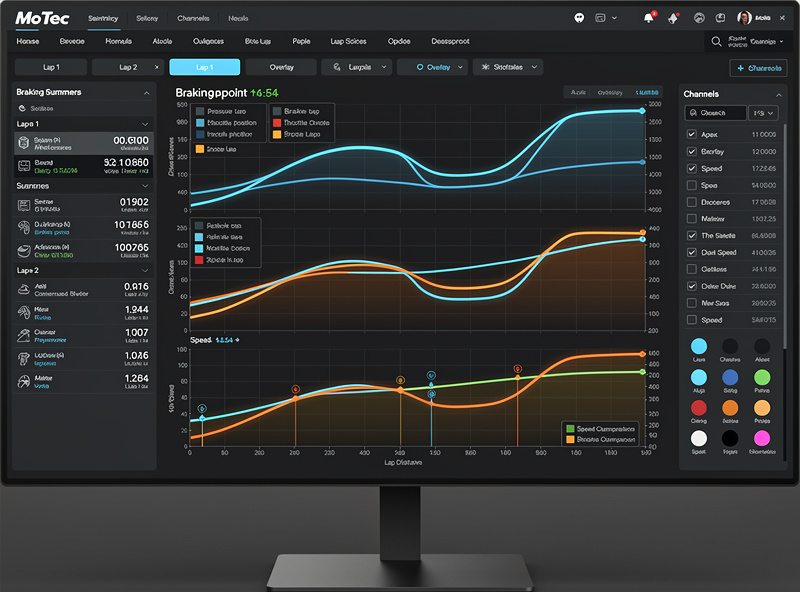
Telemetry Analysis: Tools like MoTeC, SimHub, or Raceroom’s built-in telemetry capture detailed data about your driving. I pull up MoTeC whenever a practice session has me stuck — looking at my brake traces, throttle application, and steering-angle overlay tells me what I’m doing differently from faster drivers. Analyze braking points, throttle application, steering angles, and lap time contributions sector by sector. Compare your data against faster drivers to identify exactly where you lose time. This analysis transforms subjective feelings about performance into objective improvement targets — and it’s the only reason I diagnosed FFB clipping on my direct-drive base a couple of years back, spotting clipped signal peaks in the force trace.
Dashboard Overlays: SimHub enables custom dashboard displays showing additional information beyond in-game gauges. I run a custom overlay with tire pressures, fuel consumption rate, and brake-temperature readouts on a tablet mounted to my rig. Monitor tire pressures, fuel consumption rates, brake temperatures, or create custom shift lights. These overlays display on secondary screens, tablets, or even phone mounts attached to your cockpit. For the full SimHub bass shaker configuration — profile setup, output mapping, and per-effect tuning to match your rig — the SimHub bass shaker setup guide covers it step by step.
Track Mapping and Learning Tools: Track maps with braking point references, racing line overlays, and sector timing help learn new circuits efficiently. I reference track maps when learning a new circuit on iRacing — knowing the sequence of corners before the first practice lap cuts the familiarization time in half. Some tools overlay optimal racing lines directly into the simulator view, though relying too heavily on these can inhibit developing natural circuit reading skills.
PC System Requirements and Hardware Considerations
Sim racing software demands more from your computer than general gaming, particularly when running VR or triple monitor configurations — a lesson I learned when I first plugged in my triple 1440p displays and watched frame rates drop through the floor. Understanding requirements helps avoid purchasing a simulator your system cannot run properly.
Minimum Specifications: Most simulators require at least an Intel i5-10400 or AMD Ryzen 5 3600 processor, 16GB RAM, and a GTX 1660 or equivalent GPU. These specs deliver playable framerates at 1080p on single monitors. However, minimum specs often produce inconsistent frame rates that degrade force feedback quality and cause visual stuttering — a real problem when you’re chasing a tenth through Eau Rouge.
Recommended for Competitive Racing: Target an Intel i7-12700 or AMD Ryzen 7 5800X with an RTX 3070 or better GPU and 32GB RAM. These specs maintain 100+ fps consistently at 1440p. VR requires even more GPU power: an RTX 3080 or better for stable 90fps in titles like ACC or iRacing. Storage matters too: iRacing’s own system requirements call for 50GB+ for a full content library, ACC needs 50GB, and modded Assetto Corsa can exceed 100GB. Budget at least 250GB of SSD space for sim racing software. On my rig, wired Ethernet straight to the OPNsense matters as much as the GPU — any network spike mid-corner ruins a race faster than a dropped frame.
For broader hardware context covering wheels, pedals, and cockpits, read our guide to planning your first sim racing setup.
Choosing Your First Simulator
Your first simulator should match your platform, interests, and commitment level — and I’ll tell you what I’d actually recommend to someone starting fresh, not what spec sheets say.
Console players should begin with Gran Turismo 7 on PlayStation or evaluate whether their Xbox provides satisfactory simulation options. GT7 offers accessible physics, strong community, and structured progression that teaches fundamentals naturally.
PC players seeking online competition should trial iRacing using the promotional periods often available. The subscription model requires commitment, but no other platform matches its competitive integrity and esports structure. This is where I’d point anyone who’s serious about racing other people.
PC players prioritizing driving physics and GT racing should purchase Assetto Corsa Competizione. The GT-specific focus provides depth without the complexity of iRacing’s multiple disciplines and ongoing costs — and the FFB quality on a direct-drive base is the best I’ve felt out of any title I run.
Experimenters wanting variety and modding should choose Assetto Corsa or Automobilista 2. These platforms provide extensive content and community creativity, though they lack the competitive structures of iRacing.
Whatever you choose, the simulator is a tool, not a destination. Your improvement depends on practice, study, and community engagement — I’ve seen drivers on budget gear in a five-dollar sim beat people on high-end direct-drive rigs because they actually studied their telemetry. Read our guide to sim racing driving techniques to maximize whatever platform you select.
Frequently Asked Questions
Which sim racing platform has the best physics?
rFactor 2 and Assetto Corsa Competizione set the standard for realistic physics. rFactor 2 leads in tire modeling with real-road technology, while ACC excels in GT car handling accuracy. iRacing provides consistent physics across its entire car roster with regular updates.
Is iRacing worth the subscription cost?
iRacing costs approximately $13 monthly plus $12 per car and $15 per track. Over two years, active users typically invest $400-$800 in content. The structured matchmaking, official series, and competitive integrity justify the cost for drivers who race regularly online.
Can I use a gamepad instead of a wheel for sim racing?
Most simulators support gamepads, but the experience differs significantly from wheel-based racing. Physics-based force feedback, the core communication channel in sim racing, is entirely absent on gamepads. Gamepads work for casual exploration but cannot deliver competitive lap times.
What is the best free sim racing software?
Assetto Corsa frequently drops below $5 during sales and offers unlimited free mod content. RaceRoom Racing Experience provides a free base with purchasable content. These platforms let you experience simulation physics before committing to premium options.
How do I choose between Assetto Corsa and Assetto Corsa Competizione?
Choose Assetto Corsa if you want modding variety across all racing disciplines. Choose Competizione if you want the definitive GT3/GT4 racing experience with official SRO licensing. ACC has superior weather and audio, while the original AC has thousands of community mods.
Do I need a powerful PC for sim racing?
A mid-range PC with an i5/Ryzen 5 CPU and GTX 1660 GPU runs most simulators at 1080p. VR and triple monitors require significantly more GPU power, ideally an RTX 3070 or better. Console alternatives like Gran Turismo 7 eliminate PC requirements entirely for PlayStation users.
Keep Building
- What Is Sim Racing? — Complete introduction to the hobby and hardware ecosystem
- How to Plan Your First Sim Racing Setup — Budget framework and equipment selection guide
- How to Configure Force Feedback — Calibrate your wheel for each simulator platform
- Sim Racing Driving Techniques — Skills that transfer across any simulator
- DIY Sim Racing Upgrades — Button boxes, transducers, and custom peripherals