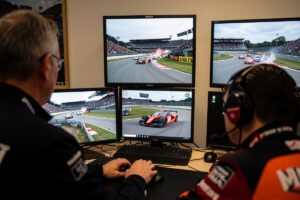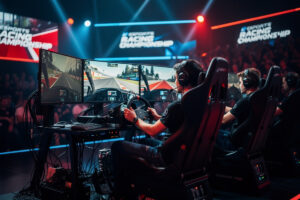
Sim racing esports has grown from a niche hobby into a genuine competitive ecosystem spanning iRacing, ACC, and Gran Turismo 7, with real prize money, factory-backed teams, and a documented pipeline into real-world motorsport. I’ve run the competitive ladder from rookie leagues to top-split races across the bases I’ve bolted onto my welded rig, and the path from your first league entry to consistent competitive finishes is well-defined if you know where to start. Entering competitive sim racing requires a Class D or higher iRacing license (or equivalent skill level), a force feedback wheel, and consistent lap times within 2-3% of the fastest splits. This guide covers every path from casual online racing to professional esports competition.
The competitive sim racing landscape in 2026 spans from free community leagues running on Discord to broadcast professional series with six-figure prize pools. Whether your goal is to race door-to-door in organized weekly leagues, climb the iRacing ladder to professional Porsche TAG Heuer Esports competition, or build a streaming career around your racing, the entry points and skill progression paths are well-defined and accessible to anyone willing to put in the practice hours. The drivers I’ve raced with who made the jump from casual to competitive all arrived at the same conclusion — the barrier isn’t talent, it’s structured seat time.
The Sim Racing Esports Landscape in 2026
Sim racing esports operates across three tiers: grassroots community leagues (free, thousands of options), semi-professional series with entry fees and broadcast coverage, and fully professional factory-backed teams competing in series sanctioned by real-world racing organizations like F1, WEC, and SRO. Research published by Grid Finder and LFM platform usage data suggests most competitive sim racers operate in the first two tiers — the professional tier represents fewer than 500 drivers worldwide.
The major professional series in 2026 include the Porsche TAG Heuer Esports Supercup on iRacing (a $30,000 World Championship prize pool, $10,000 to the winner, plus a genuine shootout for a Porsche Motorsport development seat), the SRO E-Sport GT Series on ACC, the F1 Sim Racing World Championship on F1 25, and the Gran Turismo World Series on PS5/PS4. Each series has its own qualification pathway, typically involving open qualifiers, ladder-based advancement, and regional championship structure. Entry requirements range from license-based (iRacing) to open registration (SRO, Gran Turismo). Esports racers report that the qualification formats shift year to year, so checking the official series page before committing to a title is essential.
The semi-professional tier has exploded in popularity. Platforms like Grid Finder list over 3,000 active leagues across all major sims. Weekly races with broadcast commentary, stewarding, and championship points attract drivers who want competitive racing without the commitment of professional schedules. League racing is where most sim racers develop racecraft — learning to battle wheel-to-wheel, manage tires over a stint, and execute pit strategies under pressure. Across the leagues I’ve entered over the years, the jump from running practice laps to surviving turn one in a 30-car grid is where drivers either level up or wash out.
Factory team involvement has legitimized sim racing as a sport. Porsche, BMW, Mercedes-AMG, and Ferrari all run official esports programs that recruit from the sim racing talent pool. Several sim racers have transitioned to real-world GT4 and GT3 drives — the most famous being James Baldwin, who won the World’s Fastest Gamer competition and has built a genuine GT3 career since, racing in British GT and GT World Challenge Europe while continuing to compete at the top level in sim racing. Esports recruitment programs report that the pathway from sim rig to real cockpit exists, though it requires elite-level talent and years of dedicated practice — it is not the expected outcome for the vast majority of competitors.
What You Need to Compete
Competitive sim racing requires three things: a force feedback wheel with load cell pedals, a stable internet connection (under 100ms ping to your nearest server), and enough practice time to achieve consistent lap times within 2-3% of the fastest drivers in your chosen series. Hardware beyond a basic wheel and pedal set is optional — many competitive drivers race on $500 setups against others on $5,000 rigs. I’ve raced in top-split fields on my mid-torque direct-drive base while drivers with higher-spec gear finished behind me, and I’ve also been walked by someone on a belt-driven Thrustmaster. The rig doesn’t win races — consistency does.
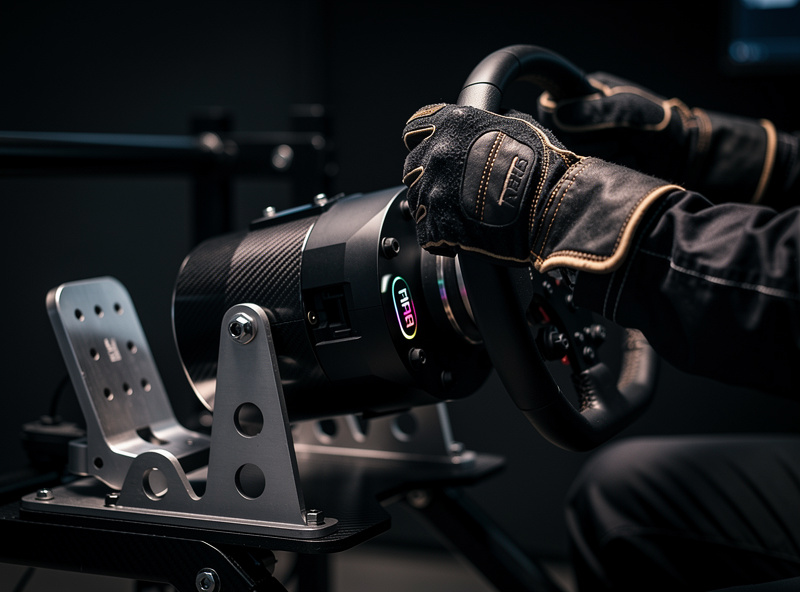
The force feedback wheel is non-negotiable. Gamepad and keyboard inputs lack the proportional control — see our driving techniques guide for why precision input matters for competitive cornering — you cannot modulate steering angle, throttle, and brake with the precision required for door-to-wheel racing on a controller. A direct drive wheel base provides the most detail, but belt-driven wheels like the Thrustmaster T300 or Logitech G Pro compete effectively at all but the highest levels. Budget $300-500 for a competitive wheel and pedal set.
Load cell brakes are the single biggest hardware upgrade for competitive consistency. A load cell measures pedal pressure rather than pedal travel, giving you the same braking feel as a real race car. Drivers switching from potentiometer brakes to load cell brakes report 0.3-0.8 second improvement in lap time consistency within the first week. On the pedal box I run, the switch from entry-level potentiometer pedals to a load-cell set was the single biggest improvement in my competitive results — not because the lap time ceiling moved, but because the floor came up. Every braking zone feels identical lap after lap, and in a 45-minute race stint, that consistency is worth more than any tenth gained from a stiffer wheelbase.
Internet stability matters more than speed. A 10 Mbps connection with 30ms ping outperforms a 500 Mbps connection with 150ms ping for online racing. The data packets in sim racing are tiny — your wheel inputs and car position — but they must arrive within tight timing windows to avoid netcode incidents (phantom contact caused by delayed position updates). Wired ethernet is mandatory; WiFi introduces packet loss and variable latency that causes netcode problems even on fast connections.
Hardware Priorities: The Correct Upgrade Order
Most drivers buy gear in reverse — they start with the rim, then the wheelbase, then wonder why they’re still inconsistent. The correct order is rig rigidity first, then pedals, then wheelbase, then rim — and I learned this the hard way across the bases I’ve bolted onto my welded steel-tube cockpit.
A rigid cockpit is the foundation that every other upgrade depends on. If your pedal deck flexes under braking or your wheel deck vibrates under high-torque FFB, a portion of every input signal is absorbed by the rig instead of transmitted to the sim. On my welded steel rig, the pedal box is bolted to a frame that doesn’t move a millimeter under 90 kg of brake pressure — I’ve tested it. Compare that to a desk clamp or a foldable wheel stand: the entire assembly moves when you threshold brake, and that movement destroys muscle memory for braking points. Even a budget aluminum-profile rig ($250-400) will improve your consistency more than a $1,000 wheelbase upgrade on a wobbly desk. Frame flex is the invisible lap-time killer that spec-sheet reviewers never mention because they don’t build their own rigs.
Pedals come second because braking is where races are won and lost. A load-cell pedal set ($200-400) gives you pressure-based braking that maps directly to deceleration — hit 80 kg of pedal pressure and the car slows the same way every time. The wheelbase you run (gear vs belt vs direct-drive) determines how much road detail you feel, but the pedals determine whether you hit the apex or overshoot it. On my rig, I’ve run a hydraulic pedal set alongside my load-cell daily driver, and the diminishing returns are real — at competitive club and league level, a quality load-cell set gets you 95% of the braking consistency of a hydraulic set at half the price.
Wheelbase torque tiers matter, but only once the rig and pedals are solid. Mid-torque direct-drive (5-9 Nm) is the sweet spot for competitive racing — it delivers enough detail to feel tire slip and weight transfer without clipping the FFB signal in high-speed corners. Higher-torque bases (12-20 Nm) add dynamic range and reduce the need for signal amplification, but on my telemetry overlay I can see that most league-level drivers run their bases at 60-70% of max torque to avoid clipping — meaning a 15 Nm base is often running at 9-10 Nm effectively. The rim itself — round vs formula vs GT sculpted — is the last piece, and it’s about personal ergonomics, not speed.
The Network Stack: Why Latency Decides Races
Competitive sim racing runs on a different kind of internet than casual gaming. The OPNsense router that segments my home network puts the sim PC on a dedicated wired low-latency link — Wi-Fi is for laptops, not racing. Even a 15ms spike from a background download or a bufferbloat event during a streaming household creates netcode incidents that can end a race, and invisible packet loss during a braking zone turns a clean overtake into a phantom punt that gets you protested.
The target is under 50ms ping to the sim server, with zero packet loss and low jitter (under 5ms variation). iRacing servers are distributed globally — US-East, US-West, Amsterdam, Sydney, and São Paulo — and the sim automatically connects you to the lowest-latency region. ACC on LFM uses European servers predominantly, so North American drivers should expect 80-120ms, which is playable but puts you at a netcode disadvantage in close door-to-door situations.
Bufferbloat — latency spikes caused by queue buildup at your router when the connection is saturated — is the most common but least understood competitive sim racing network problem. A household member streaming 4K video or downloading a game update can saturate your upload or download buffer, causing 200-500ms spikes that last several seconds. During a race, that spike manifests as cars warping around you, delayed collision detection, and server disconnections. The fix is enabling Smart Queue Management (SQM) or fq_codel queuing discipline on your router — it prioritizes the small, latency-sensitive sim racing packets over bulk traffic. I run this on my OPNsense box, and it’s the difference between a clean 45-minute race and a netcode disaster every time someone on the home network starts a Netflix stream. For help setting this up on your own network, our sister site HomelabRouter has a detailed low-latency network guide covering bufferbloat and SQM configuration for sim racing.
Skill Progression Path
Competitive sim racing follows a clear skill progression: learn the basics (1-3 months), develop consistency (3-6 months), enter league racing (6-12 months), compete at a high level (1-2 years), pursue professional opportunities (2+ years). Most drivers plateau between the consistency and league racing stages — the jump from “fast in practice” to “fast in a pack of 20 cars battling for position” requires racecraft that only comes from hundreds of competitive races. I’ve watched drivers on my friend list who could match alien pace in solo sessions implode in their first league race because they’d never defended into a hairpin with three cars alongside.
The first stage — learning the basics — involves mastering car control on a single track with a single car. Pick one car class (GT3 is the most popular) and one track (Spa-Francorchamps or Monza are common learning tracks). Drive 500-1,000 laps until the racing line, braking points, and gear selection become muscle memory. Your target is to be within 5% of alien pace — the fastest 0.1% of drivers — before moving to competitive racing.
Consistency is the bridge between practice speed and race speed. A driver who laps at 2:18 at Spa but has a 1.5-second variance lap-to-lap will lose to a driver who laps at 2:20 with 0.3-second variance over a 20-lap race. Consistency comes from eliminating mistakes — hitting the same braking point within 1-2 meters every lap, applying the same throttle at the same point on corner exit, and maintaining tire temperature within a 5°C window. Practice consistency by running full-length stints without resetting after mistakes. The telemetry overlay I run confirms what most coaches will tell you — lap time variance under 0.5 seconds is the threshold for competitive league racing, and your standard deviation across a full stint predicts your race finish position better than your single-lap pace does.
Racecraft — the ability to race wheel-to-wheel — develops only through racing against real opponents. AI opponents teach basic positioning but lack the unpredictability and psychology of human competitors. Enter your first league race as soon as you can complete 15-20 consecutive laps within 3% of your best time — our sim racing leagues guide covers how to find a grid that fits your schedule and skill level. You will finish mid-pack at best, but every race teaches overtaking angles, defensive positioning, and situational awareness that practice sessions cannot replicate.
iRacing: The Competitive Standard
iRacing — detailed in our iRacing beginner guide — hosts the largest competitive sim racing ecosystem with over 200,000 active subscribers, a license-based matchmaking system, and the most structured progression from rookie to professional. I’ve raced iRacing across four license levels on the rig I welded, and the Safety Rating and iRating systems together create cleaner, more competitive fields than any public-lobby sim I’ve run. The scheduled official series run every hour across multiple car classes and disciplines.
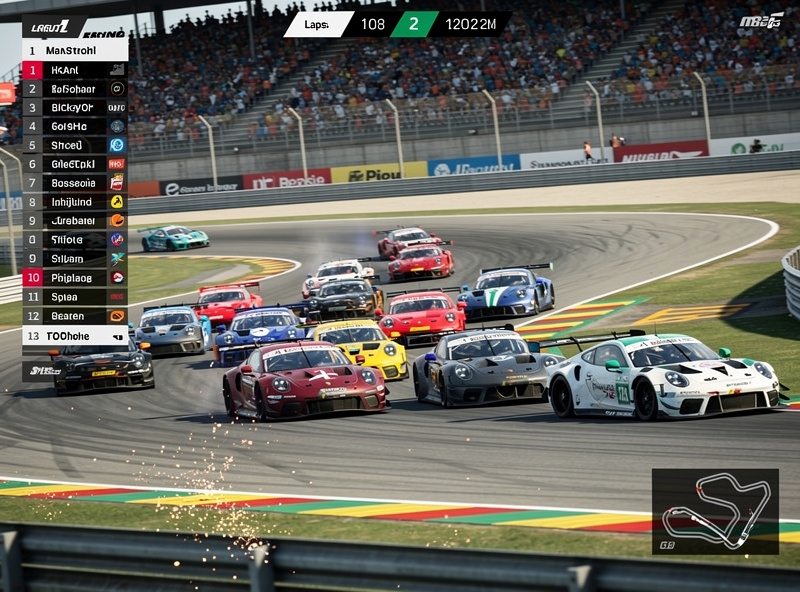
The license system (Rookie → D → C → B → A → Pro) gates content and series access based on your safety record. New drivers start as Rookies and advance by completing clean races — finishing without incidents (off-tracks, contacts, loss of control). Each license promotion unlocks faster cars and more competitive series. Reaching A-Class in oval and road racing takes most drivers 3-6 months of regular racing.
iRating is the skill-based matchmaking number. Starting at 1,350, iRating rises with good finishes and drops with poor ones. The system creates splits — groups of similarly rated drivers — in official races, ensuring competitive fields. A driver with 2,000 iRating races against other 1,800-2,200 drivers. Reaching 3,000+ iRating places you in the top 5% of all iRacing competitors and opens doors to invitation-only professional series.
The cost structure is a barrier. iRacing’s official membership runs $110/year (or $13/month if you pay monthly instead of annually) plus $12-15 per car and track. A competitive GT3 season requires purchasing 6-8 tracks at up to $15 each ($90-120) plus the car (~$12). Annual costs for a serious competitor run roughly $220-350 once you account for the annual membership discount, which is still higher than any other sim on this list. However, the quality of competition, matchmaking, and structured series justify the cost for drivers who prioritize competitive racing over casual driving.
iRacing runs official series on fixed schedules — every hour, multiple series are available across road racing, oval, dirt oval, and rallycross disciplines. The most popular road racing series include the IMSA Endurance Series (multi-class GT3/LMP2/GTE), the Porsche Cup (single-make), and the GT3 Fanatec Challenge (sprint format). Each series has a set schedule of tracks that rotates weekly, giving drivers one week to learn each track before the official races begin.
The iRacing special events — 24 Hours of Le Mans, 24 Hours of Spa, Daytona 24, Bathurst 1000 — are the crown jewels of competitive sim racing. These events attract thousands of entries across dozens of splits, with top split races broadcast live to audiences of 10,000-50,000 viewers. Winning an iRacing special event in top split is the sim racing equivalent of winning a real-world endurance race — the most prestigious achievement in the hobby.
ACC and Community Leagues
Assetto Corsa Competizione — covered in our ACC setup guide — offers the best value for competitive GT3 racing with no subscription fees and active community leagues running on platforms like Low Fuel Motorsport, SimGrid, and Pitskill. ACC’s physics model is widely regarded as the most realistic GT3 simulation, and the SRO E-Sport GT Series provides a professional-level competitive pathway.
Low Fuel Motorsport (LFM) is the largest ACC league platform, having passed 200,000 registered drivers, with hourly ranked races across multiple splits. LFM uses an ELO-based rating system similar to iRacing’s iRating, matching drivers of similar skill in each race. Races run every hour with varying weather, time of day, and track combinations. LFM is free to use — you only need the base ACC game ($40) and a Steam account.
SimGrid offers both open daily races and structured championship series. Their championship format runs 6-8 week seasons with consistent grids of 20-30 drivers, creating more meaningful competition than one-off daily races. Championship points accumulate across the season, rewarding consistency and clean racing. Entry fees are typically $5-15 per season, with broadcast coverage on YouTube and Twitch for top splits.
ACC’s advantage over iRacing for GT racing is physics depth and value. ACC’s tire model, aerodynamic simulation, and weather system are more detailed than iRacing’s GT3 implementation, and the one-time purchase ($40 base game + $20-30 DLC) versus iRacing’s ongoing subscription makes ACC accessible to drivers who want competitive racing without recurring costs. The tradeoff is smaller player population and less structured matchmaking outside of LFM and SimGrid.
Building a Competitive Practice Routine
Professional sim racers practice 2-4 hours daily, but esports racers report that a structured 60-90 minute routine delivers 80% of the improvement for drivers competing at league level. The routine should split into warmup (15 min), qualifying pace (20 min), race pace (30 min), and replay analysis (15-20 min) — the same structure I use on my rig when preparing for a new weekly track.
Warmup laps establish your reference points for the session. Drive 5-8 laps at 90% pace, focusing on consistent braking points and smooth inputs. The warmup is not about speed — it is about reestablishing the muscle memory that deteriorates between sessions. After a warmup, your first flying lap will be within 0.5 seconds of your best, versus 1-2 seconds slower without one.
Qualifying pace practice runs 5-8 lap bursts at maximum attack. The goal is to find your absolute fastest single lap, which requires different techniques than race pace — later braking, more aggressive throttle application, and higher risk tolerance. Practice qualifying separately from race pace because the driving style is fundamentally different. A qualifying specialist can start at the front; a race pace specialist can hold position — the best drivers develop both skills.
Race pace practice runs full stint lengths at sustainable speed. For a 20-minute sprint race, run 15-20 laps at a pace you can maintain without mistakes. For a 60-minute endurance stint, run 45-50 laps with consistent lap times. The goal is to minimize lap time variance — measure your standard deviation across the stint. League-level racers maintain under 0.5-second standard deviation; professionals maintain under 0.2 seconds.
Replay analysis is the most underutilized practice tool. Watch your fastest lap and your slowest lap side by side. Identify where you lose time — typically it is corner exit throttle application (too cautious) or braking zone entry (too deep). Compare your line to faster drivers using the ghost car feature or shared telemetry from services like Garage61. On my telemetry overlay I can see exactly where the FFB clips in high-speed corners or where my throttle trace falls behind a faster driver’s — those 0.1-second corner deficits compound across a lap into the half-second gaps that separate a good driver from a great one. Ten minutes of analysis per session is worth more than 30 minutes of blind hotlapping.
Esports Career Paths
A sim racing esports career can follow several paths: professional driver for a factory team, content creator and streamer, sim racing coach, broadcast commentator, or team manager. Each path requires different skills and offers different income levels — esports industry reporting suggests earnings range from supplementary income ($500-2,000/month) to full-time professional salaries ($40,000-100,000+), though verified public salary data is limited.
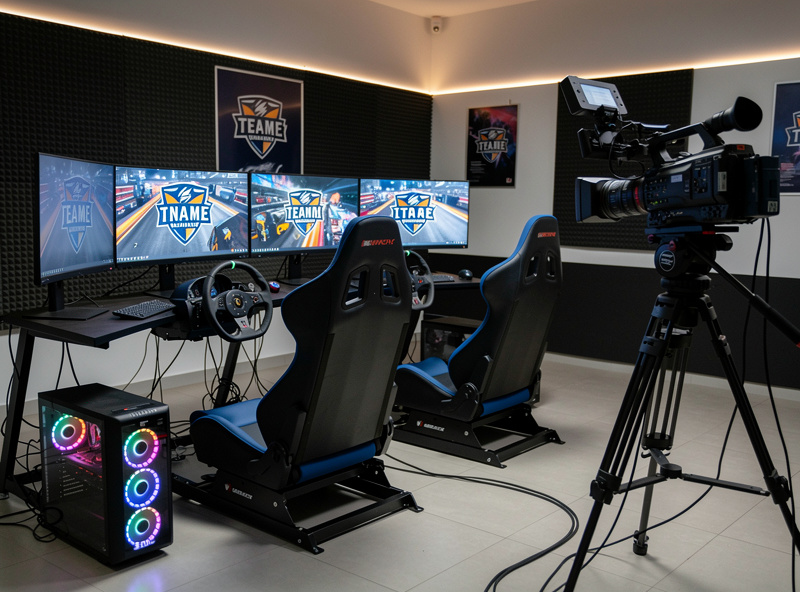
Factory team drivers earn salaries and prize money competing in professional series. Porsche, BMW, Mercedes-AMG, and other manufacturers recruit from the top of the iRacing and ACC competitive ladders. Esports recruitment programs report typical entry requirements: 4,000+ iRating, multiple championship wins in semi-professional series, and broadcast experience. The competition for factory seats is intense — perhaps 50 drivers worldwide earn full-time salaries from factory teams, making it comparable to professional golf in its selectivity.
Content creation is the most accessible career path. Sim racing content on YouTube and Twitch attracts a dedicated audience, with top creators earning $5,000-20,000/month from ads, sponsorships, and memberships. The key differentiator is personality and production quality, not raw speed — industry observers note that a 2,500 iRating driver with engaging commentary builds a larger audience than a 5,000 iRating driver who streams silently. Building an audience takes 12-24 months of consistent content before meaningful income begins.
Sim racing coaching is a growing market. Drivers who can teach racecraft, car setup, and mental preparation charge $30-100 per hour for private coaching sessions. Platforms like Coach Dave Academy and VRS (Virtual Racing School) connect coaches with students. Building a coaching reputation requires demonstrable competitive results and clear communication skills — the ability to explain what you do intuitively in a way that other drivers can learn from.
Telemetry analysis is the foundation of effective coaching. Tools like VRS, Garage61, and MoTeC’s i2 software allow coaches and students to compare throttle traces, braking points, steering inputs, and speed traces corner by corner. A skilled coach identifies where a student loses 0.1 seconds per corner — often in subtle habits like trailing brake pressure too deep into a corner or applying throttle 2 meters too late on exit. These margins are invisible to the driver in real-time but obvious in telemetry data. The same telemetry approach I use to tune my FFB profiles — comparing input traces to output forces and eliminating clipping — is the method coaches use to find time in a student’s driving line.
Comparison: Competitive Platforms
| Feature | iRacing | ACC (LFM) | Gran Turismo 7 | F1 25 |
|---|---|---|---|---|
| Monthly Cost | $110/yr + content | Free (game $40) | Free (game $70) | Free (game $50-70) |
| Matchmaking | iRating splits | ELO splits | DR/SR rating | Safety rating |
| Car Classes | 100+ cars | GT3/GT4/GT2 only | 550+ cars | F1 only |
| Pro Pathway | Porsche Supercup | SRO E-Sport | GT World Series | F1 Sim Racing WC |
| Race Frequency | Every hour | Every hour (LFM) | Daily races | Daily ranked |
| Community Leagues | Many active | Very active | Limited | Limited |
| Physics Quality | Excellent | Best GT3 | Good | Arcade-sim |
| Best For | All disciplines | GT specialists | Casual-competitive | F1 fans |
Frequently Asked Questions
How do I start sim racing esports?
Start with a force feedback wheel ($300-500), pick one sim (iRacing for all disciplines or ACC for GT racing), and drive 500-1000 practice laps to build consistency. Enter your first league race once you can complete 15-20 laps within 3% of your best time. Most drivers reach competitive league level within 6-12 months.
Is sim racing esports a real career?
Yes. Factory teams from Porsche, BMW, and Mercedes-AMG pay salaries to professional sim racers competing in series with $200,000+ prize pools. Content creators earn $5,000-20,000/month, and coaches charge $30-100/hour. The career is real but competitive — fewer than 500 drivers worldwide earn full-time income from sim racing.
What sim is best for competitive racing?
iRacing has the largest competitive ecosystem with 200,000+ subscribers, hourly official races, and the best matchmaking. ACC with Low Fuel Motorsport offers free competitive GT3 racing. Choose iRacing for variety across disciplines, ACC for the best GT3 physics and lowest cost.
How much does competitive sim racing cost?
Minimum $300-500 for a wheel and pedal set. iRacing’s official membership is $110/year plus $12-15 per car/track (roughly $220-350/year total for a serious competitor). ACC costs $40 one-time plus $20-30 DLC. Budget $500-800 for hardware and $100-350/year for software to compete seriously.
Can you go from sim racing to real racing?
Yes. James Baldwin won the World’s Fastest Gamer competition and has gone on to a genuine GT3 career, racing in British GT and GT World Challenge Europe while still competing at the top of sim racing. Several manufacturers recruit sim racers for real GT4/GT3 drives. The pathway requires elite-level talent (top 0.1%) and typically 3-5 years of dedicated competitive sim racing experience.
Do I need a direct-drive wheel to compete?
No. Belt-driven wheels like the Thrustmaster T300 and Logitech G Pro compete effectively at all but the highest professional levels. A load-cell pedal set improves competitive consistency more than any wheelbase upgrade — invest in pedals and a rigid cockpit before chasing higher wheelbase torque. Many drivers race competitively in top-split fields with mid-tier hardware.
Related Guides
- How to Get Started in Sim Racing Esports — step-by-step entry guide for beginners
- Best Sim Racing Leagues and Series — community leagues, semi-pro, and professional series ranked
- Sim Racing Streaming Setup Guide — hardware, software, and tips for streaming your races
- Sim Racing Coaching and Improvement Guide — find coaches, analyze telemetry, and break through plateaus
Related Articles
- What Is Sim Racing? A Complete Introduction to the Hobby
- Sim Racing Driving Techniques — How to Actually Get Faster
- Best Sim Racing Wheels 2026: Buyer’s Guide and Top Picks
- Sim Racing Monitor and VR Guide
- Best Sim Racing Games 2026: Every Simulator Ranked