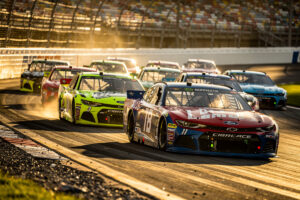
Oval racing puts 20-40 cars in a pack at 180-200 mph where inches of separation determine survival and drafting strategy controls the race outcome. iRacing is the only sim with a serious oval ecosystem — its NASCAR Cup, Xfinity, and Truck series run official races matching the real NASCAR schedule. I’m a road racer by instinct, but the hours I’ve spent in iRacing oval series have convinced me the discipline demands pack management, tire conservation, and drafting awareness that no other sim racing category provides.
Oval racing is the most misunderstood discipline in sim racing. Road racers dismiss it as “just turning left,” but competitive oval racing is one of the most mentally demanding forms of sim racing. At superspeedways, you process 20-40 cars simultaneously while managing tire wear, fuel strategy, and drafting partners — all while separated from other cars by inches at 200 mph. The concentration required is immense, and a single dropped packet on a Wi-Fi connection at that speed puts you into the wall before you can react.
Oval Track Types
Oval tracks divide into three categories that demand completely different driving styles. Short tracks (0.5-0.75 miles) like Bristol and Martinsville require hard braking and aggressive corner entry — the closest oval experience to road racing. Intermediate ovals (1.0-1.5 miles) like Charlotte and Atlanta demand aerodynamic balance and tire management over long runs. Superspeedways (2.0-2.66 miles) like Daytona and Talladega are pure pack racing where the draft controls everything.
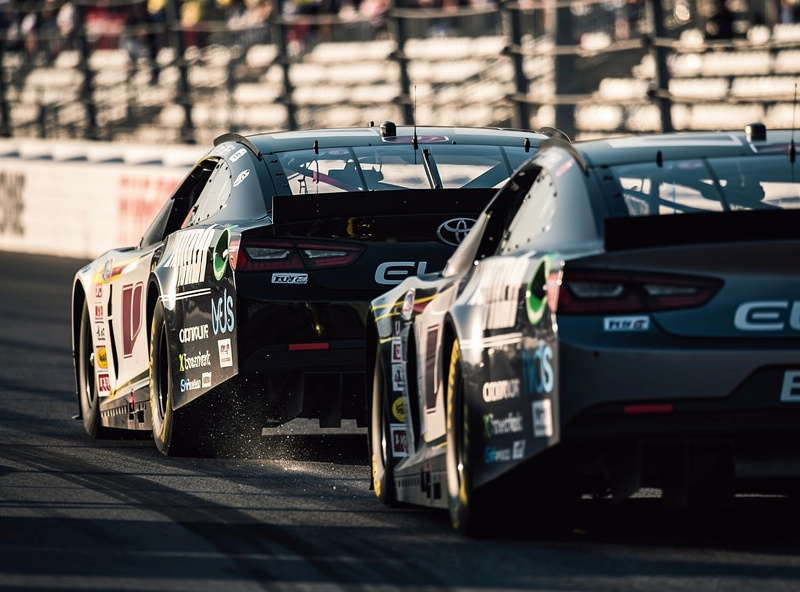
Short tracks produce the most exciting oval racing because the cars slow enough for side-by-side battles through every corner. At Bristol’s high-banked half-mile, the field completes 500 laps in 2-3 hours with constant contact, bump-and-run passes, and tempers flaring. The driving technique is heavy braking into the corner, rotation through the center, and aggressive throttle on exit — similar to road racing but with only left turns. On my rig, short-track FFB is the most violent oval workout the wheelbase gets — constant sawing at the wheel and rapid direction changes load the direct-drive motor differently than any road course.
Intermediate ovals are the most common in the NASCAR schedule and the bread and butter of iRacing oval racing. At Charlotte or Atlanta, speeds reach 180-190 mph on the straight and 150-160 mph through the corners. The car is on the edge of aerodynamic grip — too slow and the aero stalls, too fast and the car pushes wide. Managing this balance over a 200-400 lap race while conserving tires is the core challenge. Your wheelbase sees sustained mid-corner torque here, not the sharp peaks of a road-course chicane. How you set FFB damping and friction for a long intermediate run is genuinely different from how you tune for GT3 at Spa.
Superspeedways are unlike any other form of racing. The restrictor plate (or tapered spacer in modern NASCAR) limits engine power to keep speeds below 200 mph, which creates pack racing where the entire field runs within 1 second of each other. Drafting is everything — a single car in clean air loses 5-10 mph to a pack. The race is decided in the final 10-20 laps by drafting partnerships, side-drafting attacks, and three-wide moves that separate the pack. From a rig perspective, superspeedways barely stress the wheelbase — most of the cornering load is absorbed by banking — but they stress your network harder than any road race because losing connection for 200 ms in a 30-car pack at 195 mph is unrecoverable.
Drafting and Pack Racing
Drafting is the defining skill of oval racing. When you follow another car closely, the lead car punches a hole in the air that reduces drag on your car by 10-15%, allowing you to maintain the same speed with less throttle or achieve higher speeds at the same throttle position. The draft enables overtaking — you slingshot past the lead car using the speed advantage gained from their slipstream. On the wheelbase I run, the FFB goes noticeably light when you tuck into a strong draft because aerodynamic download drops — it’s a tactile cue your spotter can’t give you.
Side-drafting is the advanced technique. When you pull alongside another car at superspeedway speeds, the air flowing between the two cars creates a pressure differential that slows the car on the outside. Skilled oval racers use side-drafting defensively — pulling alongside a car attempting to pass on the outside to neutralize their speed advantage. The technique requires precise positioning within inches of the other car at 190+ mph.
Pack racing requires you to trust the drivers around you. At 200 mph in a 30-car pack, a single mistake by any driver can trigger a multi-car crash (the “Big One”) that eliminates 10-15 cars in seconds. Surviving pack races requires reading the cars ahead — watching for instability, weaving, and aggressive moves — and positioning yourself to avoid crashes rather than cause them. The wired ethernet link on my rig is non-negotiable for this — a single Wi-Fi dropout in a superspeedway pack turns you from a drafting partner into a bowling ball for the 20 cars behind you.
Tire Management on Ovals
Oval turns load tires asymmetrically because the car only turns left. The right-front tire does the most work, followed by the right-rear, while the left-side tires carry less load. Over a long run, the right-front overheats and loses grip, causing the car to push wide (understeer). Managing this degradation through line adjustments and smooth inputs is what separates good oval racers from great ones.
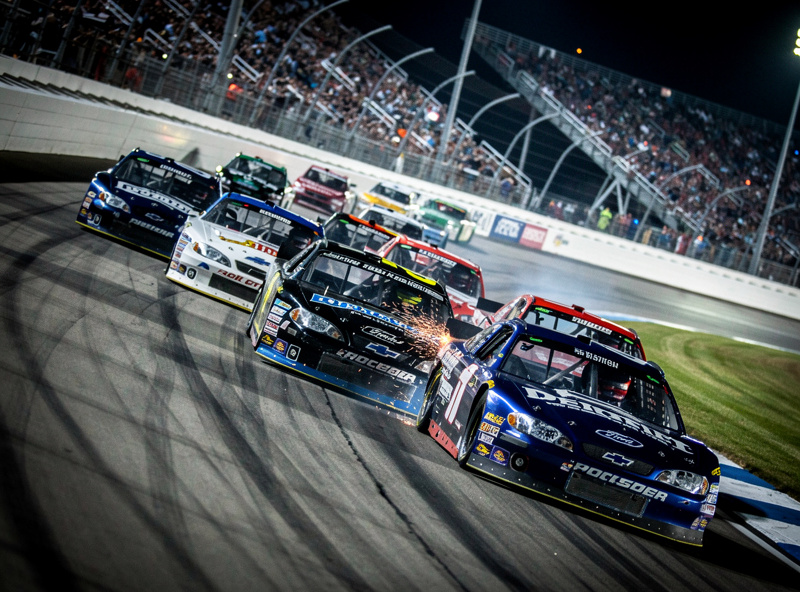
The preferred line on ovals is the bottom groove — the shortest path around the track. Running the bottom requires precise entry and exit because the radius is tight and any speed loss is magnified. As tires degrade, some drivers move to the middle or top groove where the larger radius reduces tire loading and extends tire life. This groove strategy creates racing — a driver with fresh tires on the bottom catches a driver on worn tires running the top. You feel this degradation through the wheel too: as the right-front gives up, the steering effort to hold the car on the bottom groove climbs, and the FFB starts reporting understeer push as a gradual lightening of mid-corner resistance.
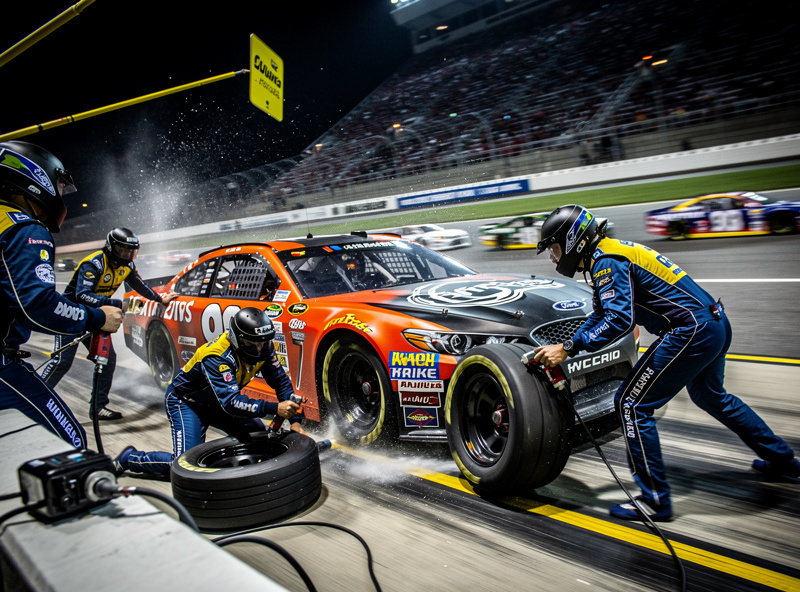
In iRacing, tire wear is modeled realistically over race distance. A 200-lap race at Charlotte consumes approximately 40-60% of the right-front tire, requiring a pit stop for tires around laps 80-100. Pit strategy — when to pit, how many tires to change (two vs. four), and how much fuel to take — is a significant competitive factor in long oval races. On short tracks, some drivers take only right-side tires to save time, gambling that the left-side wear is manageable for the remaining stint.
Force Feedback Tuning for Oval Racing
Oval racing loads a direct-drive base differently than road racing, and the FFB profile that works for GT3 at Spa will feel wrong at Daytona. The sustained mid-corner torque on intermediates and short tracks means your FFB clipping threshold needs to be set higher than on a road course to avoid the wheel going numb through the corner’s loaded phase. On the bases I’ve run, I tune FFB strength so peak torque hits about 80% of the base’s limit on corner exit — that leaves headroom for the contact spikes and bump-and-run hits that are constant on short tracks.
The frequency of FFB events on ovals is also different. Road courses deliver discrete FFB events — one curb hit, one compression, one exit slide. Oval racing at Bristol delivers a near-continuous stream of high-frequency inputs from banking transitions, surface seams, and the contact of cars around you. Running too much damping or friction in your FFB profile on a short track masks these rapid-fire cues. On my rig, I drop wheel damper to 5-10% for oval racing — lower than my road-course baseline — and let the raw torque telegraph everything the front tires are doing.
One common mistake I see with road racers trying ovals: they leave their road-course FFB profile loaded, with high interpolation and filtering, then complain the car feels vague. Oval racing rewards a more direct, less filtered FFB setup because the car’s behavior is simpler — you are not navigating 15 corner types — and the granular detail (tire slip angle, aero push onset, contact from the car alongside) is what tells you how hard you can push.
Getting Started in Oval Racing
Start with the Street Stock or Legends car in iRacing’s Rookie oval series. These low-powered cars teach the fundamentals — maintaining speed through corners, managing tire wear, and racing in traffic — without the complexity of full NASCAR Cup cars. Progress through the license ladder: Rookie → D-Class (ARCA Menards) → C-Class (Truck Series) → B-Class (Xfinity) → A-Class (Cup Series). Each step introduces faster cars with more aero dependence and longer races that punish tire abuse harder.
The biggest beginner mistake in oval racing is driving too aggressively on lap 1. The first 10-20 laps of an oval race are about survival and tire conservation, not overtaking. Cars that charge to the front on worn tires in the first 50 laps fade to the back by lap 100. Patient drivers who conserve tires in the first half of the race become the fastest cars in the second half. On the equipment side, use a round or D-shaped rim — not a formula-style wheel — for oval racing. The constant left-hand steering input and the need for quick counter-steering in pack situations make a 320-350 mm round rim the right tool for the job.
Brake bias adjustment becomes critical in oval racing in a way it simply isn’t on road courses. Running more rear bias than your road baseline helps rotate the car on corner entry at short tracks and intermediates, but it also increases the risk of spinning under braking into a pack. Most oval setups run brake bias between 52-56% front on short tracks and 54-58% front on intermediates — rearward of a typical road-course baseline — because the car only needs to rotate in one direction. Get comfortable adjusting brake bias lap to lap as tire wear shifts the balance.
Oval Track Type Comparison
| Feature | Short Track | Intermediate | Superspeedway |
|---|---|---|---|
| Track length | 0.5-0.75 miles | 1.0-1.5 miles | 2.0-2.66 miles |
| Corner speed | 80-110 mph | 150-160 mph | 180-195 mph |
| Primary skill | Braking and rotation | Aero balance and tire management | Drafting and pack awareness |
| Race distance | 250-500 laps | 200-400 laps | 160-200 laps |
| FFB load | High-frequency, violent | Sustained mid-corner torque | Light, banking carries load |
| Brake bias (front%) | 52-56% | 54-58% | 56-60% |
| Key risk | Contact and tempers | Tire fall-off late run | The Big One |
Frequently Asked Questions
Is oval racing realistic in sim racing?
Yes. iRacing’s oval physics are validated by real NASCAR drivers who use the platform for practice. Drafting, side-drafting, and tire wear models closely match real oval racing. Several eNASCAR/iRacing champions have gone on to real NASCAR Truck Series drives.
What sim is best for oval racing?
iRacing is the only sim with a serious oval racing ecosystem. It runs official NASCAR Cup, Xfinity, and Truck series with structured schedules matching the real calendar. No other sim offers comparable oval competition, physics, or community.
How do you draft in oval sim racing?
Follow the car ahead within 0.5-1.0 car lengths to enter their draft. The slipstream reduces your drag, giving a 5-10 mph speed advantage. Use this advantage to slingshot past on the outside or inside. At superspeedways, form drafting partnerships with other cars to push each other through the pack.
What is the Big One in oval racing?
The Big One is a multi-car crash at superspeedways that eliminates 10-15 cars in seconds. It is triggered when one car makes contact with another at 190+ mph, creating a chain reaction. Surviving the Big One requires reading instability in the cars ahead and positioning yourself near the bottom or top of the pack to avoid the crash zone.
Is oval racing harder than road racing?
They are hard in different ways. Road racing demands technical corner technique across varied corners. Oval racing demands pack management, drafting awareness, and tire conservation over hundreds of laps in close proximity to 20-40 other cars. Neither is objectively harder — they challenge different skills.
Do I need a special wheel rim for oval racing?
A round or D-shaped rim between 320-350 mm is ideal for oval racing. The constant left-hand steering input and need for quick counter-steering in pack situations make a round rim the better tool. Avoid small formula-style rims — they lack the leverage and rotation range oval cars demand through long corners.