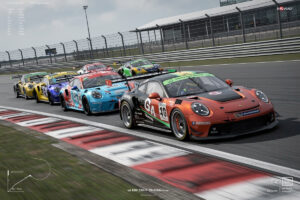
Road racing on circuits with varied corners, elevation changes, and mixed surfaces is the discipline that covers the most ground in sim racing — GT3, touring cars, and prototypes are three fundamentally different driving experiences that share the same tracks. On the rig I welded, the stiffness matters for precision threshold braking in a GT3 car, and it matters just as much when a prototype’s downforce loads up the steering in a fast sweeper. The discipline develops the broadest skill set because every corner demands a different technique — trail braking, flat-out commitment, precision chicane cutting, and late apex driving all appear on every road course.
Road racing is where most sim racers start and where many stay permanently. The combination of car variety, track variety, and competitive depth creates an experience that never feels repetitive. A GT3 race at Spa feels completely different from a touring car race at Brands Hatch, which feels different from a prototype stint at Le Mans — all within the same discipline. Across the wheelbases I’ve bolted on, the FFB signature of each class is distinct enough that you can identify what you’re driving blindfolded from the steering feel alone.
GT3 Racing: The Sweet Spot
GT3 is the most popular road racing class in sim racing because it balances speed, accessibility, and competitive depth. GT3 cars produce 500-600 hp, weigh 1,250-1,350 kg, and run with traction control and ABS — electronic aids that make them forgiving enough for beginners while still demanding skill at the limit. The class includes over 30 cars from 14 manufacturers including Porsche, Ferrari, BMW, Mercedes-AMG, Lamborghini, and McLaren. On my direct-drive base, the weight transfer through a GT3 car’s suspension under braking is the most communicative FFB signal in sim racing — a clean build-up of torque that peaks at turn-in and tapers predictably.
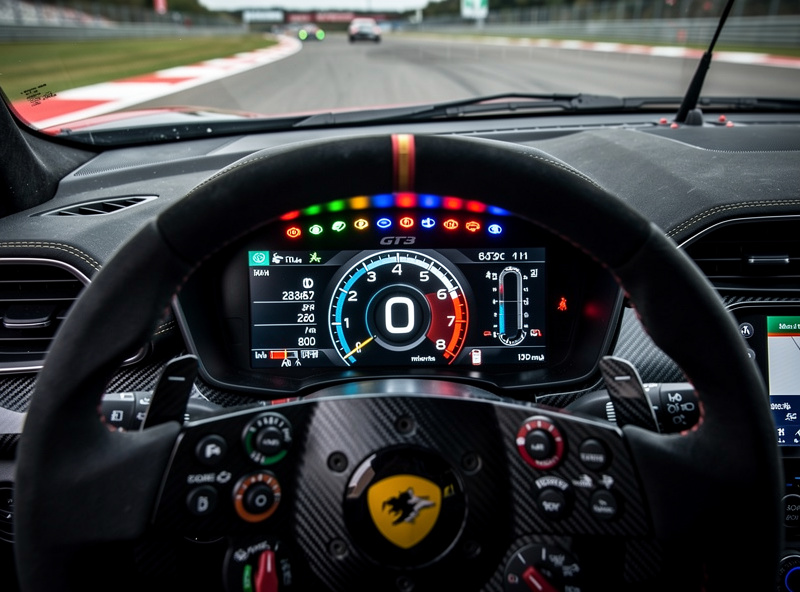
The car characteristics that define GT3 are weight transfer under braking, mechanical grip without full downforce, and tire management over stint length. Unlike formula cars that rely on aerodynamic downforce, GT3 cars generate most of their cornering grip from tire contact patches and suspension geometry. This means the car slides progressively rather than snapping — you can feel the limit approaching through force feedback and catch slides with counter-steering, which makes GT3 racing accessible and rewarding. The brake pedal is where GT3 races are won: with a load-cell pedal, you can threshold-brake precisely enough to hit the same braking point lap after lap without locking, and the pedal travel curve I run gives me a hard wall at 80% pressure for muscle-memory consistency.
ACC is the definitive GT3 simulation. Its tire model, aerodynamic simulation, and weather system are the most detailed in any racing sim, and the car roster covers every GT3 manufacturer. The competitive scene revolves around ACC’s built-in competition system and the Low Fuel Motorsport platform, which provides hourly ranked racing with ELO-based matchmaking across 3-5 splits per race. In my experience, ACC’s FFB communicates understeer onset more clearly than any other sim — you feel the steering lighten as the front tires lose grip, which is the feedback you need to correct your line before you bleed speed.
iRacing also offers excellent GT3 racing with a broader competitive ecosystem — hourly official series, weekly endurance events, and the iRacing Special Events (24 Hours of Spa, Daytona 24, etc.) that attract thousands of entries. iRacing’s GT3 cars handle slightly differently from ACC’s — less detailed tire physics but more structured competitive matchmaking. The FFB difference is noticeable: iRacing’s steering column torque model transmits less surface texture than ACC’s rack-force model, so you rely more on visual and audio cues for grip-loss detection.
Touring Cars: Contact Racing
Touring car racing in TCR and GT4 classes delivers closer, more contact-heavy racing than GT3 because the cars are slower, heavier, and more evenly matched. TCR cars (Hyundai Elantra, Honda Civic, Audi RS3) produce 300-350 hp with front-wheel drive or all-wheel drive, creating a completely different driving experience from rear-wheel-drive GT cars. Bump-drafting, door-to-door contact, and aggressive overtaking are normalized in touring car racing. On my rig, the steering torque in a front-drive TCR car is uniquely busy — the wheel tugs and fights under power in a way rear-drive cars never do, and it forces you to be smoother with your throttle hand than any other class.
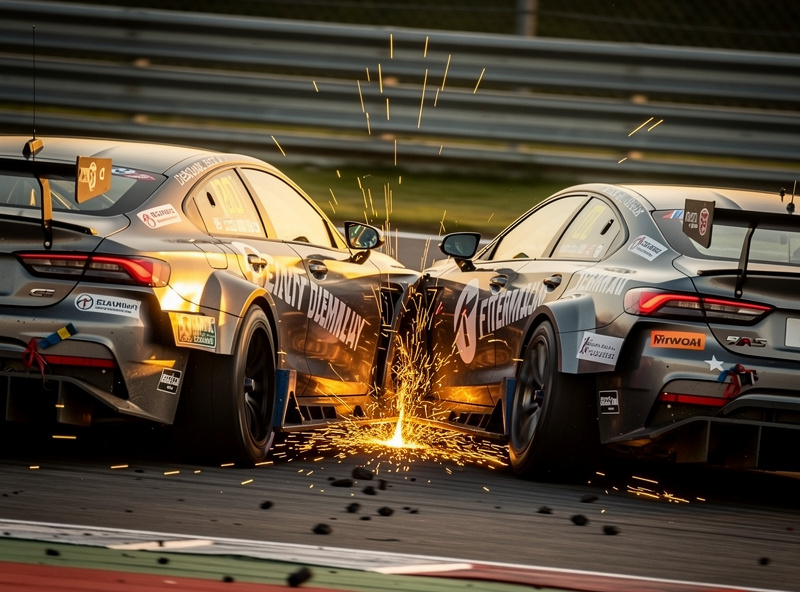
The front-wheel-drive physics of TCR cars are the unique challenge. Power oversteer is nearly impossible in a front-drive car — the front wheels both steer and put power down, meaning heavy throttle in a corner simply pushes the car wide (understeer). The technique involves trail braking to rotate the car on corner entry, then unwinding the wheel smoothly as you apply throttle. This technique translates to smoother driving in every other car class. The tire management story is also different: front tires take a beating in FWD cars because they handle all the steering, braking, and acceleration load — you’ll see the front-left temperature climb faster than any other tire, especially on clockwise circuits.
AMS2 (Automobilista 2) has the best touring car physics with Brazilian stock car and touring car content that feels visceral and alive. iRacing runs a TCR series in its IMSA Pilot Challenge alongside GT4 cars. ACC includes GT4 DLC that provides a slower, more forgiving entry point to GT racing with the same physics engine as the GT3 cars. If you’re moving up from a belt-driven wheelbase to direct drive, touring cars are a good benchmark — the constant steering torque under acceleration in a FWD car exposes any torque ripple or oscillation in the base that smoother rear-drive cars hide.
Prototypes: Maximum Downforce
Prototype racing with LMDh, LMP2, and GTP cars adds the dimension of aerodynamic downforce to road racing. These cars generate enough downforce to theoretically drive upside down on a ceiling at speed — their cornering capability exceeds anything possible with mechanical grip alone. The driving technique is fundamentally different from GT racing: precision replaces aggression, and smooth inputs replace corrections. The FFB character shifts entirely; where a GT3 wheel communicates weight transfer and tire scrub, a prototype’s steering is dominated by downforce loading — the steering goes light at low speed and progressively loads up heavier and heavier through fast corners, and your job is to stay ahead of that ramp with smooth hands.
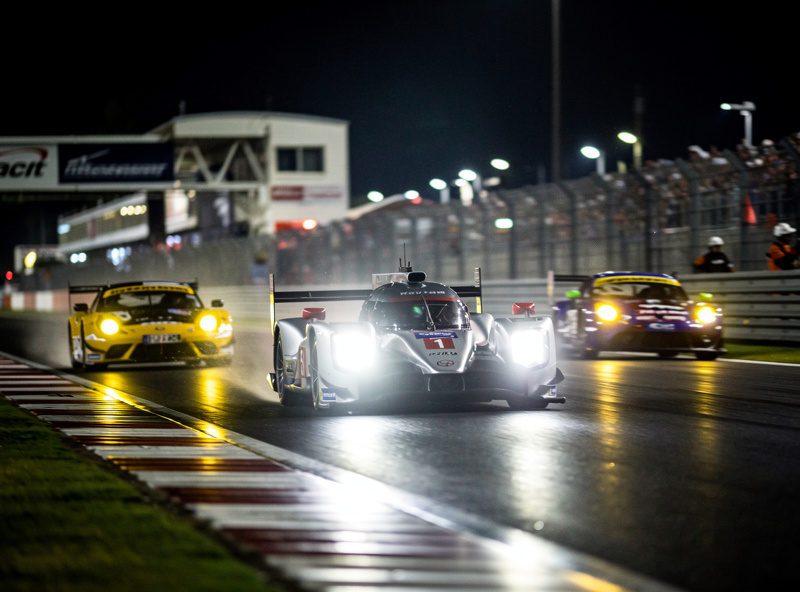
The multi-class racing format is where prototypes shine. In IMSA and WEC series, prototypes share the track with GT3 cars, racing through traffic constantly. A prototype driver must overtake 20-30 slower GT cars per stint without contact — each overtake requires reading the GT car’s line, predicting their braking point, and committing to a pass at the right moment. This traffic management skill is unique to multi-class racing and creates constant strategic tension. Multi-class is where the networked-latency argument stops being academic: if you’re on Wi-Fi and your inputs arrive 20 ms later than the server expects, a closing-speed overtake of a GT car at 300 km/h becomes a netcode incident waiting to happen. My rig is wired straight to the OPNsense for a reason.
iRacing runs the most structured prototype racing with GTP (LMDh), LMP2, and the IMSA iRacing Series that combines all three classes. The LMP2 car is the recommended entry point — it has enough downforce to feel fast but is more forgiving than the GTP hybrids. The GTP cars add hybrid energy management (deploying battery power on straights) that adds a strategic layer to every lap. On my telemetry overlay, the GTP’s energy deployment trace is one of the hardest things to optimize — you can see exactly where you’re wasting battery on partial-throttle moments that should be coast or lift phases.
Essential Road Racing Skills
Trail braking is the single most important skill for road racing speed. Most beginners release the brake fully before turning in, losing the weight transfer that helps rotate the car. Trail braking keeps 10-30% brake pressure through the initial turn-in phase, shifting weight to the front tires and allowing a tighter, faster corner entry. The technique gains 0.1-0.3 seconds per corner — on a 15-corner track, that is 1.5-4.5 seconds per lap. On the load-cell pedal set I run, the brake curve is tuned so 10-30% pressure is a distinct and repeatable band on the elastomer stack — without that hardware consistency, trail braking becomes guesswork.
Throttle modulation is the companion skill that separates fast drivers from merely competent ones. Rather than treating the throttle as a binary on/off switch, competitive road racers apply power progressively as the steering wheel unwinds through corner exit. The rule is simple: more steering angle means less throttle, because the tires have a fixed grip budget shared between turning and accelerating. Demand too much of both at once and you get understeer in a front-drive car or snap oversteer in a rear-drive car. Reading this through the wheel — feeling the FFB lighten as the rears begin to slide — is something you only learn with hours of deliberate corner-exit practice.
Tire management separates sprint racers from endurance racers. In a 20-minute sprint, you can push tires hard for the entire race. In a 60-minute stint, pushing hard for the first 20 minutes overheats the tires and costs 1-2 seconds per lap in the final 20 minutes. Learning to drive at 95% to preserve tire life while maintaining competitive pace is the core skill of endurance road racing. The telemetry doesn’t lie here: you can overlay lap times with tire temperature traces and see exactly where you crossed the thermal threshold that cost you pace later in the stint.
Racing line optimization means finding the fastest path through each corner based not on the corner itself, but on the straight that follows it. A tighter line through a hairpin that straightens the exit gives you 0.2 seconds of better acceleration down the next straight — and that pays dividends for the entire straight, not just the corner. Late apexes and early apexes are tools, not rules; the correct line changes depending on whether the next section is another corner, a short straight, or a full-kilometer blast where exit speed dominates. I pull up the telemetry overlay to compare my line to faster drivers’ — the geometric difference of half a car width at turn-in routinely produces a 3 km/h exit speed difference that compounds down the straight.
Traffic awareness is the skill that makes you fast in a pack, not just on a clear track. Overtaking requires reading the car ahead — where they brake, where their line compromises, and where the gap opens. Defending means placing your car so the attacking driver has to take the outside line into the next corner. In multi-class racing, traffic awareness becomes constant: a prototype driver overtaking GT cars must process closing speeds, braking-point differences, and the GT driver’s likely line all within a 2-second decision window.
The Rig That Teaches Road Racing
Road racing technique is inseparable from the hardware you practice it on. A desk-mounted wheel with a brake pedal that slides under heavy braking makes trail braking impossible to learn — the hardware masks the skill. The rig I welded is torsionally rigid by design: zero frame flex under maximum brake pressure, which means 100% of your pedal input reaches the load cell and zero energy is lost to pedal-plate movement. That rigidity is what makes brake-pressure consistency learnable. On a wobbly stand, you’re fighting the furniture, not developing muscle memory.
The direct-drive wheelbase matters too. The FFB detail you get from a mid-torque direct-drive base (the CSL DD and Simagic Alpha Mini class I run daily) is enough to feel the difference between understeer scrub, oversteer slip, and neutral cornering balance in every car class. Belt-driven wheels blur those signals together — the slew rate isn’t fast enough to separate understeer onset from general cornering load. If you’re serious about road racing, upgrade in this order: rigid rig first, load-cell pedals second, direct-drive base third. The wheel rim is last — a round rim on a load-cell pedal set beats a formula rim on a potentiometer brake every time.
Best Road Racing Sims
| Sim | Best Car Class | Competition | Physics | Cost | Best For |
|---|---|---|---|---|---|
| ACC | GT3 / GT4 | LFM, SimGrid | Best GT3 | $40 + DLC | GT specialists |
| iRacing | All classes | Official series | Excellent | $13/mo + content | All-around |
| AMS2 | Touring / GT | Community leagues | Great variety | $40 + DLC | Content variety |
| Assetto Corsa | Mod content | Community servers | Great mods | $20 | Modding |
Frequently Asked Questions
What is the best car class for road racing beginners?
GT4 is the best starting class — the cars are 100-150 hp slower than GT3 with more forgiving handling and wider tolerance for mistakes. ACC’s GT4 Pack DLC ($20) or iRacing’s GT4 series provide entry-level road racing with the same fundamental techniques as GT3 at a more manageable pace.
Is ACC or iRacing better for road racing?
ACC has better GT3 physics and tire detail. iRacing has more competitive structure, car variety, and official series frequency. For pure GT3 racing, choose ACC. For road racing across multiple classes (GT, prototype, touring, formula), choose iRacing.
What is trail braking in sim racing?
Trail braking is maintaining 10-30% brake pressure past the turn-in point into a corner. This shifts weight to the front tires, increasing their grip and helping the car rotate. It gains 0.1-0.3 seconds per corner and is the most important technique for road racing speed.
How do I improve tire management in road racing?
Drive at 95% of your maximum pace rather than 100%. Avoid locking brakes (use ABS or threshold braking). Maintain consistent cornering lines to distribute wear evenly. Monitor tire temperatures — ideal range is 80-95°C for most GT3 slicks (well above ambient, since these are racing slicks, not street tires). If one tire overheats, adjust your line to reduce load on that corner.
What is multi-class racing?
Multi-class racing puts different car classes on track simultaneously — prototypes race alongside GT cars in the same event. Faster classes overtake slower classes throughout the race, adding traffic management as a core skill. IMSA and WEC are the primary multi-class series in sim racing.