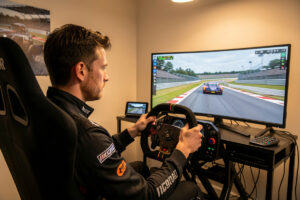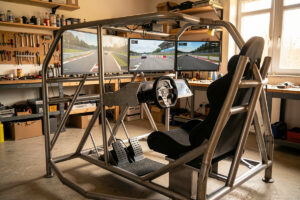
Endurance and team sim racing is the discipline where the rig, the network, and the driver all have to survive hours — not minutes — without a single failure. A 90-minute stint that drops one frame at the wrong moment, a USB hub that browns out at hour three, or a wheelbase that overheats into a torque cut will end a race that a fast lap never threatened. Endurance is the part of sim racing where my build-it lens matters most: the welded frame, the wired link to the OPNsense, and the load-cell brake that calibrates the same on lap 400 as on lap 1.
I have run iRacing and ACC endurance events off the rig I welded myself, swapped drivers across time zones, and burned whole weekends in the force-feedback menus making sure the feel held up over a long run. This guide is the map of the whole discipline — what makes an endurance car survive, how teams actually coordinate, how stints and pit windows are planned, and where the hardware quietly decides the result. Each section links to a deeper guide on its own subtopic.
What Endurance Sim Racing Actually Demands
Endurance sim racing means races of 90 minutes to 24 hours, usually shared between multiple drivers, where consistency and reliability beat raw pace. The winning car in a 24-hour iRacing event is rarely the fastest over one lap — it is the one that never crashes, never overheats its tires, and never loses a driver to a disconnect. Pace gets you pole; discipline gets you the trophy.
That changes everything about how you prepare. In a 15-minute sprint you can hold a knife-edge setup and a brake bias that bites hard, because you only need it to last a handful of laps. Over four hours, the same setup cooks the right-front, your concentration frays, and the small mistakes compound into a wall. Endurance rewards a car you can drive at 95% for hours over a car you can only hold at 100% for ten minutes. That single shift — from peak pace to repeatable pace — is the mental core of the whole discipline, and it is why I treat my rig as engineering first and a toy second.
The other demand is teamwork. Most serious endurance racing is run as a team event with shared driving, where two to six drivers split the stints. That introduces a layer no sprint racer ever deals with: handover, fuel coordination, a strategist watching the timing screen, and a setup that every driver in the car can live with. I cover that whole layer in the sim racing team strategy guide.
The Sims That Run Endurance Well
Four titles carry the bulk of serious endurance sim racing, and they are not interchangeable. iRacing runs the deepest official endurance calendar with rolling 24-hour specials and a driver-swap system built into the service. ACC owns GT3/GT4 endurance with the best night transition and tire model for that class. Le Mans Ultimate is the youngest but carries the official WEC license and multiclass DNA. AMS2 and rFactor 2 sit alongside for FFB-physics contrast and private league endurance.
I run iRacing and ACC as my dailies, dip into AMS2 and rFactor 2 for how differently their force feedback talks to me under load, and treat Le Mans Ultimate as the dedicated endurance project. The table below is how I rank them for the things that actually matter over a long run, not for a one-lap hot-lap shootout. If you are still choosing a platform, the iRacing vs ACC comparison goes deeper on the day-to-day differences.
| Feature | iRacing | ACC | Le Mans Ultimate | AMS2 |
|---|---|---|---|---|
| Official endurance calendar | Deepest (24h specials) | Strong (SRO-based) | Official WEC license | League-driven |
| Built-in driver swaps | Yes, native | Yes (sprint+endurance) | Yes | Limited |
| Multiclass depth | Excellent | Single-class focus | Hypercar/LMP2/GTE | Good |
| Night/day transition | Good | Best in class | Strong | Good |
| Tire wear modeling | Deep | Deep | Developing | Moderate |
| Best for | Official 24h, ovals, multiclass | GT3 endurance, night | WEC prototypes | Variety, FFB feel |
For the iRacing-specific path — license requirements, the special events calendar, and how the team service works — the endurance racing in iRacing guide is the deep dive. For ACC’s GT3 endurance, start with the complete ACC GT3 guide and its night-running model.
Reliability Is a Hardware Problem First
The single biggest difference between sprint and endurance racing is that your equipment has to last. A wheelbase that runs cool for ten minutes can hit thermal throttle and cut torque at hour two; a foldable rig that flexes a few millimeters per corner will have you fighting the frame instead of the car by hour four. Over a 24-hour run, every weak link in the chain gets found.
This is where the welded-steel rig earns its keep. A torsionally rigid frame means the load-cell brake reads the same on the last stint as the first, because nothing in the structure is shifting under repeated 50-plus-kilogram braking inputs. Frame flex is not a comfort issue — it is a consistency issue, because a frame that moves changes your reference point every lap. I built mine in steel for exactly this reason, and ran an 80/20 aluminum-extrusion rig alongside it long enough to feel the difference under sustained load.
The wheelbase matters too, but not the way the marketing implies. For endurance I do not run my higher-torque bases at their peak; I run a mid-torque direct-drive base at a sane setting it can hold for hours without heat-cutting. Max torque on day one is the classic beginner mistake, and over an endurance run it is also a reliability mistake — a base running near its thermal ceiling is a base waiting to fade. The direct drive versus belt drive guide covers why direct-drive heat behavior matters here, and the force feedback tuning guide covers setting a torque level you can actually live with.
The Network Is Part of the Car
Nothing ends an endurance race more abruptly than a disconnect at hour six. In a sprint a brief hitch costs you a position; in an endurance event a dropped connection during your stint can lose the whole team’s race. This is the part of endurance most drivers underrate, and the part my homelab background takes seriously.
My sim PC runs on a wired ethernet link straight to the OPNsense — no Wi-Fi for racing, ever. Wi-Fi is for laptops, not for a connection that has to hold a stable, low-jitter link for hours while a household streams and downloads around it. On the OPNsense I keep the sim PC on its own path with traffic shaping so a big download elsewhere in the house cannot starve the race connection of bandwidth at the worst moment. The full setup is in the best internet setup for sim racing guide, and the deeper networking build crosses over to my homelab router project, where the same OPNsense box segments the whole house.
Latency is a stack, not a single number. Your network, the sim itself, and your display each add milliseconds, and any one of them can ruin the feel of a long run when fatigue has already eaten your margin. A wired link removes the most variable and most catastrophic part of that stack — the part that doesn’t just slow you down but can disconnect you entirely.
Stints, Driver Swaps, and Handover
A stint is a single driver’s continuous run between pit stops, and the driver swap is the moment one driver hands the car to the next. In iRacing and ACC this is a real in-sim mechanic, not a menu trick — the car has to be stationary in the box, the incoming driver takes control through the service flow, and a fumbled handover costs real seconds. A clean swap is a rehearsed routine; a panicked one is a stalled car and a lost lap.
Stint length is dictated by fuel and tires, not by how long a driver wants to sit. You plan the race as a series of stints that fit the fuel tank and the tire life, then assign drivers to those stints based on who is fresh, who is fast in traffic, and who handles the night. The mechanics of getting in and out of the car cleanly — the service flow, the common ways a swap goes wrong, and how to rehearse one — are the whole subject of the driver swaps and stints guide.
Driver consistency across a swap is its own discipline. The car has to suit every driver in it, which usually means a slightly softer, more forgiving setup than a single qualifier would run. A setup that one alien can hold on a knife edge but that spins the moment a tired teammate touches a curb is the wrong setup for a team car. This is the unglamorous compromise at the heart of team endurance, and it is covered alongside roles and comms in the team strategy guide.
Pit Strategy and Fuel Management
Pit strategy is where endurance races are won and lost on the timing screen rather than the track. The core decisions are simple to state and hard to execute: how much fuel to take, whether to change tires, and when to box relative to your rivals. Fuel-saving by lifting and coasting can stretch a stint enough to drop a pit stop entirely, and a single skipped stop is worth far more than any line through a corner.
The discipline of running the tank down without running it dry, of reading an undercut, and of deciding tires-or-no-tires under pressure is a skill set on its own. I plan fuel off telemetry rather than guessing — I know my consumption per lap and I know exactly how many laps a tank gives at race pace versus at a lift-and-coast number. The full decision framework, with the math for fuel windows and the logic of the undercut, is in the pit strategy in endurance sim racing guide.
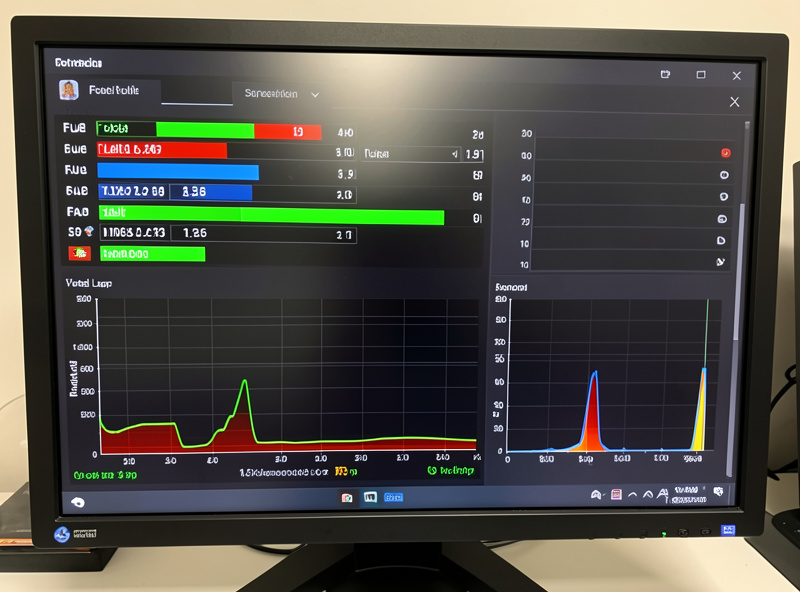
Telemetry is what turns strategy from guesswork into arithmetic. My overlay tells me fuel-per-lap, tire temps across the stint, and the deltas I need to know whether an undercut will actually work. If you are not reading your own data yet, the sim racing telemetry guide and the MoTeC telemetry guide are where strategy starts — you cannot plan a fuel number you have never measured.
Racing at Night
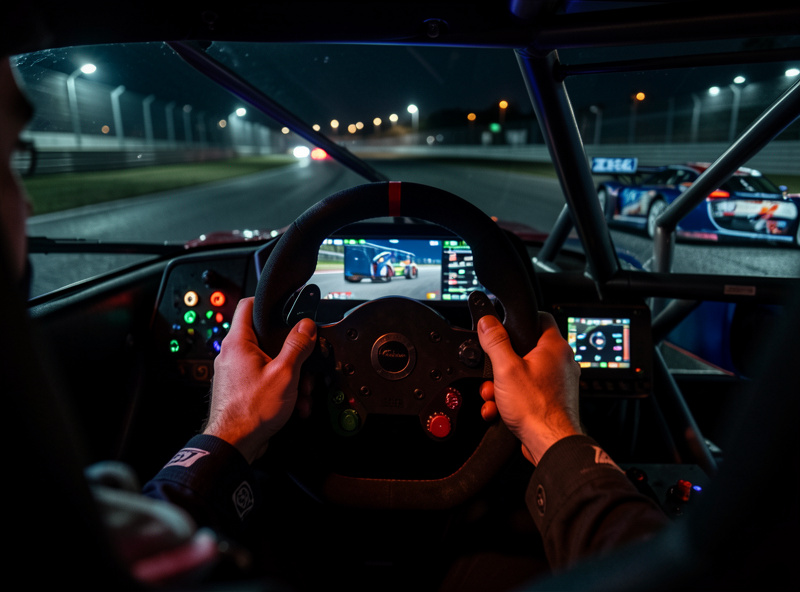
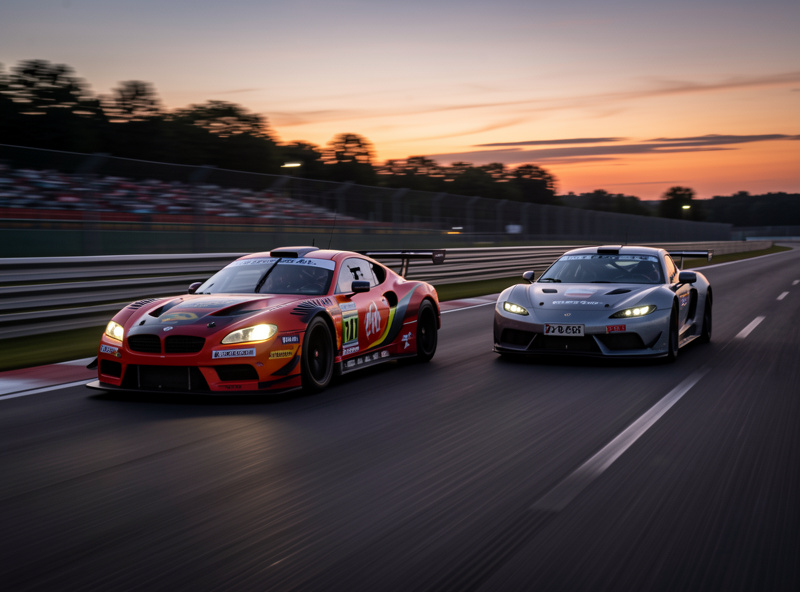
Night running is the part of endurance that separates the drivers who prepared from the ones who only practiced in daylight. The reference points you lean on all day — a curb, a brake marker, the edge of the track — go dark, and you are suddenly braking off headlight throw and memory. ACC models the day-to-night transition the best of any sim I run, and the half hour around dusk, when the track is neither lit nor bright, is the hardest driving in any endurance event.
Night driving is also a display and FOV problem. A correct field-of-view setup matters even more in the dark, because your peripheral cues are gone and your sense of speed and placement has to come from a geometry that is actually right. Most home setups run a wildly wrong FOV that the eyes tolerate in daylight but that falls apart at night. The fixes — display brightness, in-car light settings, and pacing your eyes through the transition — are in the sim racing night driving tips, and the geometry is in the FOV calculator guide.
Multiclass Traffic
Multiclass racing — fast prototypes sharing a track with slower GT cars — is the signature challenge of real endurance and the hardest traffic skill in the sport. As the faster car you have to read a closing speed of dozens of miles per hour and pick a side without lifting the slower car out of its line; as the slower car you have to hold a predictable line and let the prototype make the decision. Get it wrong and you take out a car that was never even racing you.
The skill is anticipation, not reaction. You learn to read the closing rate on the straight and commit early, because committing late in traffic is how multiclass incidents happen. iRacing runs the deepest multiclass fields of any sim, and the full set of conventions — who yields, where to pass, how to use the relative timing display — is in the iRacing multiclass racing guide. Clean traffic management also leans hard on the etiquette that keeps a long race from devolving, covered in the clean racing etiquette guide.
Setting Up a Car for the Long Run
An endurance setup is a different animal from a qualifying setup. You build in tire margin so the car still works on worn rubber, you soften the edges so it forgives a tired driver, and you set a fuel-friendly engine map where the title offers one. A car that is half a second slower per lap but never bites you is worth far more over a four-hour stint than a sharper car that punishes one lapse in concentration.
Tire management is the heart of it. The right tire pressures and a setup that doesn’t overload one corner can mean the difference between a tire that holds for a full stint and one that drops off a cliff with ten laps to go. I start from a known baseline and adjust for the long run, leaning on the complete car setup guide for the fundamentals and the beginner setup guide if you are starting from zero. Brake calibration matters here too — a load-cell brake set to a travel curve you can hit consistently when tired is worth more than one tuned for a single perfect lap.
Pedals: The Upgrade That Decides Consistency
If endurance rewards repeatable inputs, the pedal set is the hardware that delivers them — more than the wheelbase, more than the rim. A load-cell brake measures pressure rather than position, so braking to a force target is repeatable in a way a potentiometer brake never is, and over a long run that repeatability is the whole game. The brake input you can land within a few percent every single lap, fresh or fatigued, is the one that keeps you out of the gravel at hour three.
I run a load-cell brake as my daily and have tested a hydraulic set long enough to make the diminishing-returns argument honestly: the jump from a basic potentiometer brake to a load cell is transformative, and the jump from a good load cell to hydraulics is real but small. For endurance, get the load-cell brake and a brake-travel curve you can hit half-asleep before you spend anywhere else. The full breakdown is in the sim racing pedals guide. As an Amazon Associate I earn from qualifying purchases. If you want to browse current load-cell pedal sets, an Amazon search for load-cell sim racing pedals is a sane starting point.
Frequently Asked Questions
How long is an endurance sim race?
Endurance sim races run from 90 minutes to 24 hours. iRacing runs official rolling 24-hour specials, while many league endurance events sit in the 2 to 6 hour range. The defining trait is shared driving and reliability over pace, not any single duration.
Do you need a team to race endurance?
No, you can run shorter endurance events solo, but most serious endurance racing is shared between two to six drivers. iRacing and ACC both have native team services that let drivers swap during pit stops, which is the format the major endurance specials are built around.
What hardware matters most for endurance racing?
A rigid rig and a load-cell brake matter most, because both deliver repeatable inputs over hours. A wired network connection is the third pillar, since a disconnect during your stint can lose the whole team’s race. Raw wheelbase torque matters far less than reliability over a long run.
Why is a wired connection important for endurance racing?
A long race demands a stable, low-jitter connection for hours, and a single disconnect can end the team’s race. A wired ethernet link removes the most variable and catastrophic part of the latency stack, which is why a wired connection straight to the router is standard for serious endurance racing.
How are stints and driver swaps planned?
Stints are planned around fuel tank size and tire life, then drivers are assigned to those stints based on freshness, traffic pace, and night ability. The swap itself is a real in-sim mechanic in iRacing and ACC, requiring the car to be stationary in the box while control passes to the incoming driver.
Which sim is best for endurance racing?
iRacing has the deepest official endurance calendar and best multiclass fields, ACC has the best GT3 endurance and night transition, and Le Mans Ultimate carries the official WEC license. The right choice depends on whether you want official 24-hour specials, GT3 night racing, or WEC prototypes.