Rally sim racing is the discipline where car control matters most — you drive point-to-point against the clock on gravel, tarmac, and snow stages where every corner carries a different surface under the tires. Richard Burns Rally with the RallySimFans mod remains the physics benchmark in 2026, with gravel tire modeling that no modern sim has matched, while EA Sports WRC provides official WRC licensing on a current platform. The rally community reports that pacenote processing — not raw pace — separates the fast drivers from the ones who finish a 12-minute stage in one piece.
Rally is the most individual discipline on my rig. There is no opponent to follow through a braking zone, no draft to exploit, and no one to blame for a mistake. It’s you, the co-driver’s voice, the stage surface, and the car. On road circuits, I’m reacting to traffic and track position. In rally, I’m processing pacenotes at speed while managing a sliding car through forest roads on a surface that changes every 200 meters — the same direct-drive base that gives me clean FFB on iRacing and ACC transmits gravel vibration, ruts, and surface transitions as distinct force-feedback layers that are information I need to act on before I see the corner. This isolation creates a flow state that circuit racing and oval racing cannot replicate, and it’s the reason I keep gravel tires and a handbrake mounted on the rig even though my daily racing is GT3.
The Rally Sim Landscape: RBR, EA WRC, and DiRT Rally 2.0
Richard Burns Rally (RBR) is the physics standard that every modern rally sim is measured against. Despite being a 2004 title, the RallySimFans mod community has kept it alive with updated stages, cars, and graphics plugins that make it competitive with modern sims visually. The reason rally drivers keep coming back to RBR is the gravel and snow physics — the tire model captures surface degradation, rut formation, and loose-over-hard surface transitions as distinct force-feedback layers through the wheel. EA WRC and DiRT Rally 2.0 simplify this into a single surface-friction value that feels like driving on sandpaper, not gravel. On my direct-drive base, the difference is night and day: RBR transmits individual surface events through the FFB — a rut feels like a rut, a loose patch feels like a loose patch — while EA WRC lumps them into a general roughness that communicates less information. The installation process is more involved than buying a sim on Steam — you need to follow the RallySimFans installer documentation carefully — but the physics quality is unmatched. The dedicated Richard Burns Rally deep-dive covers RBR’s physics advantages, installation, and why a 20-year-old game still sits on my SSD.
EA Sports WRC (2023) is the accessible entry point for rally. It offers official WRC stages, a career mode, and online rally events with modern graphics that hold frames well on my triple monitor setup. The physics are good — the cars feel planted and predictable, which makes EA WRC the better choice for casual rally sessions where you want to drive without fighting the surface every corner. The tradeoff is that EA WRC’s simplified gravel model makes the car more forgiving, so you develop habits that don’t transfer to RBR. I keep both installed: RBR for serious rally practice where surface detail matters, and EA WRC for WRC career events and online rallying with friends who don’t want to install a 2004 game.
DiRT Rally 2.0 occupies the middle ground despite being technically superseded. Its physics sit between RBR’s raw gravel detail and EA WRC’s accessibility — the stage variety across Argentina, Poland, New Zealand, and Spain is worth the install alone, and the time trial leaderboards still have active competition. For a broader view of how rally fits alongside GT, formula, oval, and drifting, the sim racing disciplines guide maps every discipline you can run on a single rig.
Why Rally Force Feedback Hits Different
Rally demands more from force feedback than any other discipline on the rig because surface information — not just tire slip angle — is the primary data channel. On my daily direct-drive base (a mid-torque unit I run across iRacing, ACC, and all three rally sims), road racing FFB communicates when the front tires reach the limit of grip at corner entry. Rally FFB does that too, but it also has to communicate what the surface is doing under those tires every meter of the stage. The vibration that comes through the wheel when transitioning from gravel to a rutted section, the resistance change as the front tires bite into loose-over-hard gravel, and the sudden lightness when the rear steps out on snow — these are all pieces of information the FFB has to deliver clearly or you’re driving partially blind.
Setting up FFB for rally requires different values than road racing profiles across every base I’ve bolted on. In RBR, I run higher off-road effect values and lower damping than my iRacing profile because the surface detail needs to come through the wheel cleanly. If damping is too high on gravel, you mute the surface transitions and lose the early warning that tells you the car is about to rotate — I learned this the hard way on a Poland stage where backing the damping off from my road-racing values revealed FFB information I’d been missing for weeks. The force feedback configuration guide walks through per-title profiles, clipping diagnosis on the telemetry overlay, and the damping-vs-detail tradeoff that matters most in rally.
EA WRC’s FFB is simpler than RBR’s — it prioritizes clarity over detail, so you feel the main forces (steering weight, understeer buildup, oversteer onset) without the fine surface-layer data RBR delivers. This clarity makes EA WRC easier to drive at pace early, but it also means you’re missing the surface information that experienced rally drivers use to judge grip availability before committing to throttle. The rally community is split on which approach is better — competitive RBR drivers treat surface-level FFB as essential, while EA WRC drivers argue that what matters is the corner forces, not the surface texture under them.
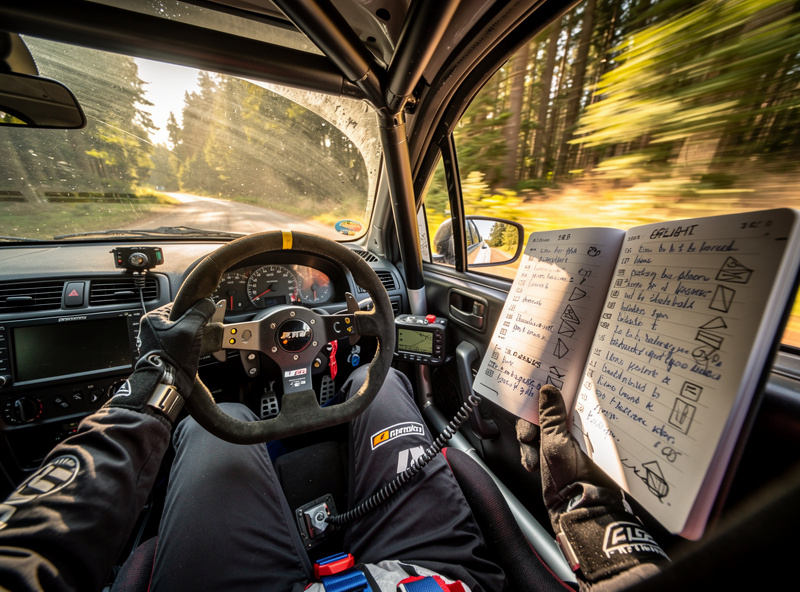
Pacenotes: The Mental Skill Beneath the Speed
Pacenotes are a co-driver’s real-time verbal description of the road ahead — corner severity on a 1-6 scale where 6 is a flat-out kink and 1 is a hairpin, direction (left/right), and modifiers (opens, tightens, crest, jump, bridge, don’t cut, into). In RBR and EA WRC, the co-driver calls notes at speed, and your ability to translate sound into steering input — reacting to “left 3 tightens, over crest” before your eyes process the road — defines your stage time more than your car control or your car setup. The rally community consistently reports that pacenote fluency, not raw pace, is what separates stage finishers from the drivers who find themselves in the trees on sector 3.
Learning the pacenote vocabulary takes 20-30 hours of deliberate practice. The experienced rally community recommends starting at 50-60% pace on stages you’ve never driven, focusing entirely on matching each note to the visual corner. “Right 5” — fast right-hander, lift slightly. “Left 2” — tight left hairpin, handbrake and full opposite lock. “Right 4 opens, don’t cut” — medium-speed right that opens up, and there’s something on the inside you’ll hit if you clip the apex. Once the vocabulary is internalized, you find yourself reacting to notes faster than your eyes can process the road ahead — your hands steering for a corner you haven’t seen yet because the co-driver already told you it’s coming. This is a skill that transfers zero percent from road racing and oval racing, which is why even experienced circuit drivers feel like beginners for their first 10-15 hours in a rally sim.
Custom pacenotes in RBR add a preparation layer that sim driving technique alone cannot provide. Competitive rally drivers walk stages before events and write detailed pacenotes — in RBR, you can replay a stage at slow speed and mark every corner, crest, and surface change manually. This preparation creates the gap between reacting to the road and anticipating it. On a stage you’ve prepped your own notes for, the co-driver is confirming what you already remember, not telling you something you don’t know. That’s the mental state the fastest rally drivers operate in — and it’s a type of preparation that has no equivalent on the circuit-racing side of the rig.
Four Surfaces, Four Cars — and the FFB Difference Between Them
Rally stages run on four surface types: gravel (loose, highest slide angle, most forgiving of mistakes), tarmac (grippiest, smallest slide window, most punishing), snow/ice (lowest grip, requires maximum input smoothness), and mixed (transitions between surfaces mid-stage). Each surface demands a different driving rhythm, and the FFB signature changes with it — the wheel transmits roughness and sliding resistance on gravel, precision and grip-loading on tarmac, and near-silent lightness on snow. Understanding each surface’s FFB signature through the direct-drive base is what lets you push before you can see the road, and it’s the same skill that makes road racing drivers faster when they learn to read the difference between understeer and surface scrub.
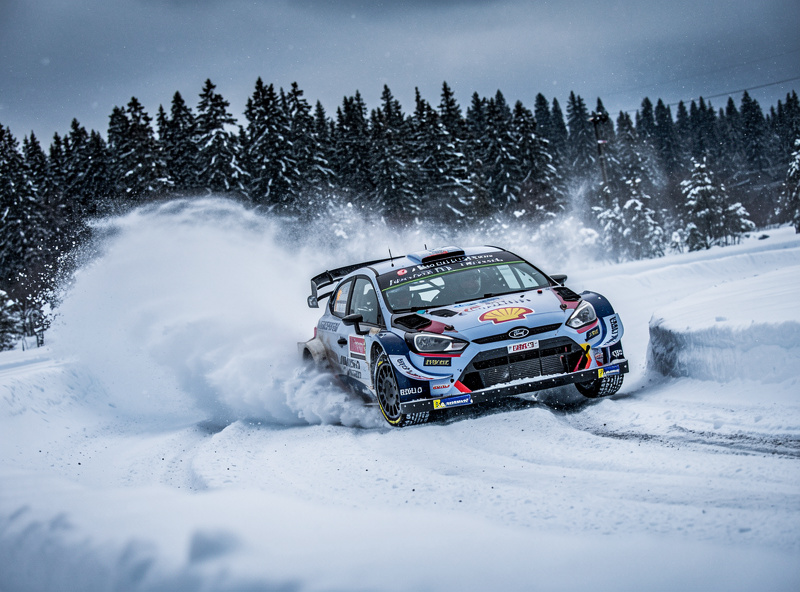
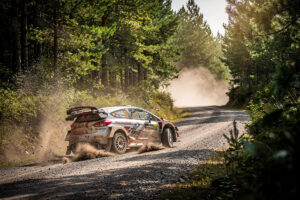
Gravel driving is about controlled slides. The car is almost always sliding through corners — handbrake or lift-off oversteer initiates the slide, then throttle and steering modulate the angle through the corner. Counter-steering is constant, and the wide slide window gives you time to correct before hitting barriers. This is the surface where rally feels most distinct from road racing, and it’s the surface where the FFB is richest — you feel everything through the base.
Tarmac rallying shifts toward precision. Grip is high, slides are tighter and develop faster, and the technique mirrors road racing more than gravel rallying — smooth weight transfer, early turn-in, and precise throttle application. The penalty for a mistake on tarmac is a spin with less time to catch it, so your inputs need to be cleaner. Snow and ice demand maximum smoothness — any abrupt input breaks traction, and the technique is to maintain momentum with gentle, progressive inputs. Cornering speeds on snow are 30-50% lower than on gravel, but the mental load is higher because every input has consequences. The skills contrast sharply with oval racing, where the surface is consistent and the challenge is aerodynamic and traffic-based rather than surface-based.
Car choice interacts with surface physics. The rally community’s standard progression is Group R2 or Rally4 (front-wheel drive, 150-200 hp) for learning fundamentals, then Rally2 (all-wheel drive, ~290 hp) once car control is consistent, then Rally1/WRC class once you can sustain pace across full stages without offs. On my rig, the FFB difference between R2 front-wheel drive and Rally2 all-wheel drive is dramatic — the front-driven R2 telegraphs understeer onset through the wheel as steering-weight loss, while the all-wheel-drive Rally2 transmits power-down oversteer as the rear tires break loose. Understanding both signals is part of becoming a complete rally driver, and it’s the same FFB literacy that makes a good circuit driver great — the base is telling you things your eyes haven’t confirmed yet.
Hardware That Survives Rally
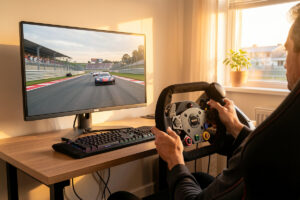
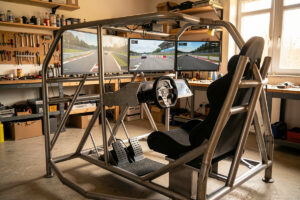
Rally punishes equipment harder than any other sim discipline because you’re always mid-corner when the FFB spikes. A wobbly rig is unacceptable — the welded steel-tube cockpit I built (the same MIG welder that built the boat frame laid the beads on my rig, and both projects are about rigidity under load) eats every FFB spike without a millimeter of frame flex. On a desk-mounted wheel or a foldable rig, the FFB detail you need to feel surface transitions is lost to the rattling desk or the flexing frame. Rig rigidity is the first hardware requirement for rally, before wheelbase torque or pedal set quality, and a direct-drive base on a flexing frame is genuinely worse than a belt-driven wheel on a rigid cockpit because the FFB signal is running into frame movement instead of your hands.
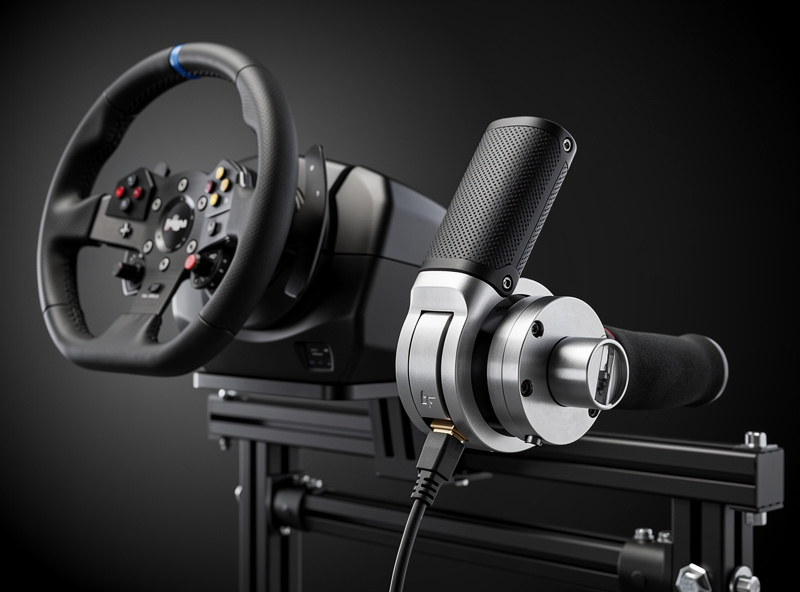
A direct-drive wheelbase is more important for rally than for road racing because surface-level FFB detail — not just cornering force — is critical information. On my daily base, the difference between gear-driven and direct-drive becomes obvious within the first gravel stage. A gear-driven wheel smears the surface detail into a general vibration; a direct-drive base separates ruts from loose gravel from hard-pack changes into distinct FFB signals you can act on. The handbrake bracket holding my USB handbrake came off the same 3D printer that prints my hydro lids — one more reason to build your rig rather than bolting together a bundle.
A handbrake add-on ($50-150 for a USB unit with analog modulation) is essential for competitive rally. The handbrake locks the rear wheels to initiate tight hairpin turns on gravel and snow — a technique used constantly through every stage. Without a physical handbrake, you’re mapping the function to a button or paddle, which gives you on/off instead of proportional input. The analog modulation matters because different hairpin entries require different handbrake pressure — pulling to 50% lock for a “left 3” hairpin versus 100% for a “left 1” is the difference between a smooth slide and a spin. The shifter and handbrake guide covers USB handbrake options and mounting approaches in detail.
Sequential shift paddles or a sequential shifter are preferred over an H-pattern for modern rally — WRC, Rally2, and Rally1 cars all use sequential gearboxes. The faster shift speed of paddles matters in rally where gear changes happen mid-corner while both hands are busy counter-steering. And your network matters more than you’d think: the OPNsense router that segments my home lab puts the sim PC on a dedicated wired low-latency link — the last thing you want on a 12-minute gravel stage is a packet drop during an online rally event. Wi-Fi is for laptops, not racing.
Frequently Asked Questions
What is the best sim for rally racing?
Richard Burns Rally with the RallySimFans mod has the best rally physics, especially on gravel and snow where the tire model captures surface degradation that modern sims simplify. EA Sports WRC offers official WRC licensing and modern graphics with more accessible physics. For competitive rally, RBR is the community standard. For casual rally, EA WRC is easier to start and has online events.
Do you need a handbrake for rally sim racing?
A handbrake is essential for competitive rally. It locks the rear wheels to initiate tight hairpin turns on gravel and snow with analog modulation that a button cannot replicate. Budget $50-150 for a USB handbrake. Without one, you must map the handbrake to a button, which gives you on/off instead of proportional control over slide initiation.
How do pacenotes work in sim racing rally?
A co-driver calls corner severity (1-6 scale), direction (left/right), and modifiers (opens, tightens, crest, jump, don’t cut) in real-time. You process these notes at speed to anticipate the road ahead before your eyes see it. Learning pacenotes takes 20-30 hours of practice — start at 50-60% pace and focus on understanding each note visually before pushing for stage times.
Is Richard Burns Rally still good in 2026?
Yes. The RallySimFans mod community has updated RBR with new stages, cars, and graphics since 2004. Its gravel and snow physics remain more detailed than any modern rally sim — the tire model captures surface degradation and loose-over-hard transitions that EA WRC and DiRT Rally 2.0 simplify. The installation process is more complex than buying a sim on Steam, but the physics quality is unmatched.
What car should I start with in rally sim racing?
Start with a Group R2 or Rally4 car (front-wheel drive, 150-200 hp). These lower-powered cars force you to learn car control fundamentals — weight transfer, handbrake turns, and pacenote reading — without the speed that amplifies mistakes. Progress to Rally2 (AWD, ~290 hp) once car control is consistent, then Rally1/WRC as your skills develop.