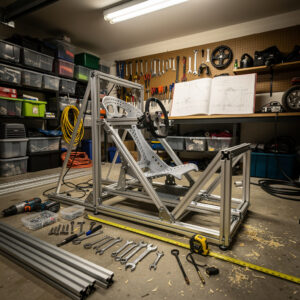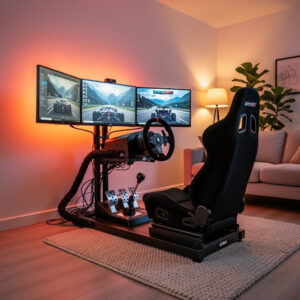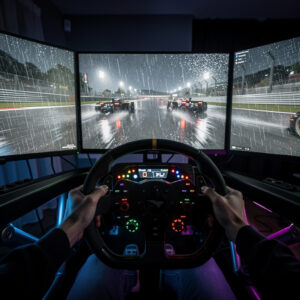
Sim racing is competitive motorsport simulation — physics-based software paired with force-feedback hardware that replicates real driving on virtual circuits. I got into it the way I get into most things: not because a review channel told me to, but because the engineering problem was irresistible. I welded my own steel-tube rig in the garage, bolted a direct-drive wheelbase to it, ran load-cell pedals through a calibration routine I tuned off telemetry, and wired the sim PC through a managed low-latency network. The global racing simulator market was valued at roughly $0.98 billion in 2025 according to Mordor Intelligence, and it’s growing fast as direct-drive hardware prices keep falling — entry-level hardware starts under $400. Whether you want structured esports competition, casual track driving, or a technical hobby that builds genuine vehicle-control skills, this guide covers hardware, software, and the upgrade philosophy I wish someone had given me on day one. A motivated beginner can be racing competitively within two weeks of bolting down a wheel and pedal set.
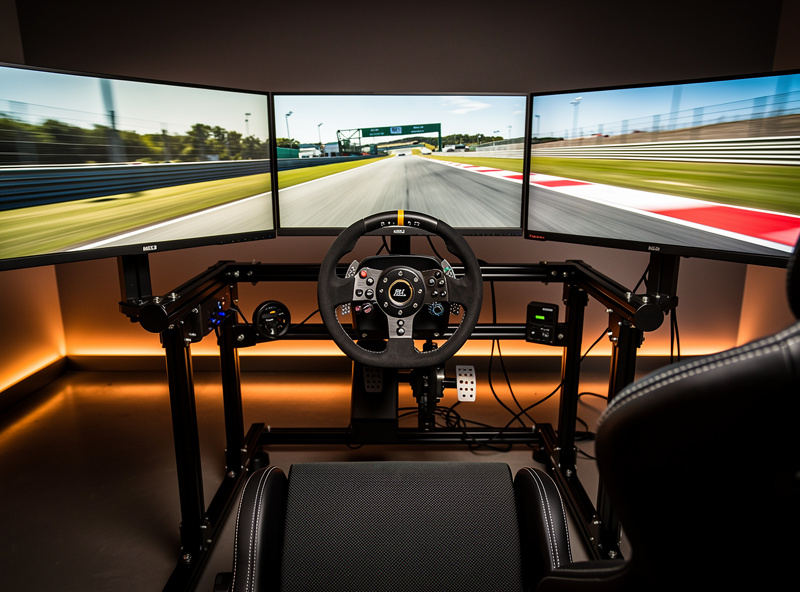
Start with our guide on planning your first sim racing setup, or explore which simulator platform matches your discipline. If you want to build a dedicated cockpit, our DIY aluminum profile rig guide walks through materials, frame geometry, and assembly step by step.
Arcade vs. Simulation: Why the Physics Engine Decides Everything
Sim racing represents a fundamental shift from casual arcade driving to physics-based motorsport simulation. Games like Need for Speed and Forza Horizon prioritize spectacle and accessibility — traction is abundant, crashes are cinematic, and the driving model aims for fun first. A proper simulator calculates tire slip angles, load transfer under braking and acceleration, aerodynamic downforce varying with speed, and suspension geometry frame by frame. When you lose control in a simulator, you exceeded the physical limits of the vehicle — the sim did not decide to create drama.
This authenticity creates a steeper learning curve but offers genuine skill transfer. Real racing drivers — Formula 1, NASCAR, IndyCar — use simulators to learn tracks and develop racecraft before ever turning a real wheel. I’ve run everything from a gear-driven Logitech to the Fanatec CSL DD I bolt up daily, and the fidelity jump from belt to direct-drive alone rewired how I read the car. On the gear-driven base I was reacting to approximate forces; on the direct-drive I feel the front tires scrubbing and the rear stepping out in real time. Several current professional drivers credit sim racing with accelerating their development because they could practice techniques repeatedly without the physical danger, tire budget, and travel cost of real-world track time.
Modern simulators model thermal tire dynamics, fuel consumption, rubber buildup on the racing surface, and aerodynamic balance changes lap over lap. Your driving strategy must adapt as conditions evolve — just as real drivers adapt to changing track temperature and tire wear. It’s the reason I still log hours every week on the same track-car combos I was running a year ago. The depth doesn’t flatten with repetition; it opens.
The Hardware Ecosystem: What Each Component Actually Does
A complete sim racing setup involves several interconnected components. I’ve bolted, wired, and tuned every class of gear below across the welded rig — and the upgrade order matters more than most beginners realize. Most people start with a wheel and pedal set on a desk, then expand as their interest (and wallet) recovers. The rule I stand behind: rigid cockpit first, then load-cell pedals, then wheelbase torque, and the rim dead last. I built the rig before I owned a direct-drive base — everything else mounts to it, so a wobbly foundation makes downstream upgrades irrelevant.
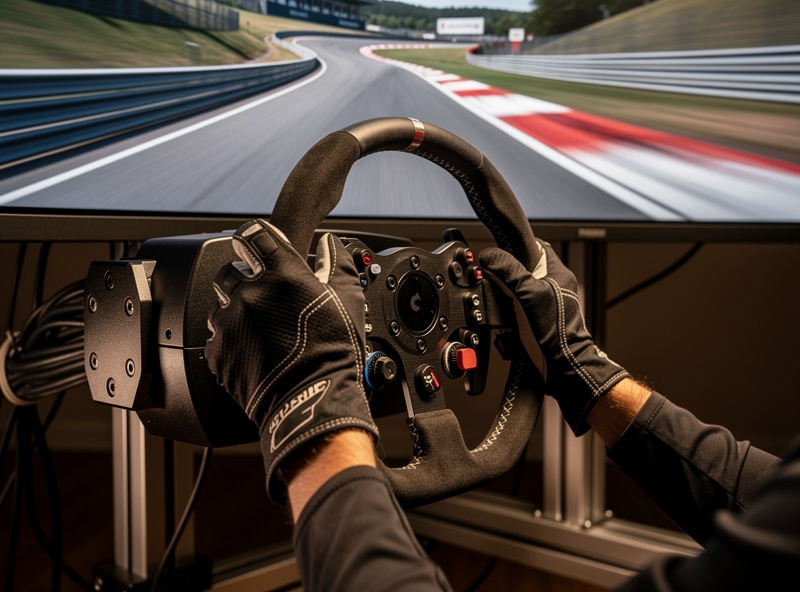
Wheelbase: The steering system is the primary interface between driver and vehicle — it’s how the car talks back. Entry-level options like the Logitech G923 use gear-driven force feedback at accessible prices. Mid-range belt-driven units like the Thrustmaster T300 smooth out the notchy feel but sacrifice some detail. Direct-drive wheelbases eliminate belts and gears entirely — the steering rim mounts directly to a motor shaft, so every surface detail, weight-transfer cue, and tire-slip moment transmits without mechanical filtering. I run a mid-torque direct-drive as my daily (the Fanatec CSL DD / Simagic Alpha Mini class) and have also spent long sessions on higher-torque Moza R9, Simagic Alpha, and Fanatec ClubSport DD-class bases. Direct-drive became the enthusiast standard because the price floor collapsed — entry DD bases now start around $400. For the FFB tuning detail that separates a usable wheel from a truthful one, see our force feedback configuration guide.
Pedals: Your feet control the two vehicle dynamics that most directly determine lap time: deceleration and acceleration. Entry-level pedals measure position — how far you have pressed. Load-cell pedals measure pressure, just like a real brake pedal, enabling consistent threshold braking through muscle memory rather than foot travel. I run load-cell pedals on the rig daily and have tested a hydraulic set for the diminishing-returns argument. The difference between a potentiometer brake where you guess and a load cell where you feel is the single largest lap-time improvement per dollar in sim racing. Experienced racers consistently recommend putting roughly 40% of your hardware budget into pedals — brake consistency impacts lap times more than wheelbase torque, and it’s not close. For throttle, hall-sensor or load-cell designs deliver the precise modulation needed to manage traction out of slow corners. Our DIY upgrades guide covers pedal mods and calibration in depth.
Cockpit and Seating: How you mount your hardware determines whether you’re actually feeling the FFB the base generates or losing it to desk flex. Desk-mounted wheels work for entry-level gear but introduce wobble that dulls feedback — a direct-drive base on a desk is like mounting a telescope on a tripod made of pool noodles. I welded my rig frame from steel tube with a MIG in the garage (the same welder that builds my boat projects — rigidity under load is the same problem across domains). The frame is torsionally stiff, the pedal deck doesn’t flex under threshold braking, and the wheel-deck doesn’t move under 8 Nm of torque. For anyone without a welder, 80/20 aluminum extrusion profile rigs offer bolt-together adjustability with similar stiffness. The 3D-printed brackets holding my button box and wheel-side mounts came off the same printer I use for hydroponic lids — once you start printing rig parts, you’ll never stop. Wheel stands that fold away work for small spaces, but the upgrade order above starts here: a rigid mount platform makes every dollar you spend downstream actually deliver what you paid for.
Visual System: You need to see the track to hit your marks. Single monitors are the affordable, plug-and-play option. Triple monitor setups provide wraparound vision essential for side-by-side racing and apex judgment. Virtual reality headsets deliver immersion by placing you inside the cockpit, though they introduce heat, reduced per-eye resolution compared to monitors, and frame-rate dependency to avoid motion sickness. Ultrawide monitors split the difference between single and triple — extended field of view without triple-monitor complexity. I’ve run triples and an ultrawide, and the FOV math (not the monitor count) is what decides whether your spatial awareness is accurate. Most home setups have FOV values that are wildly wrong — and the math beats the eyes every time. For a detailed breakdown, see our sim racing space setup guide and our monitor mounting and FOV guide.
Shifters and Handbrakes: While most wheels include paddle shifters, a dedicated H-pattern or sequential shifter adds tactile authenticity for historic cars, touring cars, and rally. I keep an H-pattern + sequential unit mounted on the rig and a handbrake for dirt stages — having both means I don’t have to reconfigure the cockpit when I switch from GT3 at Spa to a Group B stage. These connect via USB and bolt to the cockpit frame. For rally and drifting, a load-cell handbrake becomes essential — precise handbrake control is what separates a Scandinavian flick that works from one that puts you in the trees.
Audio and Transducers: Beyond what you see and steer, audio builds the immersion layer. High-quality headphones or nearfield speakers reproduce engine notes, tire squeal, and surface changes. Bass shakers mounted to the seat or pedal deck convert low-frequency audio into physical vibration — you feel engine revs, curb strikes, and traction loss through the chassis instead of just through your ears. I run a transducer on the rig and an entry-level setup costs under $100.
Force Feedback Tuning: Most buyers obsess over wheelbase brand and torque numbers, then run factory presets and wonder why the car feels vague. The real skill — and the thing I spend the most time dialing in — is FFB tuning: adjusting strength, damping, friction, interpolation, and per-title profiles so the wheel transmits only useful information. I tune FFB off a telemetry overlay that shows when the signal is clipping (the base is maxed out and you’ve lost all detail above it) and when the forces are too quiet for the car to speak. Clipping is the silent lapper — you’re turning laps convinced the wheel feels strong, but everything above the clip threshold is identical mush. The profile I run for iRacing is different from the one I built for ACC, and neither matches the one I keep for Automobilista 2. Per-title profiles tuned from telemetry are what turn a powerful wheelbase into a truthful one. Our FFB configuration guide and complete FFB tuning reference cover this end to end.
Hardware Comparison by Budget Tier
| Component | Budget ($300–$500) | Enthusiast ($1,000–$2,500) | Professional ($3,000–$5,000+) |
|---|---|---|---|
| Wheelbase | Logitech G923 (gear) or Thrustmaster T300 (belt) | Fanatec CSL DD, Moza R9, or Simagic Alpha Mini | Simucube Sport or Simucube Pro |
| Pedals | Bundled potentiometer pedals | Fanatec ClubSport V3 or Heusinkveld Sprint (load cell) | Heusinkveld Ultimate+ or Simucube ActivePedal |
| Cockpit | Desk mount or foldable wheel stand | DIY aluminum profile or welded steel frame | Custom 80/40 aluminum profile with integrated monitor stand |
| Display | Existing single monitor (27″) | 32″ gaming monitor or budget VR headset | Triple 32″ high-refresh or premium VR |
| Network | Wi-Fi (functional but adds latency) | Wired gigabit to the router | Wired through managed switch on dedicated VLAN |
| Extras | None required | Basic bass shaker ($50) | Multi-channel transducers, button boxes, wind sim |
| Best For | Learning fundamentals, confirming interest | Competitive racing, years of serious use | Esports competition, maximum immersion |
Software Platforms and What They’re Built For
Different simulators emphasize different motorsport disciplines. Understanding these specializations prevents the mistake of buying the wrong sim for the racing you actually want to do. I run iRacing and Assetto Corsa Competizione as dailies, keep Automobilista 2 and rFactor 2 installed for the FFB-physics contrast, and occasionally fire up Le Mans Ultimate. Each has a lane. Our detailed sim racing software comparison covers every platform, telemetry tools, and companion applications in depth.
iRacing: The premier online competition service built around structured racing with safety ratings, license progression, and official partnerships with real-world series. Laser-scanned tracks, 200+ officially licensed cars, and a matchmaking system that groups drivers by skill rating. The subscription model (currently $13/month per iRacing’s official membership page) and per-content pricing create ongoing costs, but the organized racing structure, protest and steward system for incident review, and professional broadcast quality make it the choice for serious competitive racers. When I want a race that matters — one where the other drivers have skin in the game because their safety rating is on the line — I open iRacing. Our iRacing beginner’s guide covers subscriptions, content acquisition, and your first races.
Assetto Corsa Competizione: The definitive GT racing simulator, officially licensed by the SRO GT World Challenge. Every car and circuit from the real GT3 and GT4 series, with exceptional audio modeling and dynamic weather. The narrow car selection means you master a category rather than sampling one — and the Kunos Simulazioni physics engine rewards that focus with handling fidelity that makes you a better GT driver across every platform. When I’m in a GT3 mood, this is the sim that loads. See our complete ACC guide for setup, car selection, and multiplayer.
rFactor 2: Known for advanced tire physics and real-road technology that tracks rubber buildup and temperature across the racing surface lap over lap. The endurance racing community values rFactor 2 for its day-night transitions and evolving track conditions over long stints. Extensive mod support expands content well beyond the base package. The force feedback delivery is different from iRacing and ACC — more raw, less filtered — and that contrast alone makes it worth keeping installed.
Automobilista 2: Built on the Madness Engine with a car list spanning historic Formula cars, Brazilian Stock Cars, modern prototypes, and karting. The Reiza Studios team prioritizes excellent force feedback and car handling across diverse vehicle types. This is the sim I fire up when I want to drive something I can’t race anywhere else — a 1990s Formula car on a historic layout — and the FFB feels right out of the box without the tuning hours iRacing demands.
Gran Turismo 7: A hybrid: accessible features built over simulation physics. The 450+ car list, polished presentation, and PlayStation exclusivity make it the entry point for most console-based sim racers. Sport mode provides structured online racing, while the single-player career offers progression unmatched by pure simulators. If you’re on console and want to know whether sim racing is for you, this is where you start.
Le Mans Ultimate: Built specifically around the FIA World Endurance Championship — Hypercars, LMP2, and GTE categories on the official WEC calendar. Still maturing compared to the platforms above, but the focus on modern endurance racing with official licenses fills a gap no other sim occupies. I run it occasionally to feel the torque delivery of a Hypercar through the wheelbase, which is a genuinely different sensation from GT3 or open-wheel.
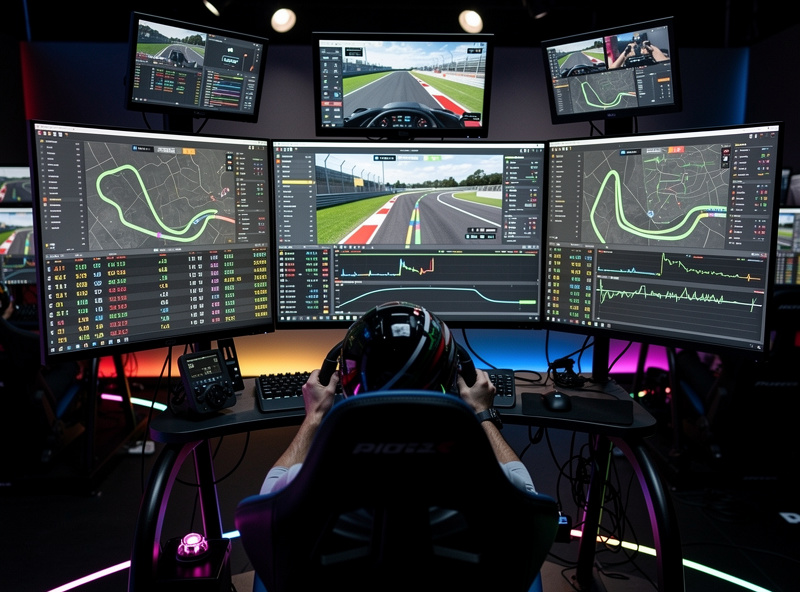
Software Platform Comparison
| Platform | Type | Cost Model | Best For | Content Scope |
|---|---|---|---|---|
| iRacing | Online competition | $13/month + per car/track | Structured competitive racing | 200+ cars, 100+ laser-scanned tracks |
| ACC | GT specialist | $40 one-time + DLC | GT3/GT4 racing mastery | Every GT World Challenge car and track |
| rFactor 2 | Physics-focused | $30 + DLC packs | Endurance racing, modding | Strong modding community, hundreds of cars/tracks |
| Automobilista 2 | Content variety | $40 + DLC | Diverse car eras and categories | Broad historic and modern car list |
| Gran Turismo 7 | Console hybrid | $70 one-time | Console entry point | 450+ cars, 100+ track layouts |
| Assetto Corsa | Modding platform | $20 one-time | Unlimited community content | Thousands of mods available |
Communities and the Competitive Ladder
Sim racing thrives through community organization. Beyond the official racing in platforms like iRacing, independent leagues organize seasons with specific car classes, race formats, and skill-based divisions. These leagues often feature longer races with mandatory pit stops, driver briefings, and stewards who review incidents — replicating real-world motorsport structure more faithfully than public lobby quick-join. I’ve run league seasons that demanded more preparation and racecraft discipline than official iRacing series, because the stewarding is personal and the drivers know each other.
Esports competitions offer pathways to professional recognition. Major events include the FIA Gran Turismo Championships, Le Mans Virtual Series, and numerous iRacing special events with significant prize pools. Real-world racing teams increasingly field esports squads, and multiple professional drivers have emerged directly from sim racing competition. The 24 Hours of Le Mans Virtual attracts professional drivers and esports specialists competing in identical equipment for substantial prizes and prestige.
Discord communities, Reddit forums, and dedicated setup-sharing sites provide spaces for technical discussion, setup files, track guides, and finding teammates. These communities become essential resources as you progress — the collaborative nature of sim racing means experienced drivers often share knowledge freely, and the gap between a public-lobby setup and one shared by a fast league driver is often half a second per lap. Our sim racing leagues guide and complete esports guide map the full competitive landscape.
Setting Realistic Expectations: What Nobody Tells You
Sim racing demands investment across money, space, time, and physical effort. Understanding these dimensions honestly prevents the disappointment that comes when a $300 wheel doesn’t make you an alien on day one.
Financial Investment: A basic setup costs $300–$500 for a wheel and pedal set on a desk. A mid-range enthusiast setup with direct-drive wheel, load-cell pedals, and a rigid cockpit runs $1,000–$2,500. Professional-grade equipment with motion platforms and high-end pedals can exceed $5,000. The good news: you can upgrade incrementally. I started with a belt-driven wheel on a desk, and every component I’ve swapped since then was a single item — pedals one month, cockpit the next year, wheelbase after that. The upgrade ladder is real, and each rung delivers a measurable improvement if you follow the right order. Our first setup planning guide walks through budget allocation.
Space Requirements: Even a desk-mounted wheel needs dedicated space. A full cockpit with monitors demands a permanent footprint — typically 4 feet by 6 feet minimum. Triple monitor setups widen that to 6+ feet. Consider whether you have space that can remain dedicated or whether you need foldable solutions. Many enthusiasts start with wheel stands that store in closets and graduate to permanent rigs as commitment grows. Our space setup guide covers ergonomics, cable management, and lighting in detail.
Learning Investment: Mastering sim racing takes months to years. The physics demand proper braking technique, throttle modulation, weight-transfer management, and track memorization. Expect to spend time studying telemetry, watching onboard laps, and practicing consistently before seeing competitive lap times. The learning curve intimidates some and rewards those who persist — and the satisfaction of finally nailing a corner sequence at racing speed is the reason most of us stay. See our driving techniques guide and racecraft guide for the skill ladder.
Physical Considerations: Direct-drive wheels and load-cell pedals exert real force — my CSL DD runs at 8 Nm peak and a full braking effort on the load cell is a genuine leg press. Proper ergonomics prevent repetitive strain and back pain. Seat height, pedal distance, and wheel reach should replicate real car ergonomics. Take regular breaks, stretch between races, and maintain awareness of posture. The network matters physically too — my sim PC connects through a wired gigabit link on a managed switch, not Wi-Fi. A single latency spike during a braking zone can undo an hour of clean racing, and the wired connection eliminates that variable entirely.
The Social Reality: Sim racing is as social as you make it. Public lobbies can be chaotic. League racing and structured series reward preparation and consistency. Finding a group of drivers at your pace level transforms the hobby from solo time-trial grinding into a genuine community experience. It’s the difference between lapping alone for leaderboard positions and showing up on race night knowing there are 25 other drivers who prepped as seriously as you did.
Getting Started: What I’d Do Differently
If I were starting fresh today, I would follow the upgrade order I wrote above — rigid platform first — and I would buy fewer things up front and better things in sequence. A desk-mounted Logitech is fine for confirming you enjoy the hobby. The mistake is putting a direct-drive base on that same desk and wondering why the FFB feels muddy.
Start with equipment that matches your commitment level. Plan your space before you order hardware. Decide whether you prefer monitor clarity or VR immersion before building the display arm. And run wired — the same OPNsense that segments the IoT VLAN at home puts the sim PC on a dedicated low-latency link, and once you’ve raced without a Wi-Fi dropout mid-corner you will never go back.
Our comprehensive guide on planning your first sim racing setup walks through the budget-space-discipline decision framework. Once you understand what sim racing is, the next step is configuring your physical environment and equipment to support your goals. For technique development, our article on sim racing driving techniques covers the skills that separate consistent drivers from one-lap wonders.
Sim racing offers a combination of engineering challenge, motorsport accessibility, and competitive depth that no other hobby genre provides. Whether you want to compete in esports championships, join a league of drivers at your skill level, or simply experience the sensation of driving an iconic car on a legendary circuit on a Tuesday night after work — the simulation genre delivers authentic experiences that reward dedication with genuine skill development and a rig you can be proud of building.
Frequently Asked Questions
What is sim racing and how does it differ from arcade racing games?
Sim racing uses physics-based software to replicate real vehicle dynamics including tire behavior, aerodynamics, and weight transfer. Unlike arcade games that prioritize spectacle, simulators model authentic driving where losing control means exceeding actual physical limits. Professional F1 and NASCAR drivers use simulators for track preparation and racecraft development.
How much does a sim racing setup cost?
Entry-level setups cost $300-$500 for a wheel and pedal set on a desk. Enthusiast configurations with direct-drive wheel, load-cell pedals, and a rigid cockpit run $1,000-$2,500. Professional setups with motion platforms exceed $5,000. Most drivers start under $500 and upgrade component by component over months or years.
What equipment should I buy first for sim racing?
Start with a wheel and pedal set like the Logitech G923 ($300) or Thrustmaster T300 ($400). Upgrade to a rigid cockpit or wheel stand second because a stable mount determines whether you feel the force feedback at all. Load-cell pedals come third for braking consistency. Wheelbase torque and rim choice come last in the upgrade order.
Is sim racing good practice for real driving?
Yes. Professional drivers in Formula 1, NASCAR, IndyCar, and GT racing use simulators regularly for track preparation and racecraft. The cognitive skills transfer directly because simulators model the same physics that govern real vehicles. Several current pro drivers credit sim racing with accelerating their development without the cost and physical risk of real track time.
Which sim racing platform is best for beginners?
Console players should start with Gran Turismo 7. PC players seeking structured competition should try iRacing. Drivers focused on GT3/GT4 racing should choose Assetto Corsa Competizione. Players who want unlimited modded content should pick Assetto Corsa. All platforms teach transferable driving physics, so the best one is the one that races the cars and tracks you care about.
How much space do I need for a sim racing setup?
A desk-mounted wheel needs about 3 feet of desk width plus pedal room underneath. A wheel stand requires a 3×4 foot floor area during use. Full cockpits with monitors need a permanent 4×6 foot footprint minimum. Triple monitor setups add roughly 2 feet of width. Many drivers start with foldable stands and graduate to permanent rigs as space allows.
Can you make money from sim racing?
Sim racing offers income paths through esports competitions with prize pools reaching $100,000+, content creation on YouTube and Twitch, driving-coaching services, and professional racing team contracts. Several real-world racing drivers transitioned directly from sim racing competition. The esports pathway is competitive but viable for drivers who invest the seat time and racecraft.
Further Reading
- How to Plan Your First Sim Racing Setup — Budget framework and space assessment for your first rig
- Building a DIY Sim Racing Rig — Step-by-step aluminum profile frame construction guide
- Sim Racing Software Explained — Detailed comparison of iRacing, ACC, rFactor 2, and more
- How to Configure Force Feedback — Calibrate your wheel for realistic feel and maximum information
- Sim Racing Driving Techniques — Trail braking, throttle control, and racing line mastery
- Setting Up a Sim Racing Space — Ergonomics, cable management, and environment optimization
- DIY Sim Racing Upgrades — Button boxes, bass shakers, wind simulation builds