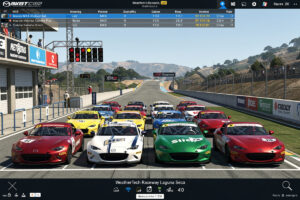
Assetto Corsa Competizione (ACC) is the official GT World Challenge simulation — and the sim I run alongside iRacing as my GT daily. It features over 50 laser-scanned cars across GT3, GT4, GT2, and single-make Cup classes (30 GT3 cars alone, from 14 manufacturers) racing on real-world circuits with dynamic weather, day-night cycles, and advanced tire physics. The game costs $40 on Steam with no subscription fee, making it the most affordable competitive GT racing simulator available. Across the direct-drive bases I’ve bolted onto the rig I welded, ACC’s force feedback detail is the reason it stays installed — no other GT sim communicates tire rubber loading through the wheel quite the way ACC does at 8–10 Nm of torque.
ACC stands apart from every other sim racer available through its singular focus on GT racing. Rather than spreading development across dozens of vehicle classes, developer Kunos Simulazioni dedicated their resources to creating the most accurate GT3 and GT4 simulation possible. The result is a game where every car handles distinctly, every track surface evolves realistically, and every weather condition changes the driving experience in ways that closely mirror real-world GT World Challenge events.
What Makes ACC Different From Other Sim Racers
ACC’s most significant differentiator is its tire physics model. The game simulates tire behavior at a level of detail that goes beyond surface temperature and wear. The model accounts for rubber pickup on track surfaces, marbles forming on racing lines, tire blanket temperatures at race start, and the thermal gradient between the inside and outside of each tire during cornering. These factors affect grip levels in ways that experienced drivers can feel through force feedback and use to their advantage during races.
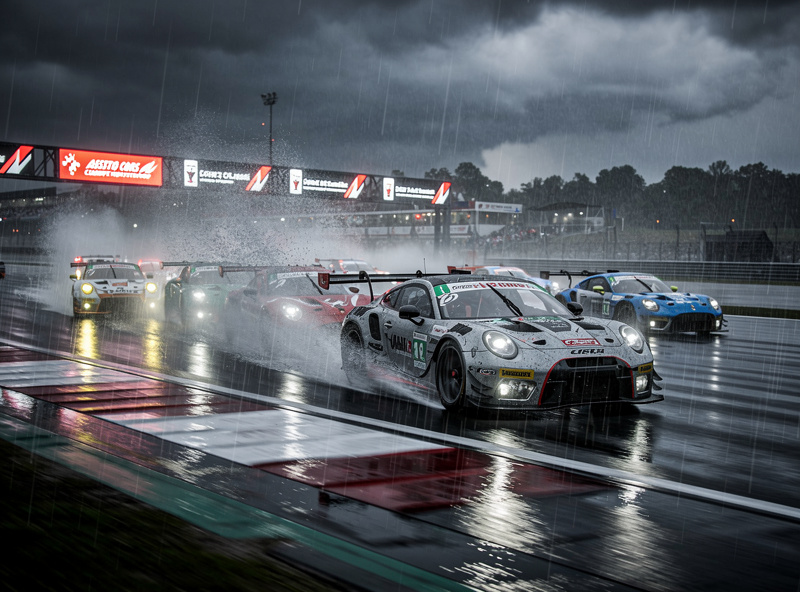
The audio setup matters significantly in ACC because sound cues communicate tire grip levels. The dynamic weather system in ACC creates race conditions that shift in real time. A race that starts in dry conditions can transition through light rain, heavy rain, and back to drying track within a single stint. The racing line dries faster than the rest of the track as cars pass over it, creating a wet-dry split that rewards drivers who adapt their line and tire choice to changing conditions. This weather complexity is unique among GT simulators and adds strategic depth that fixed-weather games cannot replicate.
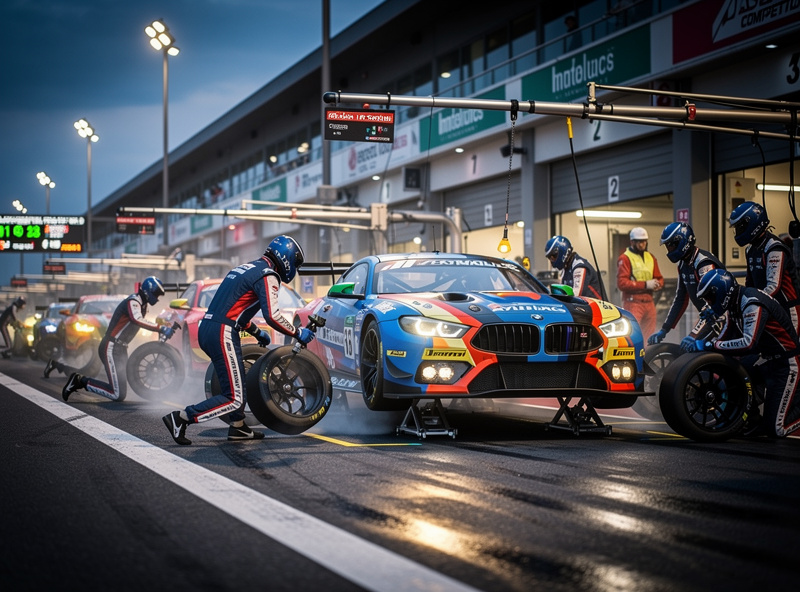
For the best visual experience, pair ACC with a high-refresh gaming monitor or VR headset. ACC’s graphics engine uses Unreal Engine 4 to deliver visual fidelity that surpasses most competitors. Car models feature accurate manufacturer liveries, working headlights and brake lights, and damage modeling that affects aerodynamic performance. Track environments include animated spectators, realistic pit lane activity, and lighting conditions that change with time of day. The visual quality contributes to immersion in ways that enhance the competitive experience during long endurance races.
The force feedback is where ACC earns its spot in my cockpit. I dial in per-title FFB profiles for every sim, and ACC’s is the most nuanced I’ve built. The tire scrub and rubber-loading feel comes through my direct-drive base with a clarity that belt-driven wheels simply cannot reproduce — the slew rate matters here, and the faster response of a direct drive translates the subtle front-end washout cue that tells you you’re asking too much of the tire before the car actually understeers. On my telemetry overlay, I can see the FFB signal strength matching the in-sim grip curve almost perfectly at 8 Nm — push past 10 Nm and you start losing detail to clipping, which is why I tune the per-car gain per track rather than cranking the master gain. This is the part the influencer reviews skip — the raw numbers don’t matter if the FFB signal is clipped to a flat ceiling in every corner.
GT3 Cars in ACC
ACC features GT3 cars from every major manufacturer competing in the real-world GT World Challenge series. The roster includes entries from Ferrari (488 GT3 and 296 GT3), Lamborghini (Huracan GT3 and GT3 Evo), Porsche (911 GT3 R), Mercedes-AMG (GT3), BMW (M4 GT3), Audi (R8 LMS), McLaren (720S GT3), Aston Martin (V8 Vantage GT3), and Honda (NSX GT3), among others rounding out the full 14-manufacturer, 30-car GT3 field. Each car is laser-scanned from the real vehicle with accurate dimensions, weight distribution, and aerodynamic properties.
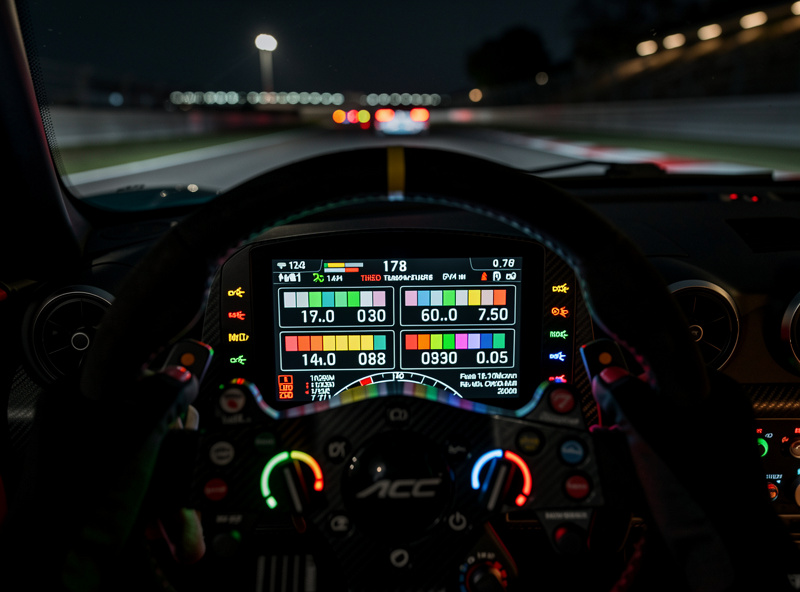
Each GT3 car in ACC handles differently based on its real-world characteristics. The sim racing wheel you use affects how much of these differences you can feel through force feedback. Front-engine cars like the BMW M4 and Mercedes-AMG tend to be more stable and forgiving, making them popular choices for beginners. Mid-engine cars like the Lamborghini Huracan and McLaren 720S offer sharper turn-in and more responsive handling but demand greater throttle precision. The Porsche 911’s rear-engine layout creates unique oversteer characteristics that reward drivers who master its distinctive weight transfer dynamics.
BOP (Balance of Performance) in ACC ensures competitive parity between different manufacturers. The system adjusts each car’s power, weight, and aerodynamic drag to create a level playing field where no single car dominates every circuit. In practice, certain cars perform better at specific track types—front-engine cars excel at high-speed circuits, while mid-engine cars shine on technical layouts. Choosing the right car for each track is a genuine competitive advantage in ACC.
On my rig, the difference between a front-engine GT3 and a mid-engine car is unmistakable through a direct-drive base. The BMW M4 feels planted and communicates loading progressively — I can feel the weight transfer building into the steering column on corner entry, which gives me time to adjust my trail-braking curve on my load-cell pedals. The McLaren 720S, by contrast, rotates faster and the FFB signal spikes more sharply as the rear steps out. If you’re on a gear-driven or belt-driven wheelbase, the mid-engine snap-oversteer feel arrives too late to catch — by the time the belt’s inertia communicates the slide, the car is already sideways. That’s not a driver-skill problem, it’s a hardware-ceiling problem, and it’s why I recommend direct drive for anyone serious about ACC GT3 racing.
GT4 Cars and Entry-Level Racing
ACC’s GT4 class provides a slower and more accessible entry point to GT racing. The GT4 cars include the BMW M4 GT4, Porsche 718 Cayman GT4, McLaren 570S GT4, Alpine A110 GT4, Aston Martin Vantage GT4, and Chevrolet Camaro GT4 among others. These cars produce approximately 350 to 450 horsepower compared to the 500 to 600 horsepower of GT3 machinery, and their simpler aerodynamic packages make them more forgiving for developing drivers.
Load cell brake pedals are particularly important in GT4 racing because the cars require precise brake pressure modulation. GT4 racing in ACC teaches fundamentals that transfer directly to GT3 competition. The cars share the same physics engine and tire model, so skills developed in GT4—trail braking, weight management, tire conservation, and racecraft—apply directly when transitioning to faster machinery. Many league organizers recommend starting with GT4 before moving to GT3, and the GT4 class produces close, competitive racing that rivals the GT3 class for excitement.
The GT4 cars are also essential for multi-class racing events where GT4 and GT3 cars share the same track. Managing traffic between faster and slower classes adds a dimension of awareness and timing that single-class racing does not require. Learning to find gaps in GT3 traffic while maintaining your own pace is a skill that develops naturally through GT4 multi-class experience.
From a hardware standpoint, GT4 racing is where I tell new drivers to calibrate their brake pedal properly before they ever touch a GT3 car. The lower horsepower means you lose less time per mistake, but the brake zones are where GT4 lap time is made or lost — and a load-cell pedal with a well-dialed brake curve is what lets you consistently hit the trailing threshold without locking up. I run a stiffer elastomer stack on my pedal box for GT4 because the cars reward brake-pressure precision more than outright peak force; in GT3, I soften the curve slightly because the higher speeds give less time to modulate. Getting this right in GT4 builds muscle memory that carries cleanly into GT3 braking technique.
ACC Track List and Laser Scanning
ACC includes 25 circuits from the GT World Challenge calendar with all DLC packs installed, each laser-scanned to millimeter accuracy. The track list covers iconic European circuits like Spa-Francorchamps, Monza, Silverstone, Nurburgring, and Barcelona, as well as international venues like Suzuka, Bathurst, Kyalami, and Indianapolis. The laser scanning captures every bump, kerb, and surface change that affects car handling on the real circuit.
Track surface evolution is a critical feature in ACC. As cars lap a circuit, rubber deposits on the racing line increase grip levels over the course of a session. The offline areas remain slippery, rewarding drivers who stay on the optimal line and punishing those who venture off-line to attempt passes. Track temperature also affects grip levels, with cooler conditions providing more mechanical grip but less tire temperature, and hot conditions generating more tire heat but potentially causing thermal degradation.
Each track in ACC features multiple layout configurations including the full Grand Prix circuit, national layouts, and endurance configurations. Night racing at circuits like Spa and Paul Ricard uses realistic lighting conditions where headlights illuminate only a limited section of track ahead. The combination of surface evolution, weather changes, and lighting conditions means that every session at every track feels different from the last.
The laser scanning isn’t a marketing bullet point — it’s a direct input into the FFB channel. The bump entering La Source at Spa, the camber change through Eau Rouge, the surface undulation under braking into Turn 1 at Monza — these are millimeter-accurate reproductions of the real circuit, and they feed distinct forces through the wheel that a hand-built track model would miss. On my rig, I can feel the difference between a freshly rubbered-in racing line and the offline marbles through the wheel’s self-aligning torque, which is what lets me push the car deeper into corners knowing the grip is there beneath me.
Car Classes in ACC
| Class | Horsepower | Car Count | Skill Level | Popular Cars |
|---|---|---|---|---|
| GT3 | 500–600 HP | 30 | Intermediate to Expert | Ferrari 296, Porsche 911 R, BMW M4 |
| GT4 | 350–450 HP | 11 | Beginner to Intermediate | BMW M4 GT4, Porsche Cayman, McLaren 570S |
| GT3 Cup | 500 HP (spec) | 1 | Expert | Porsche 911 GT3 Cup |
| Cup Cars | Varies | 3+ | Intermediate | Lamborghini Super Trofeo, Ferrari 488 Challenge |
Competitive Racing and Esports in ACC
ACC hosts several official esports series that attract professional sim racing teams and drivers. The SRO E-Sport GT Series is the flagship competition, running alongside the real-world GT World Challenge with teams competing for prize pools exceeding $100,000. The championship features a pro category for invited professional teams and a silver category open to qualifying amateur drivers, creating a pathway from casual racing to professional competition.
Beyond official esports, ACC’s competitive ecosystem thrives through community-organized leagues. Platforms like Low Fuel Motorsport, The Sim Grid, and Apex Online Racing run structured seasons with multiple skill splits, stewarding, and championship standings. These leagues provide the closest racing experience outside of professional esports and attract thousands of participants across European, American, and Asian time zones.
Endurance racing in ACC replicates the real-world GT World Challenge Endurance calendar with events ranging from 3 hours to 24 hours. Team endurance events require driver swaps, pit strategy coordination, and tire management over long stints. The Spa 24 Hours is the pinnacle event, drawing hundreds of teams for a full-day race that tests every aspect of team preparation and racecraft. These endurance events are where ACC’s realistic physics and weather systems create the most compelling racing experiences.
I’ve run LMF (Low Fuel Motorsport) as my main ACC multiplayer platform for over a year, and the ELO-based matchmaking is what makes it work. Public servers are a gamble — one session might feature clean, respectful racing and the next might be a turn-one demolition derby. LMF’s safety-rating system filters out the chaos, and once you climb into the higher splits, the racing is genuinely close to what you’d see in an iRacing top-split session. My rig is wired directly through the OPNsense — no Wi-Fi — because even 15 ms of jitter on a wireless connection will ruin a close side-by-side battle at Spa or Monza. ACC’s netcode has improved significantly since launch, but it still punishes unstable connections more harshly than iRacing’s predictive model.
ACC Game Modes and Structure
ACC offers several game modes that cater to different racing preferences. Career mode provides a structured single-player experience across multiple championship seasons with increasing difficulty and car class progression. Quick Race allows instant access to any car and track combination with customizable weather, time of day, and AI difficulty settings. Championship mode replicates the real GT World Challenge season calendar with accurate rules and scoring.
The multiplayer mode is where ACC truly shines. Public servers host races every hour with varying conditions and car classes. While these servers lack structured matchmaking, they provide accessible racing for drivers who want to jump into a session without commitment. The real competitive action happens on third-party platforms like Low Fuel Motorsport (LMF), which provides ELO-based matchmaking, safety ratings, and organized seasons that mirror iRacing’s competitive structure at no additional cost.
Practice mode provides an open session where drivers can test setups, learn tracks, and develop car control without time pressure or competitive pressure. Practice sessions show real-time telemetry data including tire temperatures, brake temperatures, and fuel consumption that help drivers optimize their setup and driving technique. The ability to rewind time and retry sections of a lap makes practice mode the most efficient learning environment in ACC.
Hotlap mode allows drivers to compete for the fastest single lap on any circuit with any car. The global leaderboard system ranks every lap time submitted by the ACC community, creating an always-active competition that extends beyond traditional races. Hotlapping is also the best way to learn a new car or track because it provides immediate feedback on pace and consistency without the pressure of racing traffic. I use hotlap mode as my FFB tuning environment — with no traffic to account for, I can isolate exactly how the wheel communicates at each corner and adjust the per-car gain until the telemetry overlay shows no clipping. That tuned profile then carries into race sessions where the FFB signal is already clean and predictable.
Sound Design and Immersion
ACC’s sound design received multiple awards from the sim racing community and is consistently rated as the best in the genre. Every car has a unique engine note recorded from the real vehicle, including turbo spool, exhaust pops, and intake roar that changes with throttle position and RPM. The tire sounds communicate grip levels through scrubbing and squealing that experienced drivers use as audio cues for finding the limit of adhesion. Interior sounds include dashboard warnings, pit crew radio communications, and the mechanical clunks of gear changes that add authenticity to the cockpit experience.
Environmental sounds in ACC contribute to race immersion. The development team recorded audio at real GT World Challenge events to capture authentic crowd noise, team radio, and pit lane ambience that plays during races. These layers of sound create an atmosphere that makes each race feel like attending a real motorsport event. Rain impacts on the windshield change intensity with weather severity. Tire spray from cars ahead creates a whooshing sound that communicates the amount of water on track. Kerb strikes produce distinct thuds that vary by kerb height and car speed. These audio details are not just cosmetic—they provide real-time information about track conditions and car behavior that supplement visual and force feedback cues.
On my rig, I run audio through a wired headset with the bass shaker mounted to the pedal plate wired separately — the tire-scrub frequencies through the shaker tell me when I’m approaching the limit of adhesion before the steering wheel does, especially in wet conditions where the FFB signal is naturally softer. ACC maps its audio channels correctly to surround setups, but I recommend keeping the audio chain wired regardless — Bluetooth latency on wireless headphones introduces a subtle desync between what you hear and what the wheel is telling you, and in a sim where audio cues are this tightly coupled to grip information, that 30–40 ms lag matters.
The spatial audio implementation supports surround sound and headphone virtualization. Cars approaching from behind are accurately positioned in the stereo field, helping with spatial awareness during close racing. The combination of detailed engine sounds, environmental audio, and spatial positioning creates an immersive experience that enhances both casual driving and competitive racing.
ACC Setup and Tuning Basics
Car setup in ACC affects performance significantly, but beginners should focus on driving technique before diving into tuning. The default aggressive setup for each car and track combination is competitive enough for most public server racing. The safe setup provides a more stable baseline for learning a new car or track, while the aggressive setup unlocks the car’s full potential for experienced drivers.
Proper force feedback configuration is the first step before touching any setup parameter. On my direct-drive base, I run per-car FFB gain settings rather than a single master gain because each car’s steering geometry loads the FFB signal differently — the Porsche 911 GT3 R generates higher peak torque through the wheel than the BMW M4 GT3 at the same in-game setting, and if you don’t compensate per car, you’ll clip the Porsche signal while leaving headroom on the BMW. I check this on my telemetry overlay by watching for the FFB bar hitting 100% (full clip) in high-load corners — if it’s flatlining at the ceiling, I back the gain down 10% for that car/track combo until the signal stays in the 85–95% range.
The five most impactful setup changes for beginners are tire pressures, brake bias, wing angle, traction control, and ABS settings. Tire pressures should be adjusted to reach 27.0 to 28.0 psi when hot—this is the optimal operating window for ACC’s tire model. Brake bias forward provides more stable braking at the cost of corner entry rotation. Wing angle adjusts the trade-off between straight-line speed and cornering grip. Traction control and ABS settings should start at higher values and be reduced as your car control improves.
For endurance racing, consider a proper cockpit or stand to maintain consistent pedal and wheel positioning during long stints. Advanced setup changes include suspension geometry, damper settings, anti-roll bars, and differential preload. These parameters interact with each other in complex ways, and changing one often requires compensating adjustments to others. Beginners who attempt advanced setup changes without understanding these interactions often make their car slower rather than faster. Our detailed ACC setup guide covers every parameter with specific starting values for each car class.
ACC Hardware Requirements
ACC requires a mid-range gaming PC to run at acceptable frame rates. The official minimum specifications call for an Intel i5-4460 or AMD FX-8120 processor, 4GB of RAM, and a GTX 460 2GB or equivalent graphics card — though in practice you will want considerably more headroom than that floor to hold a stable frame rate in a full-grid race. The official recommended tier is an Intel i5-8600K, 16GB of RAM, and an RX 580 or equivalent, but for smooth 60fps at 1080p with high settings and a full 20+ car grid, I’d budget for something closer to a current mid-range card rather than the bare recommended spec.
VR performance in ACC is significantly more demanding than flat-screen gaming. The Unreal Engine 4 implementation requires an RTX 3070 or better for acceptable VR frame rates, and many VR users report needing to lower graphics settings to maintain smooth performance. If VR is your primary display method, iRacing’s older but more optimized engine provides a noticeably better VR experience with lower hardware requirements.
Triple monitor and ultrawide monitor support is well-implemented in ACC, with configurable FOV settings and multi-display rendering. A triple-monitor setup provides peripheral vision that helps with spatial awareness during close racing and traffic management in multi-class events. The sim racing monitor and VR guide covers display options and optimal configurations for ACC.
A direct drive wheel is particularly recommended for ACC because the detailed force feedback implementation benefits from higher torque and faster response times. A force feedback wheel is essential for competitive ACC play. The detailed tire physics and track surface information transmitted through the steering wheel is critical for finding the limit of grip and managing tire wear over race stints. I’ve run ACC on a belt-driven base before upgrading, and the difference is not subtle — the belt introduces inertia that smooths out the fine-detail FFB cues ACC generates, particularly the initial slip-angle warning that arrives 50–80 ms before visible understeer. On a direct drive, that information arrives instantly, and you can catch the slide before it costs you half a second.
Budget wheels like the Logitech G29 work well, but direct drive wheels unlock the full detail of ACC’s force feedback implementation. Pedal quality matters even more—load cell brake pedals provide the consistent brake pressure input needed for the precise braking techniques that GT racing demands. On my pedal box, I run a brake force curve calibrated so that 80% of my physical pedal travel maps to the first 60% of in-game brake pressure — this gives me fine modulation in the trail-braking zone where lap time is won or lost, while the final 20% of travel provides the hard stop for heavy braking zones. Without a load cell, you’re braking by pedal position rather than pressure, and ACC’s brake model rewards pressure consistency in ways a potentiometer pedal simply cannot deliver.
One hardware factor most guides skip: your cockpit rigidity matters as much as your wheelbase for ACC. If your pedal plate flexes under hard braking, the brake-pressure consistency you’re chasing with a load cell is lost to frame deflection. The rig I welded uses a steel-tube frame with zero measurable flex at the pedal mount — every Newton of pedal force goes into the load cell, not into bending the rig. An 80/20 aluminum extrusion rig achieves the same result, but even a mid-tier direct-drive base on a wobbly desk mount will deliver less usable FFB detail than a gear-driven wheel bolted to a rigid cockpit.
Frequently Asked Questions
Is Assetto Corsa Competizione worth buying in 2026?
Yes. ACC remains the best GT3 simulation available in 2026 with active multiplayer through Low Fuel Motorsport, regular community events, and physics that continue to set the standard for GT racing. The $40 price point makes it exceptional value.
What is the best car in ACC for beginners?
The BMW M4 GT3 is the most forgiving GT3 car for beginners due to its front-engine layout and stable handling. The Porsche 718 Cayman GT4 is the best entry point in the GT4 class with predictable behavior and good all-around performance.
Can you play ACC with a controller?
While ACC supports controllers, a force feedback wheel is strongly recommended. The detailed physics model requires precise steering and throttle inputs that controllers cannot reliably provide. Budget wheels like the Logitech G29 work well and cost around $200.
How many players play ACC online?
ACC typically has 2,000 to 5,000 concurrent players on Steam during peak European evening hours. Low Fuel Motorsport has surpassed 200,000 registered users and runs multiple splits per hour during peak times across GT3 and GT4 classes.
Does ACC have crossplay between PC and console?
No. ACC does not support crossplay between PC and console platforms. The PC version receives updates earlier, has a larger player base, and supports mods and third-party platforms like LFM that are not available on console versions.
What DLC do I need for ACC?
The base game includes enough content for competitive racing. The 2023 GT World Challenge DLC adds updated cars and liveries. The GT4 pack adds the full GT4 class. The Intercontinental GT Pack adds Suzuka, Kyalami, Bathurst, and Laguna Seca. Prioritize the GT4 pack if you want entry-level racing.
Related Guides
- Best Cars in ACC for Beginners: GT3 and GT4 Picks — find the right car for your skill level
- ACC Multiplayer Guide: Public, LFM, and Private Servers — how to find competitive racing online
- ACC Track Guide: Every Circuit Ranked by Difficulty — master every track on the calendar
- ACC LFM (Low Fuel Motorsport) Setup and Racing Guide — join the competitive community
- ACC Setup Guide: Cars, Tracks, and Tuning — optimize your car setup for every circuit
- iRacing vs ACC: Which Sim Is Right for You? — compare both platforms directly