I’ve turned laps on every ACC circuit across three direct-drive wheelbases and a load-cell pedal set, and the one thing I wish I’d known starting out is that Barcelona teaches you car control while Bathurst teaches you humility — pick your first 20 hours of track time accordingly. ACC ships 25 laser-scanned circuits once you count the base game and every DLC pack (the base game alone carries 11 from the GT World Challenge calendar), and ranking them by real-world learning curve rather than lap-time delta is what separates drivers who plateau from drivers who keep finding tenths. Barcelona, Hungaroring, and Monza are the circuits where you develop baseline car control without walls eating your Safety Rating. The Nordschleife and Bathurst are the ones where you’ll spend a month just learning the racing line before you even open a setup menu.
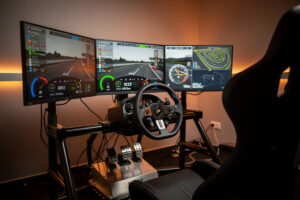
Track difficulty in ACC isn’t just about corner count. It’s about whether the circuit lets you survive a mistake and whether the layout teaches transferable skills. A track with wide run-offs lets you push the car into controlled oversteer and learn where the limit actually lives. A track with walls on corner exit teaches you that the limit isn’t something you find — it’s something you approach from underneath. I learned this the expensive way on my first week at Bathurst, on a welded steel rig built in-house, and it’s why I rank circuits the way I do below. The ranking reflects how each circuit actually feels under a load-cell brake pedal and through a direct-drive wheelbase with honest force feedback dialed in from telemetry — not how the circuits look on a track map.
Where to Start: The Circuits That Teach Without Punishing
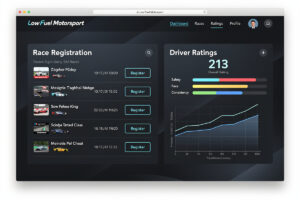
Circuit de Barcelona-Catalunya is where I send anyone new to ACC, and it’s where I go myself when I’m testing a new wheelbase or dialing in a fresh FFB profile. The track combines a long front straight for checking top-speed stability, a sequence of medium-speed sweepers where you feel what the base does under sustained cornering load, and the tight stadium section at the end where rapid direction changes expose whether your force feedback clips on quick inputs. Every corner type you’ll encounter anywhere else on the calendar shows up here, and the run-off is generous enough that you can deliberately overdrive the car to map where grip actually ends — something you cannot safely do at Bathurst. Barcelona appears frequently in LMF and league schedules, which makes it essential to master early if you plan to race competitively on Low Fuel Motorsport.
Hungaroring is the second circuit I recommend because it forces precision without punishing speed. The track is narrow and the corners chain together — Turn 1 into Turn 2, the chicane after Turn 5 — which means you’re always setting up the next corner while finishing the current one. There are no long straights where you can relax; the track keeps you busy and builds the kind of rhythmic consistency that pays off on every other circuit. The grass run-offs give you recovery space, and the lack of high-speed corners means you’re not fighting the car at triple-digit speeds while still absorbing the basics of weight transfer and trail braking.
Monza comes third in the beginner tier, and I rank it here for one reason: it’s the fastest circuit in ACC and teaches you what a low-downforce car setup feels like at 280 km/h. The long straights connected by chicanes — Variante del Rettifilo, della Roggia, Ascari — turn every lap into a braking-point drill. Getting the car stopped consistently from top speed into first gear five times per lap is the single skill that transfers most directly to racecraft. The Parabolica is the only corner demanding genuine commitment, and after 15-20 laps the rest of the circuit becomes a rhythm exercise. That simplicity is precisely why Monza belongs in the beginner tier — you’re learning one hard thing at a time instead of 170 at once.
The Tracks Where Setup and Consistency Start to Matter
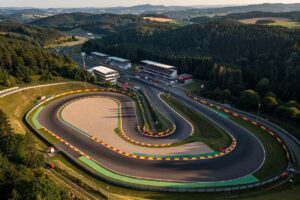
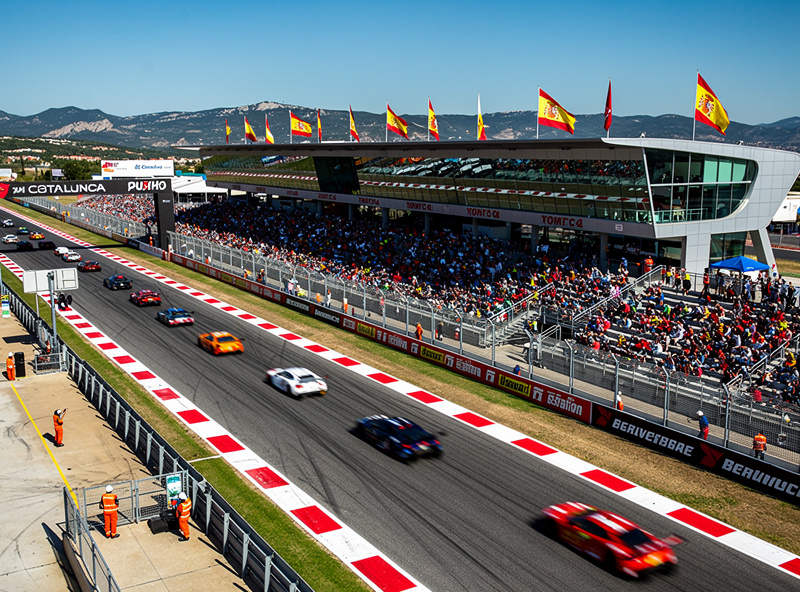
Spa-Francorchamps is the most popular circuit in ACC and the one where drivers discover whether their setup is actually dialed in or just felt OK at Monza. Eau Rouge-Raidillon is the headline — climbing uphill through a compression that loads the car differently than any other corner on the calendar. If your rear-end setup is too stiff, the car steps out at the top of Raidillon at 250 km/h and you’re in the wall before you can correct. Pouhon is the mid-lap test — a long fast left-hander demanding you trust the aero and hold the throttle, where every millimeter of understeer shows on exit. Spa exposes setup weaknesses that easier circuits hide, which is why I rank it intermediate despite the layout being straightforward to memorize. The circuit is also where I evaluate any new wheelbase I bolt onto the rig — the sustained cornering load through Pouhon and the rapid FFB transitions through the Bus Stop chicane tell me more about a base’s torque delivery and slew rate than any spec sheet.
Silverstone combines high-speed flowing sections with tight technical complexes. The Maggots-Becketts-Chapel sequence is the part I point to when someone asks what a direct-drive base buys you over a belt-driven wheel. The rapid direction changes through Becketts — left, right, left, right at over 200 km/h — demand force feedback that resolves quickly enough for you to feel the weight transfer before the car has already started sliding. On a mid-tier belt base, you’re reacting to what already happened; on a direct-drive with the FFB dialed properly on my rig, you’re catching the slide as it starts. The track width also lets you experiment with different racing lines through the same corner, which is valuable practice for overtaking without leaving track limits.
Paul Ricard falls in the intermediate tier for a different reason: the Mistral straight is the longest full-throttle section in ACC outside Monza, and the Signes corner at the end — a flat-out right-hander — tests whether you trust your downforce package. The circuit’s distinctive blue-and-red run-off stripes confuse depth perception at speed, and the technical infield requires a completely different driving style than the flat-out Mistral. Zandvoort sits here too — its narrow track and banked final corner demand the kind of commitment Monza never prepares you for, and the sand traps mean one mistake costs you the lap, not just a tenth. Zandvoort is the intermediate track that borders on hard; the margin between a clean lap and the barrier is thin enough that I treat it as the graduation test before tackling the expert circuits below.
The Circuits That Cost You Hours Before a Clean Lap
Suzuka — one of the four circuits added by the Intercontinental GT Pack DLC — is the first of the expert tracks I’d recommend someone graduate to once they’ve put 50-plus hours into the easier circuits. The figure-eight layout with the crossover under the bridge means you’re always in a corner or setting up for one — there’s zero recovery time on the straights. The Degner curves are a blind entry into a tightening radius, and 130R is a flat-out left-hander at the end of the back straight where the car’s aero balance is the only thing keeping you out of the barrier. Suzuka taught me that a higher-torque base doesn’t just make the FFB stronger — it communicates the aero wash through the Esses in a way a mid-torque unit genuinely cannot. After 10 laps at Suzuka I’m more tired than after 20 at Spa because the corners never let up.
Mount Panorama (Bathurst) is the circuit I have the most respect for and the one I still approach cautiously after hundreds of laps. The mountain section — from the Cutting through to Forrest’s Elbow — is a sequence of blind crests, off-camber corners, and concrete walls that sit inches from the racing line. There is no run-off on the mountain. If you dip a wheel onto the grass at Skyline, you’re in the wall at the Dipper. If you carry 2 km/h too much into the Elbow, you’re in the wall. The Conrod Straight drops downhill at over 300 km/h before the Chase — a braking zone where the car gets light over a crest just as you need maximum stopping power. Bathurst is where I learned that brake calibration matters as much as car setup: if your load-cell pedal’s brake curve isn’t tuned for the exact pressure you need at the Chase, you’re going straight on into the gravel. Consistent laps take hundreds of attempts, and the rigidity of your rig matters here — the constant curb strikes and compressions on the mountain expose frame flex that Barcelona would never reveal.
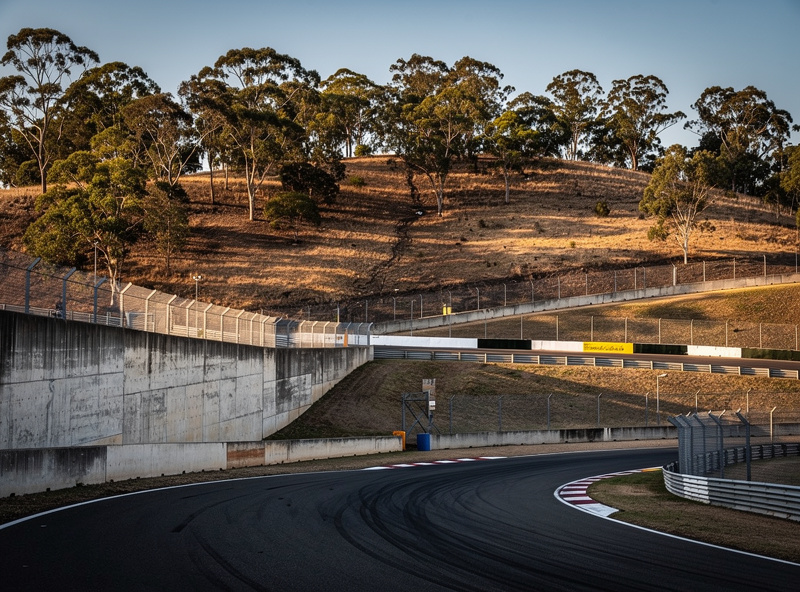
The Nurburgring Nordschleife is its own category. The 20-kilometer circuit has over 170 corners through dense forest, 300 meters of elevation change, and blind sections where you’re driving entirely from memory because you cannot see the next corner until you’re already committed. I treat the Nordschleife as a separate discipline — memorizing it isn’t a weekend project; it’s a multi-week exercise where you learn sections individually (Adenauer Forst, Karussell, Pflanzgarten) before stitching them together. The circuit appears in ACC’s special endurance events, and the drivers who enter those races have typically spent hundreds of hours on this one track alone. If you’re running any competitive sim on a properly tuned setup, the Nordschleife reveals whether your work actually holds across wildly different corner types — the Karussell’s banking alone requires a fundamentally different car attitude than the flat-out Fuchsrohre compression that follows it minutes later.
Full Difficulty Ranking at a Glance
| Difficulty | Track | What You Learn Here | Lap Time |
|---|---|---|---|
| Easy | Barcelona | Every corner type in one circuit | ~1:45 |
| Easy | Monza | High-speed braking consistency | ~1:48 |
| Easy | Hungaroring | Tight-corner rhythm and precision | ~1:44 |
| Medium | Spa-Francorchamps | Setup tuning under aero load | ~2:18 |
| Medium | Silverstone | High-speed direction changes | ~1:59 |
| Medium | Paul Ricard | Switching driving styles mid-lap | ~1:54 |
| Medium | Zandvoort | Commitment on narrow, banked lines | ~1:35 |
| Hard | Suzuka | Endurance through non-stop corners | ~2:00 |
| Expert | Bathurst | Blind-crest precision, wall management | ~2:03 |
| Expert | Nordschleife | Memory, patience, and 170 corners | ~8:15 |
Weather, Temperature, and Night Racing — When Every Track Gets Harder
ACC’s dynamic weather system means a track’s difficulty isn’t fixed — it changes session to session. On my rig, I’ve watched Spa go from a predictable intermediate circuit to a survival exercise when rain rolls in mid-session. Wet conditions reduce mechanical grip enough that the braking points you’ve memorized across 50 dry laps become irrelevant — you brake earlier, softer, and avoid every painted kerb because white lines have the coefficient of friction of ice. The hardest tracks in the wet become genuinely dangerous: Bathurst in rain means the mountain section goes from high-risk to near-impossible without backing the pace off by 4-5 seconds per lap. The Nordschleife in variable conditions is a special kind of misery — the circuit is so long that one section can be bone-dry while another is soaked, and you don’t know which until you arrive.
Track temperature is the less obvious difficulty multiplier. Above 40 degrees Celsius, tire degradation accelerates and the car’s balance shifts through a stint. A setup that felt planted on lap 3 pushes wide on lap 12 because the rears have overheated, and on a track like Suzuka where you’re cornering constantly, the thermal load is relentless. Cold tracks below 20 degrees give you more outright grip but make it harder to bring tires into the operating window — which is why cold-track qualifying laps often feel inconsistent. The fixed-setup servers remove this variable, but on open-setup races, a temperature-aware setup is the difference between fighting the car and driving it.
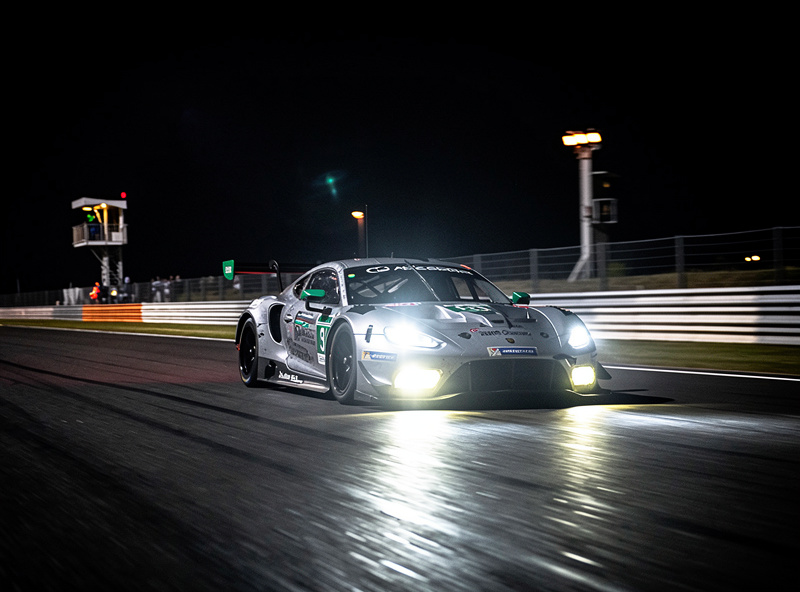
Night racing at circuits like Spa, Paul Ricard, and Barcelona adds a visibility layer that compounds every other difficulty factor. Headlights in ACC illuminate roughly 100-150 meters ahead — at 250 km/h on the Kemmel straight, that’s about 2 seconds of visibility. Your braking references at night have to come from trackside markers and memorized visual cues, not depth perception, because depth disappears in the dark. After spending an evening session running Spa in darkness, I came away convinced that night racing effectively bumps every track up one difficulty tier — a medium circuit demands hard-circuit focus, and a hard circuit becomes genuinely draining to drive cleanly for a full stint.
Frequently Asked Questions
What is the easiest track in ACC?
Circuit de Barcelona-Catalunya is the easiest track in ACC. It has wide run-off areas, forgiving kerbs, and a balanced mix of corner types that teach fundamental driving skills. I start every new driver here because skills learned at Barcelona transfer directly to every other circuit on the calendar.
What is the hardest track in ACC?
Mount Panorama (Bathurst) and the Nurburgring Nordschleife are the hardest tracks. Bathurst has narrow mountain sections with concrete walls and blind crests with zero run-off. The Nordschleife covers 20 km with over 170 corners that must be driven from memory. Both demand hundreds of hours for consistent laps.
How many tracks are in ACC?
ACC’s base game includes 11 circuits from the GT World Challenge calendar. DLC packs add the rest — the Intercontinental GT Pack (Suzuka, Kyalami, Bathurst, Laguna Seca), the British GT Pack (Oulton Park, Snetterton, Donington Park), and the American Track Pack (Indianapolis) among others — bringing the full roster to 25 circuits.
Which ACC track is best for learning car setup?
Spa-Francorchamps is the best circuit for learning setup tuning because Eau Rouge and Pouhon expose aero-balance issues that easier circuits hide. The long lap time also gives you more data per lap to evaluate setup changes against your telemetry traces.
Do ACC tracks have different grip levels?
Yes. Each track surface has unique grip characteristics that change with temperature, rubber buildup, and weather. The racing line gains grip over a session as rubber deposits, while offline areas stay slippery — this gradient is especially sharp at circuits with high tire-wear rates.
Does track difficulty change in wet conditions?
Yes. Every circuit becomes significantly harder in the wet. Grip drops enough that dry braking points are irrelevant, and painted kerbs become extremely slippery. Bathurst in the wet is near-impossible without backing off by several seconds per lap, and the Nordschleife in variable conditions means one section can be dry while another is soaked.
Further Reading
- Assetto Corsa Competizione: The Complete GT3 Guide — full platform overview
- Best Cars in ACC for Beginners — which GT3 and GT4 cars suit each circuit
- ACC Setup Guide: Cars, Tracks, and Tuning — suspension and aero tuning per track
- ACC LFM Guide: Competitive Racing on Low Fuel Motorsport — which tracks appear in LFM seasons
- Sim Racing FOV Calculator Guide — correct view settings for track learning