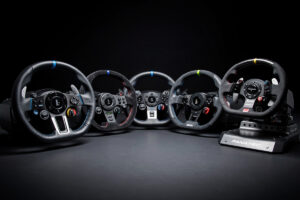
For most home racers the Moza R9 is the smarter buy: at 9 Nm it already delivers more wheel weight than you’ll use day to day, and the R12’s extra 3 Nm mostly buys headroom you’ll dial back down. Choose the R12 only if you run heavy GT3 and prototype cars, want detail at the very top of the force range, and already have a rig stiff enough to deserve it.
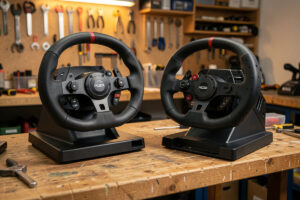
I’ve run both of these bases on the same welded rig with the same load-cell pedals and the same two rims, swapping nothing but the base itself and re-tuning each one honestly off a telemetry overlay. That’s the only fair way to answer this, because on paper it’s just 9 versus 12 and the real difference is more subtle than the number suggests. Here’s how the two actually compare once they’re under your hands.
The core difference: 9 Nm vs 12 Nm in practice
The headline gap is 3 Nm, and in isolation that sounds like a third more wheel. In practice it doesn’t feel like a third more, because I don’t run either base at its ceiling. On my rig the R9 lives around 6–7 Nm of actual peak force in most cars; the R12 around 7–8 Nm. The extra ceiling on the R12 matters when a heavy car loads the front under trail braking and the R9 starts to compress the top of its range — the R12 keeps a little more separation between “loaded” and “fully loaded.”
For formula cars, drift, and lighter GT4 machinery, I genuinely could not pick the two blind. The R9 has every bit of detail I need and the lighter wheel suits quick direction changes. The R12 earns its keep specifically in heavy cars where you want the steering to physically resist you mid-corner. If you mostly race open-wheel or road cars, that resistance is a cost, not a benefit — it’s just more arm fatigue over a long stint.
Torque you’ll actually use vs torque on the box
The mistake I see constantly is people buying the bigger number and then running it at 40% strength because full force is exhausting and clips on every curb. If you’re going to cap the R12 at the same output the R9 produces flat-out, you bought 3 Nm you will literally never feel. I’d rather see that money go to a better brake pedal or a stiffer rig, both of which change lap time more than the top 3 Nm of a base you won’t use.
Where the R12’s headroom is real: it lets you run a slightly lower gain with the same peak force, which keeps the mid-range more linear and the curbs less likely to clip. That’s a tuning nicety experienced racers will appreciate and beginners won’t notice. On my overlay the R12 at moderate gain shows a touch more usable resolution before the trace flat-tops. It’s a refinement, not a revolution.
Rig rigidity decides whether the R12 makes sense
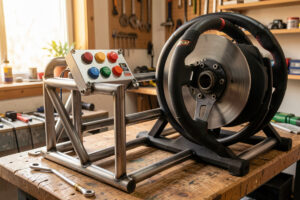
Here’s the part the spec comparisons skip: a 12 Nm base is only worth it on a frame that can hold it. Bolt an R12 to a wheel stand or a flexing desk clamp and the extra torque just twists the frame instead of your hands — you feel mush, not detail. The R9’s lower peak is actually more forgiving of a so-so mounting. I built my cockpit from welded steel tube specifically so a high-torque base has something rigid to push against; on anything less, the R12 advantage evaporates.
So the honest decision tree runs through your rig first. If you’re on a solid 80/20 aluminium-profile or welded frame, the R12 can express its headroom. If you’re on a folding stand or a desk mount, buy the R9, save the difference, and put it toward a rigidity upgrade — you’ll feel that far more than the extra 3 Nm. The base should never be the stiffest thing in the chain.
Specs and verdict at a glance
| Spec | Moza R9 | Moza R12 |
|---|---|---|
| Peak torque | 9 Nm | 12 Nm |
| Tier | Mid-torque | High-torque |
| Best cars | All-round: formula, GT4, road | Heavy GT3, prototypes |
| Rig demand | Tolerant of mid-stiffness frames | Needs a genuinely rigid rig |
| Who it’s for | 90% of home racers | Heavy-car specialists with a stiff rig |
| Ecosystem | Shared Moza rims, pedals, dash | Identical ecosystem to R9 |
Both bases share the exact same Moza ecosystem — rims, pedals, button boxes, and the Pit House software all carry across — so this is purely a torque-and-rig decision, not an ecosystem one. That’s a relief, because it means you can’t pick “wrong” on accessories. You’re only choosing how much ceiling you want and whether your frame can use it.
Software, FFB feel, and tuning
Both run through Moza Pit House, which is the easiest tuning software of the major brands to get a clean profile from. The FFB character is identical in flavour — Moza’s signature is slightly crisp and detailed rather than smooth — and I build the same kind of per-title profiles on both. In iRacing I set min force and keep gain low enough that curbs don’t clip; in ACC I let the processed FFB do more of the work. Neither base changes that workflow.
The one tuning difference worth naming: with the R12 I can chase a more linear force curve because I have ceiling to spare, so I rarely push gain into clipping. With the R9 I’m a little more careful at high-grip tracks because the top of the range is closer. It’s the difference between comfortable margin and adequate margin — not between good and bad. If you want the full method, my force-feedback tuning guide walks through reading clipping off the overlay.
My recommendation
Buy the R9. For nine out of ten home racers it’s the right base — enough torque, lighter on the arms over a long stint, more forgiving of your rig, and it leaves money for the upgrades that matter more. Step up to the R12 only if you specifically race heavy GT3 and prototypes, you already have a rig stiff enough to anchor it, and you value the extra tuning headroom enough to pay for ceiling you’ll mostly leave unused. Both are excellent; the R9 is simply the one most people should actually own.
As an Amazon Associate I earn from qualifying purchases. You can compare current pricing on Moza direct-drive bases if you want to check where each tier sits today.
Keep Building
- Best Direct-Drive Wheelbase Brands: Moza vs Fanatec vs Simagic
- How Much Wheelbase Torque Do You Actually Need in Nm?
- Is a High-Torque Direct-Drive Base Worth It Over Mid-Torque?
- Sim Racing Force Feedback Tuning: The Complete Guide
- Best Sim Racing Pedals 2026: Load Cell, Hydraulic, and Budget
Frequently Asked Questions
Is the Moza R12 worth it over the R9?
Only if you race heavy GT3 and prototype cars on a genuinely rigid rig. The R12’s extra 3 Nm is headroom most home racers dial back down. For formula, GT4, and road cars, the R9 delivers all the detail you need and is lighter on the arms.
Do the Moza R9 and R12 share the same rims and pedals?
Yes. Both bases use the identical Moza ecosystem, so rims, pedals, button boxes, dashes, and Pit House software all carry across between them. The choice between R9 and R12 is purely about torque and rig stiffness, not accessories.
Will the R12 feel stronger than the R9?
At full output, yes, but most people run both bases well below their ceiling. If you cap the R12 to the same force the R9 produces, you will never feel the extra 3 Nm. The R12’s real benefit is tuning headroom, not raw strength you actually use.
Does the R12 need a stronger rig than the R9?
Yes. A 12 Nm base twists a flexing frame instead of your hands, which feels vague. The R12 only expresses its advantage on a stiff aluminium-profile or welded rig. On a folding stand or desk clamp, the R9 is the better and more forgiving choice.
Which Moza base is best for beginners?
The R9. It offers plenty of torque, tolerates a mid-stiffness rig, and leaves budget for a load-cell brake, which improves lap times more than extra Nm. Beginners rarely benefit from the R12’s headroom and often find high torque tiring at first.
Can I upgrade from an R9 to an R12 later?
Easily, because they share the entire Moza ecosystem. Your rims, pedals, and software move straight across, so you only replace the base unit. That makes starting on the R9 a low-risk choice if you are unsure whether you need high torque yet.