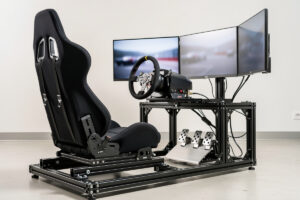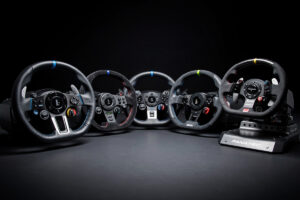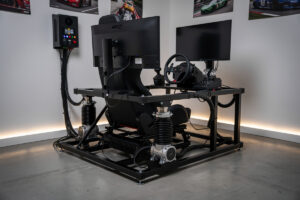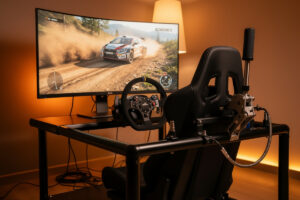
A sim racing shifter and handbrake add realism and car control that paddle shifters alone cannot provide. Sequential shifters simulate rally and touring car gear changes with a tactile up-down lever, while H-pattern shifters replicate the gated manual transmission found in classic and modern sports cars. Handbrakes are essential for rally and drifting, allowing you to initiate slides and manage rotation through tight corners. Adding a shifter to your sim racing setup transforms the experience from pressing buttons to physically driving the car.
Most sim racers start with paddle shifters on their steering wheel, which work fine for GT and formula cars. But if you drive rally, drifting, classic touring cars, or street cars in simulators like Assetto Corsa, a dedicated shifter makes the experience dramatically more immersive. A handbrake is non-negotiable for rally and drifting — trying to map the handbrake to a button on your wheel is a compromise that costs both immersion and control precision.
Why Paddles Aren’t Enough for Manual Cars
On my rig, I run paddle shifters for iRacing GT3 and ACC — they are the correct input because those cars use sequential boxes in real life. But the moment I load up a classic Formula car or a street car in Assetto Corsa, reaching for paddle shifters breaks the illusion completely. Your hands expect a lever, your muscle memory wants a gate, and your brain processes the paddle click as video-game input rather than driving. The disconnect is noticeable enough that I started avoiding manual-transmission cars entirely until the shifter was mounted. For how the wheel and ecosystem shape the whole setup before you even add a shifter, start with the Sim Racing Wheels Guide.
There is a subtler reason a shifter matters that most gear reviews miss: load. When you muscle a sequential lever hard in a rally stage, or nail a heel-toe downshift into Turn 1 while threshold-braking, the shifter takes real physical abuse. A flimsy desk-clamped unit flexes and eventually fails. The rigidity of the mount and the mechanism’s durability become the bottleneck, not shifting speed. That is why I bolt everything to the rig frame — nothing clamped, nothing wobbly. In iRacing, I can watch my input traces on telemetry and see a sloppy mount producing inconsistent shifts that cost tenths in lap time.
Sequential vs H-Pattern Shifters
Sequential shifters use a single lever that pushes forward for upshift and pulls back for downshift. They are the standard in rally cars, touring cars, and many modern racing disciplines. H-pattern shifters have a gated pattern that mimics a traditional manual transmission, requiring you to move the lever to specific positions for each gear. Both add immersion but serve different types of racing — and which one you need depends entirely on what you drive.
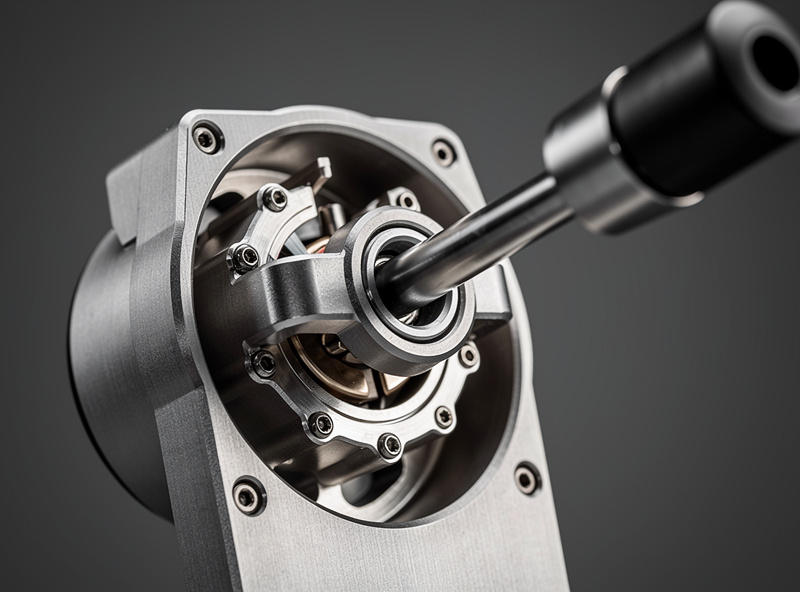
Sequential shifters are the most versatile add-on because they work across rally, GT, touring car, and endurance racing. The best sequential shifters use a magnetic mechanism that provides a crisp, tactile click on each shift — the unit I keep bolted to my rig uses magnets, and the difference from a spring-loaded lever is night and day. The Thrustmaster TH8A in sequential mode, the Fanatec ClubSport Shifter SQ, and the Aiologs Sequential Shifter are the three I have run across rig builds. The Fanatec ClubSport SQ is unique because it switches between sequential and H-pattern modes with a physical toggle, giving you both functions in one unit — the toggle lives permanently in sequential on my rig, because when I want H-pattern I want a dedicated H-pattern gate feel. Fanatec lists the SQ at $299.99 direct from Fanatec, not the bargain the spec sheets sometimes imply — budget accordingly if the dual-mode toggle is the feature you actually want.
H-pattern shifters are essential for racing classic cars in Assetto Corsa, beamNG.drive, and any sim that features manual transmissions. The best H-pattern shifters have a mechanical gate that physically restricts movement to the correct gear pattern, preventing accidental shifts from third to fifth or missing gears entirely. The Thrustmaster TH8A, Fanatec ClubSport SQ, and Frex H pattern are the most common options. Budget alternatives like the SHH Newt shifter offer 7-speed H-pattern with decent quality around $100 — the mechanism is simpler but functional if you are on a tight budget. For the broader ecosystem picture including pedal and wheel compatibility, see our full first sim racing setup guide.
Handbrakes for Rally and Drifting
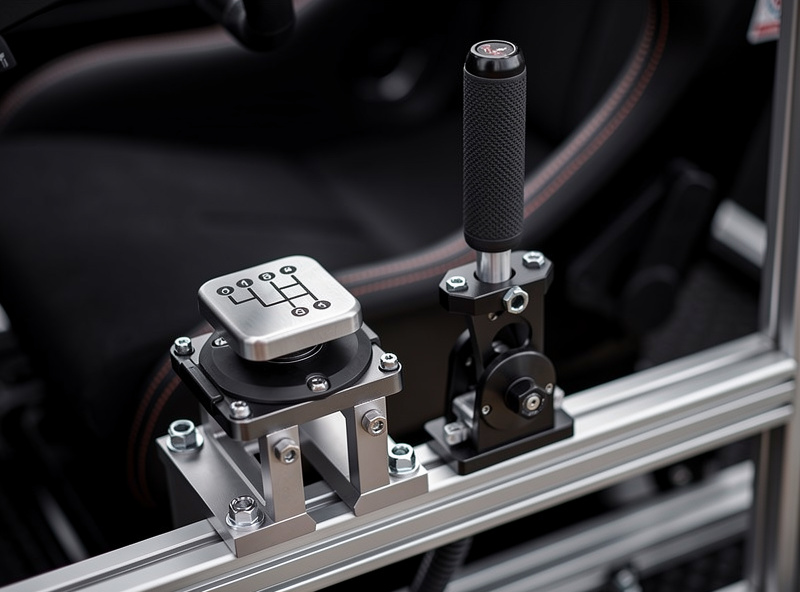
A sim racing handbrake is a lever that applies rear brake pressure to lock the rear wheels, initiating a slide for drifting or managing rotation in rally corners. Without a handbrake, you must use a button or analog stick to simulate the handbrake, which lacks the physical resistance and travel needed for precise modulation. A real handbrake lever lets you feather the brake input — applying just enough force to break traction without fully locking the rear wheels. On my rig, the handbrake is the accessory I use less often than the shifter but miss much more when it is not there.
Hydraulic handbrakes use a real brake master cylinder and fluid for the most realistic feel. The Simagic TB-1 (around $189 direct from Simagic) and Heusinkveld Handbrake are the top hydraulic options. Load cell handbrakes measure lever pressure without fluid and offer similar precision at lower cost — the same load-cell principle that makes a brake pedal consistent applies to the handbrake. The Fanatec ClubSport Handbrake V1.5 (around $130 new) and Moza HBP (around $99) are the budget-friendly load cell options. The Aiologs handbrake is a nicer-finish analog unit, but it now sits in the same $180-200 range as Aiologs’ sequential shifter — no longer the budget pick it once was, so weigh it against the Moza HBP if cost matters more than fit and finish.
Mounting position matters for handbrake usability. In a real rally car, the handbrake sits to the right of the shifter or on the center console. Your sim handbrake should be positioned so your right hand can reach it without looking or moving your arm from the shifter position. Most cockpit manufacturers sell side-mounted handbrake brackets that position the lever at the correct angle and height relative to your seat. I run the handbrake on a 3D-printed bracket I designed myself — it bolts to the 80/20 profile and sits exactly where my hand falls when I release the shifter. See our DIY Sim Racing Upgrades guide for building your own brackets and mounts.
Best Shifters and Handbrakes Compared
| Product | Type | Price | Mechanism | PC | Console |
|---|---|---|---|---|---|
| SHH Newt Shifter | H/Sequential | $100 | Mechanical gate | Yes | No |
| Thrustmaster TH8A | H/Sequential | $200 | Magnetic | Yes | PS |
| Fanatec ClubSport SQ | H/Sequential | $300 | Magnetic | Yes | Xbox |
| Aiologs Sequential | Sequential | $180-200 | Magnetic | Yes | No |
| Fanatec Handbrake V1.5 | Handbrake | $130 | Analog | Yes | Xbox |
| Moza HBP Handbrake | Handbrake | $99 | Load Cell | Yes | No |
| Simagic TB-1 | Handbrake | $189 | Hydraulic | Yes | No |
| Aiologs Handbrake | Handbrake | $180-200 | Analog | Yes | No |
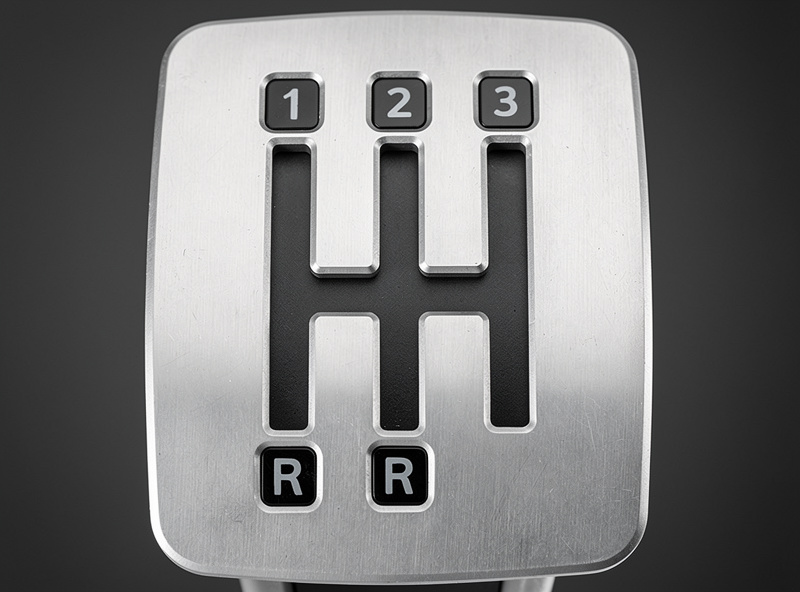
For most sim racers, the Fanatec ClubSport Shifter SQ is the best single purchase because it handles both H-pattern and sequential shifting in one unit at around $300. If you want dual-mode capability without paying Fanatec’s premium, the SHH Newt at around $100 is the better-value budget pick — Aiologs’ own sequential shifter has crept up into the same $180-200 bracket as the Fanatec unit, so it no longer wins on price, only on its magnetic-click feel for dedicated sequential-only builds. For handbrakes, the Moza HBP at around $99 provides load cell precision at the most budget-friendly price in the category.
Shifter and Handbrake Mounting
Proper mounting ensures your shifter and handbrake stay in position during aggressive driving. Desk-clamped shifters tend to wobble under hard shifting, which breaks immersion and can damage the mechanism over time. A cockpit-mounted solution bolts the shifter directly to your rig’s frame, providing zero flex regardless of how hard you pull the lever. I have tested both desk-clamp and frame-mount configurations — a wobbly shifter is worse than no shifter because it trains your arms to compensate for movement that should not exist.
Most 80/20 aluminum profile cockpits include shifter mounts or have bolt-on accessories available. Side-mounted shifter brackets position the lever at the correct height relative to your seat, typically at elbow height when your arm is at rest. If you run both a shifter and handbrake, position the shifter on the right side of the seat and the handbrake slightly forward and to the left of the shifter, mimicking the real rally car layout. The welded steel rig I built includes shifter and handbrake mounting plates — absolutely zero flex, and I can swap positions in minutes with a few bolts. For cockpit options and more mounting solutions, see our Sim Racing Cockpit and Stand Guide.
Wiring, USB Ports, and Mapping Them In-Sim
Nobody warns you about this part until you have four accessories fighting for three USB ports. A wheelbase, a shifter, a handbrake, and a button box each want their own USB connection, and running them all off a cheap unpowered hub is how you get intermittent shift misses that look like a hardware fault but are actually a power-starved hub dropping a device mid-session. On my rig, everything runs through a single powered USB hub mounted to the frame, cables zip-tied along the same 80/20 extrusion that carries the shifter and handbrake brackets — no cables draped across the desk to snag an elbow mid-shift.
Most of these units are plug-and-play with no drivers required — the SHH Newt and Aiologs shifters show up as a generic USB game controller and map directly inside the sim’s control settings. Fanatec gear is the exception: the ClubSport SQ and Handbrake V1.5 route through Fanatec’s own driver panel, which is where you also set button assignments if you are not using their wheelbase’s onboard profile. Either way, map the shifter and handbrake in-game first, then confirm the mapping is actually registering cleanly — I run my input traces through my telemetry overlay for a session after any new accessory goes in, watching for double-triggers or missed gear registrations before I trust it in a race. A shifter that occasionally skips a gear under load is worse than no shifter, because you will not know it happened until you are already in the wall.
When to Add a Shifter to Your Setup
Add a shifter when you find yourself avoiding manual transmission cars because paddle shifting feels wrong. If your primary sim racing is GT3 or formula cars in iRacing or ACC, paddle shifters are actually the correct input — these cars use sequential or semi-automatic gearboxes in real life. But if you drive rally in Richard Burns Rally, classic cars in Assetto Corsa, or street cars in beamNG, a dedicated shifter transforms the experience.
Add a handbrake when you start rally or drifting. These disciplines require handbrake inputs that are too nuanced for a button — you need to modulate the handbrake force through a physical lever. A handbrake is also useful in circuit racing for managing weight transfer in tight hairpins, though this is an advanced technique. The shifter and handbrake sit further down the upgrade priority list than the cockpit and load cell pedals — the rig needs to be rigid and the braking consistent before accessories earn their place. For the full build sequence including budget planning, see our First Sim Racing Setup guide.
Do I need a shifter for sim racing?
You need a shifter if you drive rally, drifting, classic cars, or any vehicle with a manual transmission. For GT3 and formula racing, paddle shifters on the wheel are the correct input and a separate shifter is unnecessary.
What is the best sim racing shifter in 2026?
The Fanatec ClubSport Shifter SQ is the best overall sim racing shifter in 2026 because it switches between H-pattern and sequential modes for around $300. The SHH Newt at around $100 is the best budget dual-mode option. The Aiologs Sequential now runs $180-200, so it is a premium dedicated-sequential pick rather than a budget one.
Is a handbrake worth it for sim racing?
A handbrake is essential for rally and drifting, where it is used on nearly every corner. For circuit racing, a handbrake is a niche tool used mainly in tight hairpins. If you primarily race GT or formula cars, skip the handbrake and invest in load cell pedals instead.
Can I use a shifter and handbrake on console?
Fanatec shifters and handbrakes work on Xbox through any Fanatec wheelbase. Thrustmaster TH8A works on PlayStation. Most other brands including SHH, Aiologs, Moza, and Simagic are PC-only. Always verify console compatibility before purchasing.
Where should I mount my shifter and handbrake?
Mount the shifter at elbow height on the right side of your seat. Mount the handbrake slightly forward and to the left of the shifter, mimicking a real rally car layout. Both should be bolted to your cockpit frame rather than desk-clamped to prevent wobble during aggressive use.
What is the cheapest way to add a shifter?
The SHH Newt shifter at around $100 offers both H-pattern and sequential modes with a mechanical gate for the lowest price in the market. It connects via USB and works on PC with any wheelbase. For console users, the Thrustmaster TH8A at around $200 is the cheapest compatible option.
Keep Building
- Best Sim Racing Wheels 2026: Buyer’s Guide and Top Picks
- Best Sim Racing Pedals 2026: Load Cell, Hydraulic, and Budget
- What Is Sim Racing? A Complete Introduction to the Hobby
- DIY Sim Racing Upgrades — Button Boxes, Wind Simulation, and Bass Shakers
- How to Plan Your First Sim Racing Setup — A Budget and Space Framework