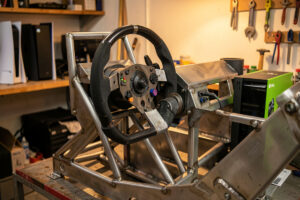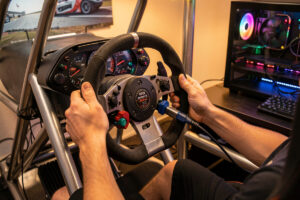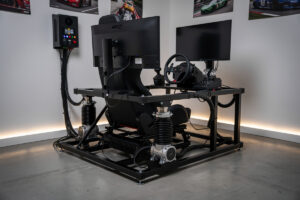
A 2-DOF motion platform running two 750-watt AC servo motors draws 1,500 watts continuously at full rated load and can surge to 4,500 watts during a rapid heave-and-roll transition — AC servo motors are commonly rated for 2-3x their continuous torque for a few hundred milliseconds, and 3x is the number to size an inverter against. A 4-DOF platform doubles the servo count and both numbers with it — 2-DOF and 4-DOF platforms serve different use cases, but both demand the same power discipline. The inverter that powers the rig must handle the surge without tripping its protection circuit, sustain the continuous draw without overheating, and deliver a pure sine wave that the servo drives can actually read. Most sim racers size the inverter to the nameplate wattage and discover the hard way that a 2,000-watt inverter stalls when both actuators fire at once. Motion-platform power is an inverter-sizing problem, not a plug-it-in problem, and getting it wrong costs more than the inverter — it costs the race.
Sim-racing motion platforms are the highest-power consumer devices in a home workshop after the welder and the sauna. In gentle driving a single 750-watt servo might only be working at 60-70 percent of its rated torque, but sizing for that light-duty number is exactly the mistake that trips inverters — a curb strike, a loss-of-traction correction, or a hard heave-roll combination pushes both servos toward their full rated draw and then toward peak simultaneously, and even budget motion platforms draw within 15 percent of premium units because the power envelope is set by physics, not brand markup. The inverter that powers them must deliver the full rated-load-plus-peak scenario — 1,500 watts continuous surging to 4,500 watts on a 2-DOF rig, as above — plus the PC, the monitors, and the wheel base. Surge capacity is the spec that matters, not the continuous rating manufacturers print in the largest font.
Why Motion Platforms Need Pure Sine Wave, Not Modified Sine Wave
Motion-platform builders consistently report the same failure mode: the rig jolts, the servo stutters, and within five minutes the inverter trips. AC servo drives use pulse-width-modulated signals to control motor position, and the PWM timing depends on a clean zero-crossing reference from the AC waveform. A pure sine wave crosses zero exactly twice per cycle at predictable intervals. A modified sine wave — a stepped square wave with flat sections at the top and bottom — crosses zero at intervals that vary with the load, confusing the servo drive’s zero-crossing detection circuit. The servo loses position or faults entirely, and the motion platform bucks the rig in ways that feel nothing like the track. Modified-sine-wave inverters are incompatible with servo-driven motion platforms for the same reason they are incompatible with any precision motor-control application — the timing reference is wrong. For the full picture on how motion platforms stack up, see the sim racing motion and haptics guide, which covers every platform type from bass shakers to 6-DOF actuators.
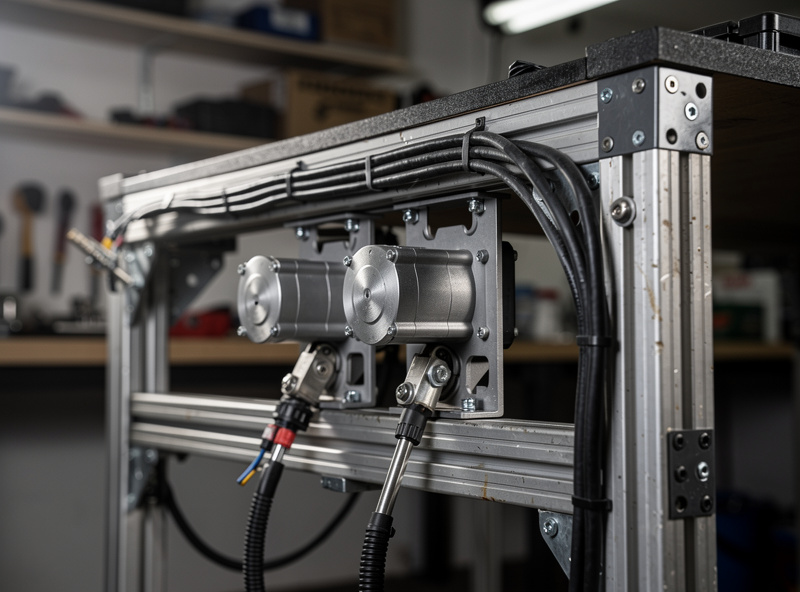
Pure-sine-wave inverters cost roughly 50 percent more than modified-sine-wave units at the same wattage, and every dollar of that premium goes to the waveform quality that the servo drives need to function. A 3,000-watt pure-sine-wave inverter with a 9,000-watt surge rating — the Victron Phoenix or Giandel class — handles a 2-DOF platform with 1,500 watts of continuous servo draw plus roughly 950 watts for the PC, monitors, wheel base, and accessories, for 2,450 watts continuous total, with room for the servo-driven motion spikes that push the system to roughly 5,500 watts. The inverter runs at roughly 82 percent of its continuous rating during steady-state racing and climbs to roughly 61 percent of its surge rating during the hardest motion events — warm on the continuous side, comfortable on the surge side. The full breakdown of inverter selection, including surge-capacity curves and manufacturer trustworthiness at their published ratings, is covered in the hybrid inverter guide, which applies the same sizing logic to loads that draw harder than their nameplates suggest.
Sizing the Inverter: 2-DOF vs 4-DOF Platforms
A 2-DOF platform with two 750-watt servos needs a 3,000-watt continuous inverter with a 9,000-watt surge rating to cover both servos at full draw plus the PC and peripherals. The math: 1,500 watts continuous for both servos (2 x 750W), 800 watts for the PC and monitors, 150 watts for the wheel base and accessories — 2,450 watts continuous. The surge case only applies to the servos — the PC and monitors don’t spike — so peak draw is the servos’ 3x-rated surge (2 x 2,250W = 4,500W) plus the steady 950W of peripherals, for roughly 5,500 watts at the hardest instant of a rapid direction change. The 3,000-watt inverter covers the continuous load at 82 percent of rating — warm but safe — and the 9,000-watt surge rating covers the spikes at just 61 percent of peak capacity, with real headroom to spare.
A 4-DOF platform doubles the servo count: four 750-watt motors pulling 3,000 watts continuous and surging to roughly 9,000 watts at the servos alone, or about 3,950 watts continuous and 9,950 watts peak once the PC, monitors, and wheel base are added on top. The inverter to handle this is a 5,000-watt continuous unit with a 15,000-watt surge rating — a commercial-grade pure-sine-wave inverter that costs $1,200 to $2,000 and, run at its full rated capacity on a 120-volt circuit, draws 42 amps (5,000W ÷ 120V). If the wiring cost pushes a 4-DOF build past the budget, belt-tensioner motion systems deliver haptic feedback without the electrical overhead. The breaker panel in the room where the rig lives must support that load; a standard 15-amp circuit trips at 1,800 watts (15A x 120V), and a 20-amp circuit trips at 2,400 watts (20A x 120V) — both are nowhere close. Sizing a breaker also has to respect the National Electrical Code’s 80-percent continuous-load rule, so a 42-amp draw needs a breaker rated well above 42A ÷ 0.8 = 52.5A — in practice a dedicated 50-amp (bare minimum) to 60-amp 120-volt circuit, or better, ask the electrician about running the inverter on a 240-volt circuit instead, which drops the same 5,000 watts to about 21 amps (5,000W ÷ 240V) and fits comfortably on a 30-amp 240V circuit. Either way, this is a job for an electrician, not a DIY Saturday. The rig that draws more power than the house wiring can deliver does not need a bigger inverter — it needs a bigger (or higher-voltage) circuit, and no amount of inverter math fixes the breaker panel.
Battery Backup: Why Your iRating Needs a UPS
An online race that loses power for half a second during a brownout costs iRating, safety rating, and the goodwill of the 23 other drivers you just collected in Turn 1. A pure-sine-wave UPS rated at 1,500 VA — roughly 900 watts — covers the PC, monitors, and wheel base for 5 to 10 minutes of runtime, enough to finish a lap and safely park the car. It does not cover the motion platform — covering the servos requires a UPS in the 3,000 VA range at $800 to $1,200 — but the servos losing power in a brownout is a soft failure (the rig goes static, the car handles wrong) rather than a hard one (the PC shuts off mid-corner). Protect the compute and the displays first. Protect the motion platform second if the budget allows.
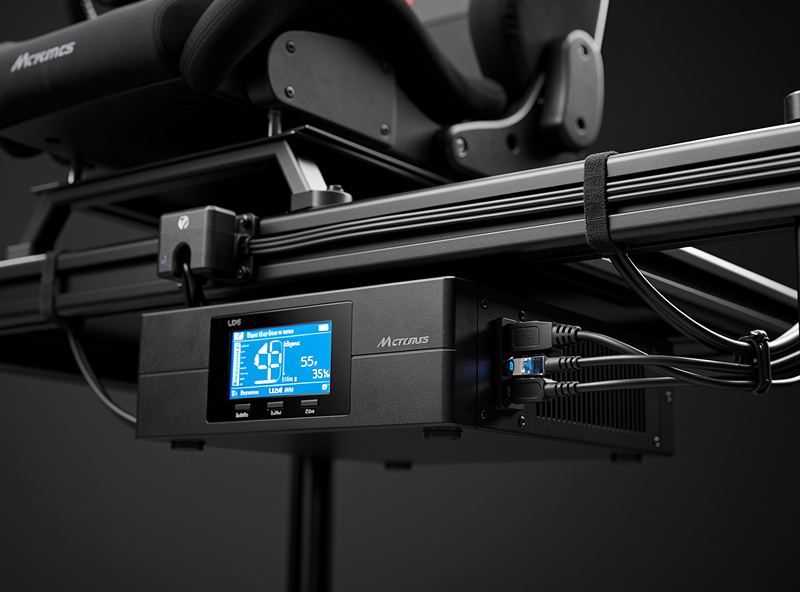
The UPS must be pure sine wave — a standby UPS that switches to a stepped-square-wave inverter during an outage causes the same servo-drive timing errors as a modified-sine-wave inverter and the motion platform faults during the switchover. A line-interactive pure-sine-wave UPS from APC or CyberPower at the 1,500 VA level costs $180 to $250 and covers the non-motion electronics through a typical 30-second brownout. The same sizing logic applies to the PC and displays even without a motion platform — see the triple-monitor PSU and battery backup guide for protecting the compute side. For sim racers who have lost an iRacing special event to a brownout — and anyone who has been in the hobby long enough has a story — the UPS is the cheapest insurance per incident in the entire rig.
Installing the Inverter: Cable Gauge, Ventilation, and Noise
The DC cables from the battery bank to the inverter carry high current — a 3,000-watt load at 12 volts draws 250 amps, which requires 2/0 AWG cable to keep voltage drop below 3 percent across a 2-meter run. A 48-volt battery bank cuts the current to 63 amps for the same 3,000-watt load and allows 4 AWG cable, which is cheaper, easier to route, and generates less heat at the terminals. Builders who skip the full motion platform and go with bass shakers instead of transducers avoid the battery-bank question entirely — shakers run off a standard audio amplifier and a wall outlet. If the battery bank is going to power the motion rig, build it at 48 volts. The higher voltage halves the copper cost and doubles the safety margin on every connection between the battery and the inverter.
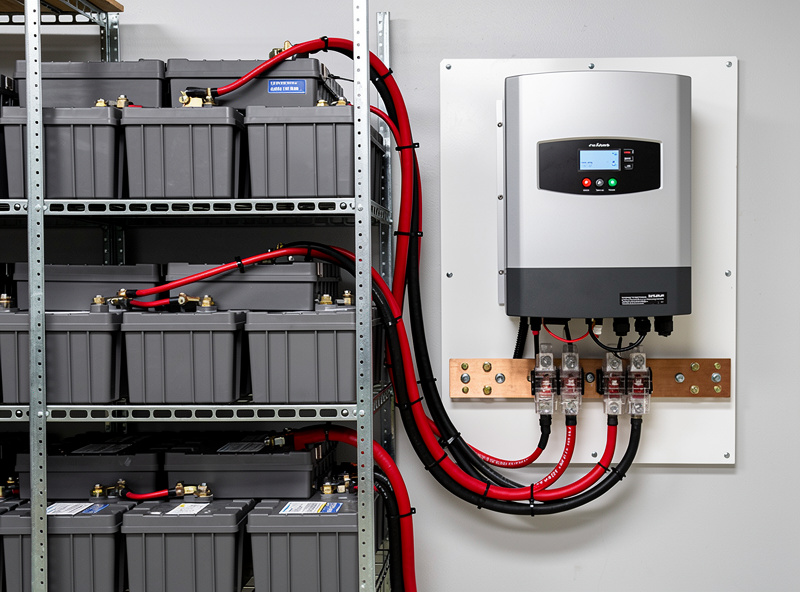
The inverter generates heat — roughly 10 to 15 percent of the load wattage is lost as heat in the inverter’s MOSFETs and transformer. A 3,000-watt load produces 300 to 450 watts of waste heat, which is a space-heater-level output that must be ventilated. Mount the inverter on a wall bracket with 15 centimeters of clearance on all sides, in a room that is not the same room as the rig if possible — inverter cooling fans run at 45 to 55 decibels under load, which is audible through open-back headphones during quiet sections of a race. A remote start-stop switch wired to the inverter’s control terminals lets you power the motion platform on and off from the rig without walking to the inverter room. Motion-rig owners who have solved this well tend to land on the same layout: inverter and battery bank in a small vented closet one wall away from the cockpit, with just the remote switch and a status LED mounted within reach of the seat — the fan noise is real, but it stops being a distraction the moment it is not sitting directly behind your head during a quiet formation lap.
Frequently Asked Questions
What size inverter do I need for a 2-DOF motion platform?
A 3,000-watt continuous pure-sine-wave inverter with a 9,000-watt surge rating covers two 750W servo motors, the PC, monitors, and wheel base. The servos draw 1,500W continuous and surge to 4,500W during rapid direction changes. Modified sine wave inverters are incompatible with servo drives.
Will a standard wall outlet power a motion platform?
A 2-DOF platform on a 3,000W inverter draws roughly 25 amps at 120V and requires a dedicated 30-amp circuit. A standard 15-amp outlet trips at 1,800W. A 4-DOF platform needs a 50-amp circuit. Have an electrician pull the dedicated circuit before installing the inverter.
Do I need a battery bank to run a motion platform?
No, if you are on grid power. The inverter runs directly from mains AC through a rectifier stage and converts to the DC bus voltage the servo drives use. A battery bank is only necessary if you want off-grid operation or brownout protection for the motion platform itself.
Can I power my whole sim rig from one inverter?
Yes, if the inverter’s continuous rating covers the combined load of the motion platform, PC, monitors, and wheel base. A 2-DOF rig with peripherals needs roughly 2,450W continuous and a 3,000W inverter. Do not plug the PC into a modified-sine-wave inverter — the power supply may fail to regulate on a stepped waveform.
Why does my motion platform stutter when both actuators move at once?
The inverter is undersized for the surge load. Two servos accelerating simultaneously can draw 3 times their running current for 200 to 500 milliseconds, and an inverter that cannot deliver that surge in that time window clips the voltage, causing the servo drives to lose position. Upgrade to an inverter with a surge rating at least 3 times the continuous servo draw.
How loud is the inverter under load?
A 3,000W inverter under 80 percent load produces 45 to 55 decibels of fan noise — roughly the volume of a quiet conversation. Mount the inverter in an adjacent room or closet with ventilation if the noise is distracting during racing. A remote start-stop switch lets you power the inverter on and off from the rig.
Further Reading
- Sim Racing Motion and Haptics: The Complete Guide
- 2DOF vs 6DOF Sim Racing Motion: Which Platform?
- Budget Sim Racing Motion: The Cheapest Path That Works
- Belt Tensioner Sim Racing: Motion Without a Platform
- DOF Reality vs Next Level Racing Motion Platforms