iRacing is a subscription-based multi-discipline simulator with the largest online competition ecosystem, while Assetto Corsa Competizione is a one-time purchase focused exclusively on GT3 and GT4 racing with superior graphics and physics. iRacing costs $110 per year on the discounted annual plan (or $13/month if you pay month to month) plus paid content, while ACC costs $40 once with most content included. I run both as my daily sims on the direct-drive rig I welded, and they serve fundamentally different purposes — the answer depends on whether you value competitive matchmaking or driving realism more.
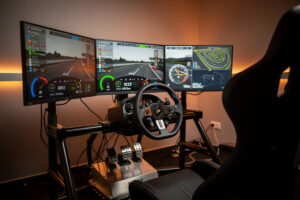
These two simulators dominate competitive sim racing but the split in my own seat time tells the story. On weeknights when I want a structured race against matched opponents, I open iRacing. On weekends when I want the richest GT3 feedback through my base and pedals, ACC loads. Understanding the strengths each platform brings prevents investing hundreds of hours and dollars into the wrong tool for your goals. Every section below comes off the rig I built and the bases I’ve bolted on — not from spec sheets or launch trailers.
Pricing and Business Model
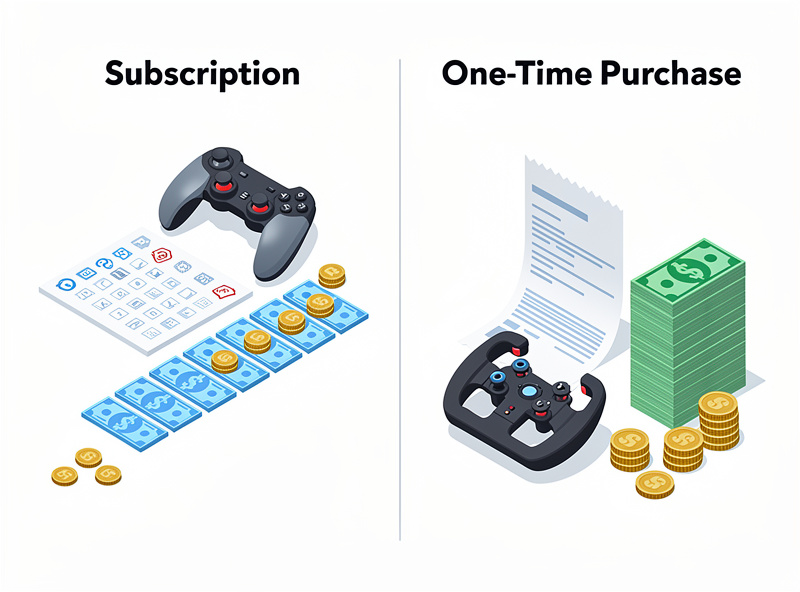
iRacing operates on a subscription model. Prepaying for a full year costs $110 (about $9.17/month effective), while paying month-to-month costs $13/month — which adds up to $156/year if you never switch to the annual plan. The subscription includes 32 cars and 29 tracks, but accessing the most popular series requires purchasing additional content. Individual cars cost $11.95, and tracks cost $11.95 or $14.95 each. Most active iRacing members spend $300 to $500 per year on the platform when combining subscription fees with content purchases. My own annual iRacing spend lands at roughly $350 — subscription plus four new tracks and one car per season — and that covers competitive racing in three series.
ACC is a one-time purchase of approximately $40 on Steam, with DLC packs available for additional car packs and the 2023 GT World Challenge season. The total cost to own all ACC content is under $100, and the base game alone includes enough cars and tracks to race competitively for years. There is no subscription fee, no ongoing content purchases required to race every series, and no pay-to-progress system. For a detailed breakdown of what iRacing actually costs across a full year, see the iRacing cost breakdown.
The cost difference is significant. A three-year iRacing membership with moderate content purchases costs $900 to $1,500. Three years of ACC costs $40 to $100 total. However, iRacing members argue that the competitive structure and content depth justify the premium, while ACC fans point out that the driving physics are comparable or superior at a fraction of the cost. On my own rig, I consider ACC the best value in sim racing — the physics fidelity you get for a one-time $40 is unmatched — but iRacing is the only platform where I can race a full oval series on Tuesday and an open-wheel road race on Thursday against people who actually care about their safety rating.
Physics and Driving Feel
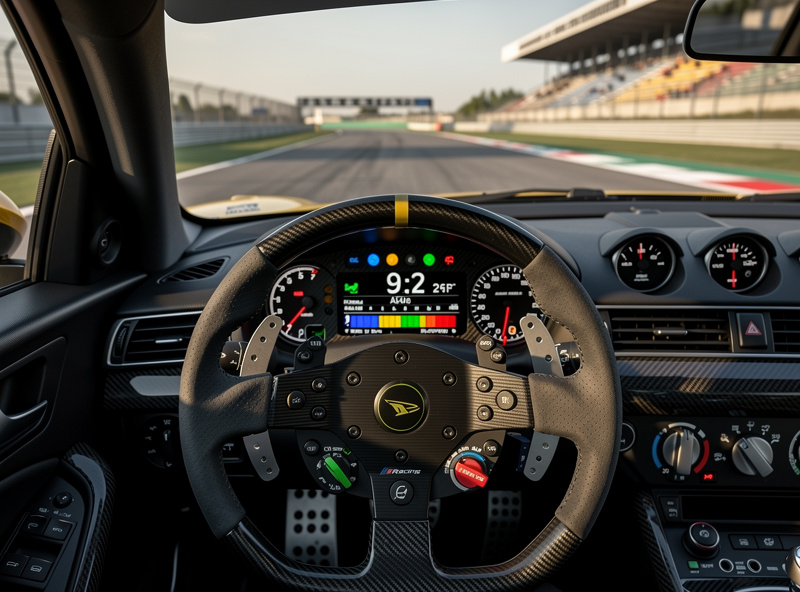
ACC is widely regarded as having more realistic tire physics and car behavior, particularly in GT3 vehicles. The Kunos tire model simulates thermal buildup, rubber degradation, and surface contamination with a granularity that iRacing’s older tire model does not fully match. ACC also features more realistic ABS and traction control behavior, aerodynamic wake effects, and brake temperature modeling that affect car handling in ways that feel closer to real-world GT3 feedback. On my load-cell pedal set, the difference in ABS feedback between the two sims is stark — ACC communicates exactly when the system engages through the pedal, while iRacing’s ABS feel is more muted and on-off.
iRacing’s physics have improved significantly with its recent tire model updates, but the platform prioritizes consistent and predictable handling across its wide range of vehicles over maximum realism in any single class. iRacing’s force feedback feels communicative and detailed, giving drivers clear information about grip levels and car behavior through the steering wheel. The platform also handles multi-class racing physics better than ACC because it was designed from the ground up for mixed-class competition.
What matters more than lab-level physics comparisons is how each sim feels through your hands and feet on the hardware you actually own. Across the direct-drive bases I’ve run — a mid-torque daily and higher-torque units I’ve tested at length — ACC’s force feedback delivers finer road texture and more progressive grip-dropoff in GT3 cars. iRacing’s FFB is cleaner and more immediate on weight transfer cues, which is why I prefer it for formula cars and prototypes where feeling the rear step out early matters more than surface grain. Neither sim clips on a properly configured base if you set headroom correctly, but ACC runs closer to the ceiling on mid-torque bases because its FFB signal carries more high-frequency content that eats dynamic range. If you are dialing in your own FFB profiles, the FFB tuning guide covers per-title settings that eliminate clipping across both sims.
Both simulators use laser-scanned tracks that reproduce real-world surfaces with millimeter accuracy. ACC’s track surface evolution over a session — as rubber gets laid down and track temperature changes — affects grip levels in ways that closely mirror real-world conditions. iRacing tracks are equally detailed but the grip evolution model is less pronounced. On a stiff rig like the welded steel cockpit I built, ACC’s surface detail transmits through the chassis in a way that makes iRacing feel slightly numb by comparison — but that same stiffness is wasted if your cockpit has frame flex.
Online Competition and Matchmaking
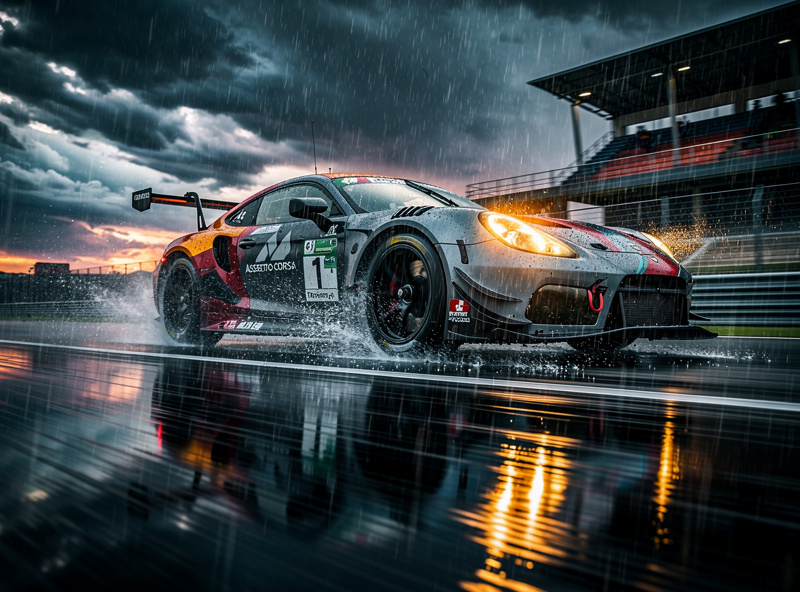
iRacing’s competitive structure is its defining advantage. The platform runs official series on 12-week seasons with structured license progression, iRating-based matchmaking, and Safety Rating enforcement. At any hour of the day, multiple official series are running with full fields of similarly skilled drivers. The system automatically splits large registrations into skill-grouped servers, ensuring that every race features competitive and fair competition. I have been on the grid for a GT3 fixed race at 2 AM on a Tuesday with a 20-car split full of drivers within 200 iRating of each other — no other platform can deliver that.
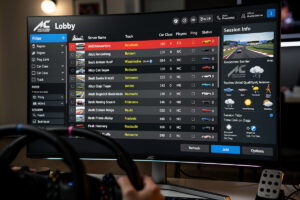
ACC relies on third-party platforms for structured competition. Low Fuel Motorsport (LFM) provides an iRacing-like experience with ELO ratings, safety ratings, and organized seasons, but it requires a separate registration and operates on a volunteer basis. The official ACC public servers offer unranked racing with no skill matching, which often produces chaotic first-lap incidents and inconsistent competition quality.
The difference in competitive accessibility is stark. In iRacing, you click “Register” and race against matched opponents in a structured series. In ACC, you either join chaotic public servers or invest time in setting up and maintaining a LFM profile. For drivers who want structured competition without extra setup steps, iRacing is the clear winner. For drivers who prefer a more relaxed or community-driven approach and are willing to configure LFM, ACC’s flexibility is an advantage — the ACC LFM guide walks through the full setup if that sounds like your path.
Content and Car Selection
iRacing offers the widest variety of any sim racing platform. The service includes GT3, GT4, formula cars from F4 to F1-style, NASCAR, rallycross, dirt oval, sports prototypes, and historic vehicles. The content library exceeds 100 cars and 100 tracks (with many more individual layouts and configurations) across four racing disciplines. If you want to race anything from a Mazda MX-5 to a NASCAR Cup car to a Formula 1 car, iRacing is the only platform that offers all of these in a single ecosystem. The full sim racing game comparison puts this breadth in context against every other title on the market.
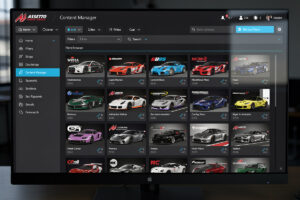
ACC focuses exclusively on GT3 and GT4 cars from the real-world GT World Challenge series. The car roster includes entries from Ferrari, Lamborghini, Porsche, Mercedes, BMW, Audi, McLaren, Aston Martin, and Honda among others. Each car is meticulously modeled with accurate physics, sounds, and visual details. The focused approach means every car in ACC receives more development attention than any single car in iRacing’s larger roster.
Track selection favors iRacing for variety and ACC for GT-specific depth. iRacing covers circuits from every major racing series worldwide, while ACC focuses on the GT World Challenge calendar including Spa, Monza, Nurburgring, Suzuka, Bathurst, and Watkins Glen. ACC’s track list is smaller but every circuit is essential for GT3 competition. For a practical breakdown of which iRacing tracks to buy first and how to maximize your content budget, read the iRacing track buying guide.
Side-by-Side Comparison
| Feature | iRacing | Assetto Corsa Competizione |
|---|---|---|
| Price Model | $110/year (or $13/mo) + paid content | $40 one-time purchase |
| Annual Cost | $300–$500 typical | $0 after purchase |
| Car Count | 100+ across 4 disciplines | 30+ GT3 and GT4 cars |
| Track Count | 100+ circuits | 20+ GT circuits |
| Online Structure | Built-in official series | Third-party (LFM) or public |
| Matchmaking | iRating + Safety Rating | LFM ELO (external) |
| FFB Character | Clean weight transfer, less texture | Rich surface detail, progressive grip drop |
| Physics Quality | Good, consistent across cars | Excellent GT3-specific |
| Graphics | Adequate, dated engine | Superior, Unreal Engine 4 |
| Disciplines | Road, Oval, Dirt Road, Dirt Oval | GT3, GT4 only |
| VR Support | Full native support | Supported but less optimized |
Which Simulator Is Right for You?
Choose iRacing if competitive structure matters more than driving realism. The official series, license progression, and iRating matchmaking deliver a competition experience that no other simulator matches. If you want to race every day against similarly skilled opponents in a structured championship format, iRacing is the only option that provides this out of the box. The cost is high, but the competitive infrastructure justifies it for serious sim racers. On my own rig, iRacing is what I open when I want to know where I stand against other drivers — the iRating number is brutally honest about your pace.
Choose ACC if driving feel and GT3 authenticity matter more than competitive structure. The physics, graphics, and sound design in ACC are best-in-class for GT racing, and the one-time price makes it accessible to every budget. If you are willing to set up LFM or join a league for structured competition, ACC delivers a driving experience that rivals or exceeds iRacing at a fraction of the cost. When I want to feel a Porsche 992 GT3 R through my fingers — the tire loading up, the ABS pulsing through the pedal, the rear stepping just enough on exit — ACC is the sim I load. That level of fidelity on a mid-torque direct-drive base is why I recommend upgrading your pedals to load cell before chasing more base torque — the brake feel matters more than the wheel Nm for what either sim can communicate.
Many sim racers own both platforms — I do, and the split makes sense once you stop treating them as competitors. iRacing serves as the daily competitive platform for structured online racing, while ACC provides the weekend driving experience for when you want the most immersive GT3 simulation available. The two platforms complement each other rather than compete, and the total cost of owning both is still less than a single year of active iRacing membership with full content access. If you are building your first rig and trying to decide which sim to start with, the complete sim racing setup guide priorities the hardware order of operations — the rig comes first, then pedals, then the base, and the sim choice follows naturally from what kind of racing you want to do.
Frequently Asked Questions
Is iRacing or ACC more realistic?
ACC has more realistic GT3 physics with superior tire modeling, thermal dynamics, and aerodynamic wake effects. iRacing offers broader realism across more disciplines but its individual car physics are less detailed than ACC’s focused GT3 simulation.
Can you play ACC competitively online for free?
Yes. ACC costs $40 once with no subscription. Low Fuel Motorsport (LFM) provides free ranked matchmaking similar to iRacing. You need only the base game and a free LFM account to race in structured competitive seasons.
Is iRacing worth it over ACC?
iRacing is worth it if you value structured official competition, license progression, and racing across multiple disciplines. ACC is better value if you primarily want GT3 racing with the best physics and graphics at a lower cost.
Which has better graphics, iRacing or ACC?
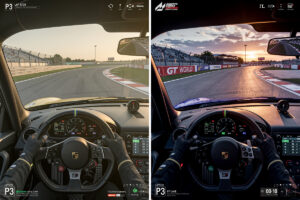
ACC uses Unreal Engine 4 and has significantly better graphics, lighting, weather effects, and car detail than iRacing. iRacing’s graphics engine is older and while functional, it cannot match ACC’s visual fidelity.
Do pro sim racers use iRacing or ACC?
Both. Professional esports series exist in both platforms. iRacing hosts the Porsche TAG Heuer Esports Supercup and NASCAR iRacing Series. ACC hosts the GT World Challenge Esports and SRO E-Sport GT Series. Many pros compete in both.
Related Articles
- iRacing Series and Progression: A Complete Guide — the full iRacing platform overview
- iRacing Cost Breakdown: Subscription, Cars, and Tracks in 2026 — detailed pricing analysis
- Assetto Corsa Competizione Setup Guide: Cars, Tracks, and Tuning — ACC car setup deep-dive
- Best Sim Racing Games 2026: Every Simulator Ranked — how both compare to the full market
- Sim Racing Force Feedback Tuning: The Complete Guide — dial in FFB properly for both sims