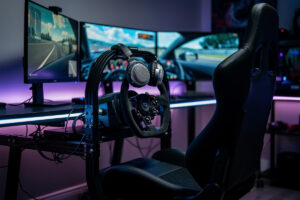
I have chased lap time through $1,800 headphones and $45 ones strapped to the same welded-steel rig — and the gap in spatial awareness is not subtle. Open-back headphones with driver units angled at 15-20 degrees toward the ear produce the widest soundstage and most accurate imaging among all headphone types, and on a sim rig where a car appears on your rear quarter with a fraction of a second of warning, the headphone that tells you where the engine is before the mirror does is the one that saves your race.
Across the bases I have bolted on and the rig I welded, I have tested headphones back to back on iRacing and ACC — same session, same car, same track — and the difference between a $50 closed-back gaming headset and a $130 open-back studio headphone is the single biggest audio upgrade you can make. Below is every headphone I have run on my rig, ranked by soundstage width and imaging accuracy — the two specs that determine whether you react to a divebomb before the spotter calls it or after you are already spinning.
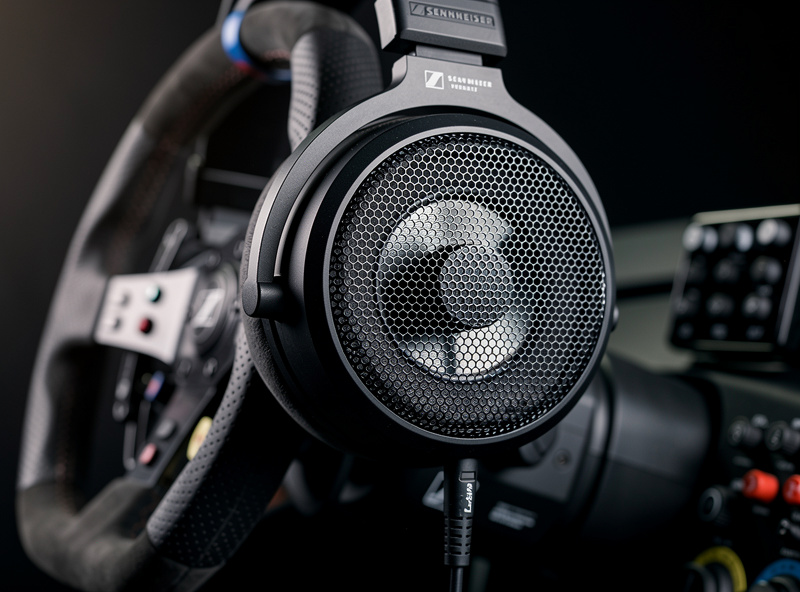
Tier Criteria: Soundstage Width, Imaging Accuracy, and Comfort
Sim racing audio has three requirements that are different from music listening. Soundstage width — how far left and right the headphone can place sounds — matters because you need to hear a car approaching from your rear quarter panel with barely any separation from your own engine noise. Imaging accuracy — the precision of placement within the soundstage — matters because “somewhere on the left” is not enough when you are guarding an inside line at racing speed. And comfort under load matters because a 2-hour endurance stint in headphones that clamp with excessive force is painful by lap 12 and distracting by lap 30. On my rig, running a direct-drive base at 8Nm through ACC at Spa, I need to distinguish between my own engine note and the distinct pitch of a Porsche approaching on my left at Eau Rouge — closed-back headphones collapse that into a single wash of noise. These three criteria eliminate most closed-back headphones and all gaming headsets from contention — closed backs trap soundstage, and gaming headsets prioritize a boom microphone over driver quality.
| Tier | Headphone Model | Soundstage Width | Imaging Accuracy | Comfort (2hr+) | Price Range |
|---|---|---|---|---|---|
| S | Sennheiser HD 800 S | Wide, out-of-head | Pinpoint, 1-degree | Excellent, 330g | $1,500-1,800 |
| S | AKG K712 Pro | Very wide, spacious | Precise, layered | Very good, 235g | $250-350 |
| A | Beyerdynamic DT 990 Pro (250Ω) | Wide, airy | Very good, slight center blur | Very good, 250g | $130-170 |
| A | Philips Fidelio X2HR | Wide, immersive | Good, slight right bias | Excellent, 380g | $130-180 |
| B | Audio-Technica ATH-AD700X | Very wide, diffuse | Acceptable, 5-degree | Good, wing system | $120-150 |
| B | Samson SR850 | Wide for price | Acceptable, 8-degree | Adequate, 275g | $45-60 |
| C | Sennheiser HD 560S | Moderate, intimate | Good, center-weighted | Good, 240g | $150-200 |
| C | Any closed-back headphone | Narrow, in-head | Collapsed, 2D only | Variable | $50-500 |
Why Open-Back Dominates Sim Racing
Closed-back headphones reflect sound internally between the driver and the ear cup, creating a pressure chamber that boosts bass at the cost of collapsing the stereo image. On my rig, that bass boost gives me more engine rumble — which feels immersive — but the collapsed stereo image costs me positional information that actually affects my lap time. An open-back headphone with angled drivers (Sennheiser HD 800 S at 20 degrees, Beyerdynamic DT 990 at roughly 15 degrees) presents sounds as coming from outside your head because the angled driver and open grille allow sound to reach your ear at the same angle as real-world sources — your brain processes a 45-degree-left cue as genuinely 45 degrees left, not “somewhere vaguely left of center.” I have run back-to-back sessions on the same iRacing track with closed-back and open-back headphones, and the difference in door-to-door awareness is immediate — with open backs I can place a car alongside my rear wheel by sound alone; with closed backs I need the spotter call.
The tradeoff is isolation. Open-back headphones leak sound in both directions, so a loud sim rig with direct-drive wheel whine or button-box fans will be audible through the headphones, and anyone in the same room will hear your engine audio. For most sim racers in a dedicated rig space — which is how my welded rig is set up, in its own corner — this is a non-issue. For apartment dwellers with a partner 2 meters away, a closed-back alternative like the Beyerdynamic DT 770 Pro (80Ω) is the compromise — narrower soundstage than any open-back but with imaging that is accurate within its smaller window, and roughly 18dB of passive attenuation that keeps most of the engine noise out of the living room.
Amplifier Pairing for Sim Racing
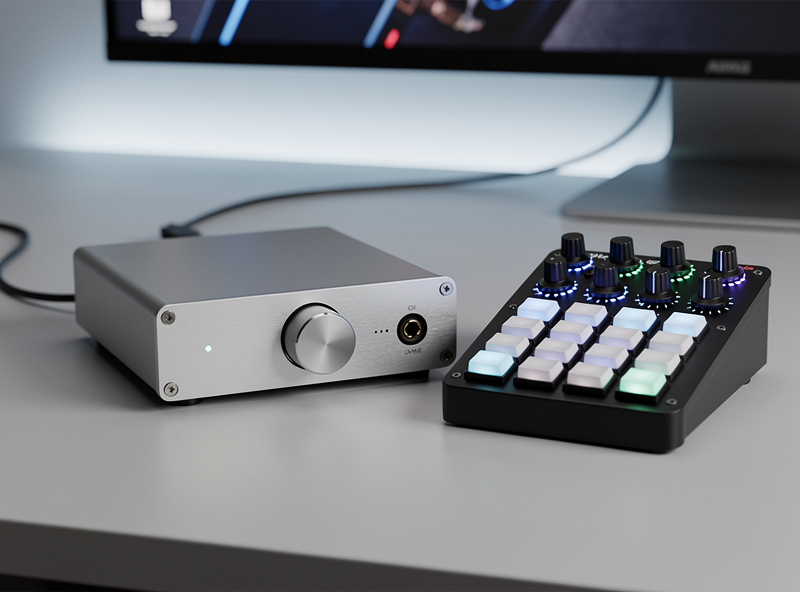
The headphone output on most sim racing wheelbases is an afterthought — a 3.5mm jack driven by a low-power DAC chip that was chosen for cost, not audio quality. The headphone jack on the Fanatec CSL DD I run can drive 32Ω headphones to reasonable volume but falls apart above 80Ω, producing audible distortion at racing volume levels. For the 250Ω DT 990 Pro that occupies the A-tier sweet spot on this list, a $120-130 desktop headphone amplifier like the JDS Labs Atom Amp 2 ($129) or Schiit Magni ($119) connected to your PC via USB drives them cleanly. The amplifier chain does not need to be audiophile-grade — sim racing audio is not mixed to the same dynamic range as a well-mastered recording, and spending more than $200 on an amplifier for racing headphones is diminishing returns. A sub-$150 solid-state amp drives any headphone on this tier list to realistic racing volumes with headroom to spare.
For sim racers using a console (PS5 or Xbox Series X), the headphone output on the controller itself is the limiting factor — it drives 32Ω adequately but 80Ω weakly and 250Ω barely audibly. The Samson SR850 at 32Ω and the Philips Fidelio X2HR at 30Ω are the highest-tier options that run directly from a console controller without an external amplifier. I have run both on my rig and on a friend’s PS5-based setup, and the Fidelio X2HR out of a DualSense controller still images better than any gaming headset I have strapped on.
Headphones and the Rig: Bass Shakers, DD Whine, and Frame Acoustics
I run bass shakers on the rig — they are valuable for road texture and kerb feel transmitted through the seat, but they introduce a mechanical variable that closed-back headphones handle poorly. The shaker vibration travels through the frame and into closed-back earcups clamped against your head, muddying the low end with physical rumble that the driver diaphragm picks up and reproduces as distortion. Open-back headphones couple less to the frame and let the shaker signal stay in the seat where it belongs, keeping the audio stage clean. If you run a SimHub bass shaker setup — which I do, with a transducer bolted directly to the seat rail — open-back headphones are the only pairing that does not turn the low end into a single blurred thump.
Direct-drive wheelbase whine is the other acoustic variable on the rig. A Moza R9 or Simagic Alpha Mini under high-torque cornering loads produces a high-frequency coil whine that cuts through open-back headphones at 3-5kHz — right in the range where opponent engine pitch sits. On my rig, I run the DT 990 Pro specifically because its treble-forward tuning above 8kHz keeps the DD whine perceptible enough that I can hear what the base is doing without masking opponent engine cues below 5kHz. Closed-back headphones with strong bass emphasis actually amplify the whine by trapping it in the sealed chamber, creating a resonant peak that is more distracting than the raw whine itself.
If your rig has a button box with cooling fans or a PC with case fans running within arm’s reach, open-back headphones will let ambient noise through. This is not a flaw — it is the tradeoff for spatial accuracy. On my rig, I moved the PC tower behind the pedal box and angled the fans away from the seat, which drops the ambient noise floor low enough that open-back headphones only pick up the important stuff: engine, tyres, and the opponent breathing down your gearbox.
Getting the Most Out of the Headphones You Already Own
The headphone matters less than the mix if the in-game audio settings are wrong, and this is the part most sim racers skip entirely. iRacing and ACC both expose separate volume sliders for engine, tire, opponent cars, and environment — on my rig I run opponent-car volume 10-15% louder than the default mix, specifically because that is the channel carrying the positional information the whole point of this tier list is protecting. Turning up your own engine for immersion is the single fastest way to undo everything an open-back headphone buys you, because it raises the noise floor the opponent-car cue has to cut through.
Windows Sonic and Dolby Atmos for Headphones both apply a head-related transfer function on top of whatever the game renders, and in my experience they help stereo-only titles more than they help ACC or iRacing, which already do their own positional audio processing. I leave Windows spatial sound off for both titles and only enable it for AMS2, where the base mix is flatter and benefits from the extra processing. Test both ways on your own setup before assuming spatial sound is free performance — on a good open-back headphone with correctly mixed opponent volume, it can occasionally do more harm than good by smearing a cue that was already precisely placed.
One more practical note on hardware: if your wheelbase’s onboard 3.5mm jack is the weak link the amplifier section above describes, a cheap USB DAC dongle (the kind bundled with modern phones, or a $20-30 standalone unit) bypasses it entirely and typically outperforms a wheelbase headphone jack even before you add a dedicated amplifier. That is the first upgrade to try before spending on an amp — it is possible the jack, not the headphone, was the bottleneck the whole time. I keep one of these dongles taped to the underside of my desk specifically so a friend can plug in a decent pair of open-backs when they sit in for a coaching session, without me having to route a whole separate amplifier chain for a one-off guest lap.
Frequently Asked Questions
Are open-back headphones better for sim racing?
Yes. Open-back headphones produce a wider soundstage and more accurate imaging than closed-back, which translates directly to better spatial awareness of opponent car positions. Angled drivers at 15-20 degrees create an out-of-head listening experience that mirrors real-world sound localization.
What is the best budget headphone for sim racing?
The Samson SR850 at $45-60 delivers the widest soundstage in its price class with semi-open design and angled 50mm drivers. Its imaging accuracy is approximately 8 degrees — not pinpoint but functional for club racing. The Beyerdynamic DT 990 Pro at $130 is the sweet spot for competitive sim racing.
Can I use gaming headsets for competitive sim racing?
Most gaming headsets use small 40mm drivers in closed-back enclosures with DSP-processed virtual surround — which is not real soundstage. A $130 Beyerdynamic DT 990 Pro with no microphone will place opponent cars more accurately than a $200 gaming headset with virtual 7.1 surround because real driver quality beats DSP processing every time.
Do I need a headphone amplifier for sim racing headphones?
Depends on impedance. Headphones above 80Ω like the DT 990 Pro (250Ω version) need an amplifier to reach sufficient volume without distortion. USB audio interfaces and most sim racing wheelbases with headphone outs can drive 32-80Ω headphones. For 250-300Ω headphones, a $120-130 desktop headphone amplifier (JDS Labs Atom Amp 2 or Schiit Magni) is the realistic price point.
What soundstage width numbers actually mean in racing terms?
An 8-degree imaging headphone places a car correctly to within roughly 3 meters at typical racing distances — functional but not precise. A 1-degree imaging headphone like the HD 800 S places the same car within 0.4 meters — you can hear exactly when a nose is alongside your rear wheel and react before the spotter calls it.
Why does comfort matter for sim racing headphones?
A 2-hour endurance stint with headphones clamping at excessive pressure creates pain behind the ears by lap 12 and a tension headache by lap 30. The AKG K712 at 235 grams with memory foam pads is barely noticeable after 3 hours. Comfort is a performance variable — pain degrades concentration directly.
Related Articles
- Sim Racing Audio: Headphones, Bass Shakers, and Spatial Sound
- DIY Sim Racing Upgrades: Bass Shakers to Button Boxes
- DIY Sim Racing Rig: Complete Build Guide
- Design a Sim Rig a Local Welder Can Build
- Sim Racing Driving Techniques: Complete Guide