The best sim racing wheel rim is the one that matches your discipline, your hand size, and the quick-release your base already speaks — not the most expensive carbon-and-Alcantara showpiece on the shelf. Across the bases I’ve bolted on, a 30cm round rim with a load-cell-clean quick-release covers 90% of what a home racer drives, and it costs a fraction of a full formula wheel.
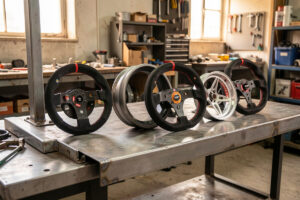
I run a mid-torque direct-drive base as my daily on a steel-tube cockpit I welded myself, and I’ve swapped a round formula-style rim and a sculpted GT rim back and forth across that base and a couple of higher-torque ones. That swapping is the whole point of this guide: the rim is the part you touch, but it’s also the part people over-buy first and under-think. This is the detachable-rim buying decision — shape, material, diameter, quick-release, and paddles — kept separate from which wheelbase to buy.
What Actually Matters When You Buy a Rim
A rim does four jobs: it gives your hands a shape to hold, it carries your buttons and paddles, it sets your grip material, and it clamps to the base through a quick-release. Everything else is marketing. The single biggest mistake I see is buying a rim to fix a feel problem that lives in the base, the pedals, or the FFB profile — a fancier rim on a flexy desk mount still feels like a fancier rim on a flexy desk mount.
Order of operations matters. If your rig still moves under braking, or your brake is a potentiometer instead of a load cell, spend there first. The rim is the last 10% of the cockpit, not the first. Once the frame is rigid and the pedals are honest, the rim decision becomes about ergonomics and discipline, and that’s where this guide lives. For the wider hardware picture, my best sim racing wheels buyer’s guide covers complete wheel-and-base bundles; this page is strictly about the rim you bolt on.
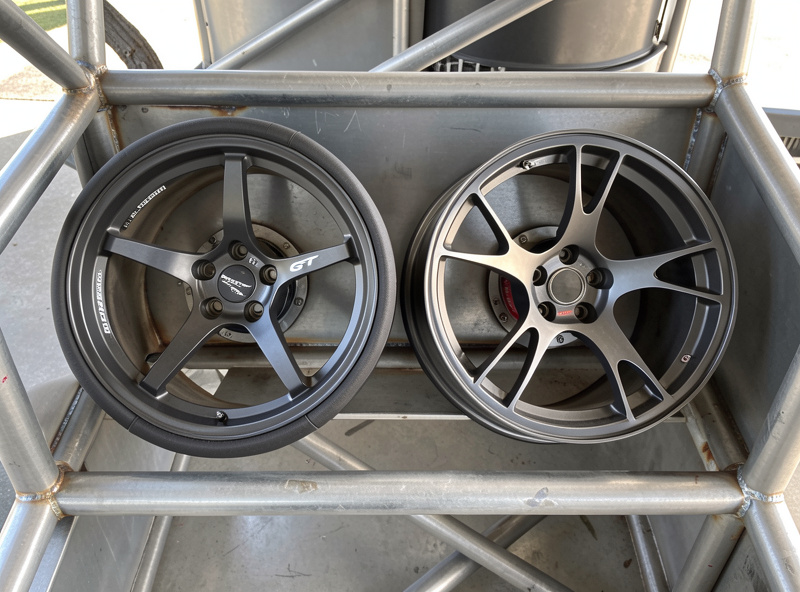
Rim Shape: Round, Formula, and GT
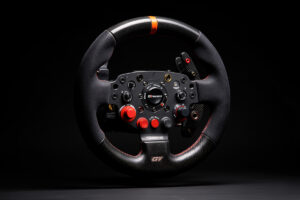
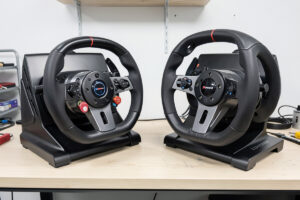
Rim shape is the first fork, and it maps almost perfectly to what you race. A round rim suits touring cars, GT3, rally, and anything with real steering lock. A formula (D-shape or wheel-with-flat-top-and-bottom) suits open-wheelers where you never take your hands off the wheel. A GT-style rim splits the difference with a sculpted, often suede-wrapped grip.
The practical test is lock angle. If you drive cars that need more than about 360 degrees of wheel rotation — most road and GT cars — you want a round or GT rim so your hands can shuffle or cross without hitting a flat spot. Formula cars cap out around 240-300 degrees of rotation, so a flat-top-and-bottom rim never rotates far enough for the flats to bother you, and it clears your thighs. I go deeper on this in the dedicated pieces on formula vs GT rims and whether round versus formula rim shape changes your pace.
Rim Diameter: 28cm, 30cm, or 32cm
Diameter changes steering effort and precision more than any single spec on the box. A smaller rim (28cm) gives quicker, twitchier response and needs less torque to turn; a larger rim (32cm) gives more leverage, smoother feel, and better slow-corner precision but demands more base torque to feel weighty. 30cm is the do-everything middle that most GT and touring drivers land on.
Think of it as gearing for your arms. On a mid-torque base, a 32cm round rim can feel light because the extra leverage overpowers the motor; a 28cm rim on that same base feels meatier because there’s less leverage working against the FFB. Match the diameter to your base torque, not to a photo. The full breakdown, with which diameter suits which base class, is in my wheel rim diameter guide.
Grip Material: Alcantara, Leather, or Rubber
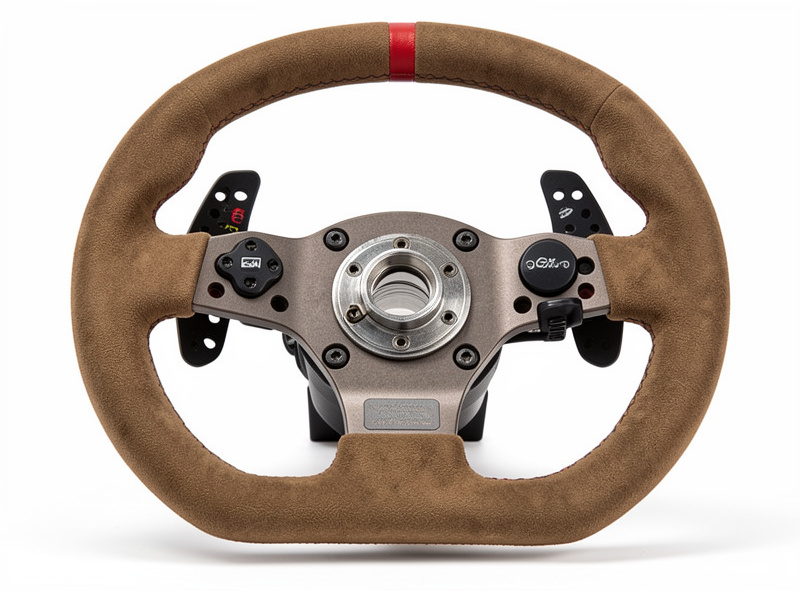
Grip material is the part your hands actually judge, and it’s mostly about sweat and longevity, not lap time. Alcantara (suede) gives the highest dry grip and the most “real race car” feel, but it soaks up sweat and skin oil and eventually goes shiny and slick if you don’t clean it. Leather is more forgiving of sweaty hands and wipes clean, at a small cost in outright grip. Rubber and moulded-grip rims are the budget-and-durability play — grippy enough, sweat-proof, and basically indestructible.
If you race in gloves, Alcantara is a joy and the sweat problem disappears. Bare-handed in a warm room, leather or rubber will age better. I keep a suede rim for gloved GT stints and a rubber-gripped rim for quick bare-handed sessions, and I clean the Alcantara with a soft brush and suede cleaner every few weeks. The full material comparison, including cleaning routines, lives in Alcantara vs leather vs rubber grips.
Quick-Release: The Part Everyone Ignores Until It Rattles
The quick-release (QR) is the coupling between rim and base, and a bad one ruins an otherwise perfect rim. A QR has two jobs: transmit torque without any rotational slop, and let you swap rims in seconds. Cheap plastic QRs and mismatched adapters introduce free play you feel as a tiny dead zone at center — the exact place you need the most precision. On a direct-drive base, that slop shows up on the telemetry overlay as a wandering center, not just a feeling.
Match the QR to your base’s native standard where you can. If you’re adapting a third-party rim to a different base, a solid metal QR adapter is worth every krona. I’ve run both plastic and metal QRs across my bases, and on anything above roughly 8 Nm the metal QR is not optional — the plastic ones flex under the torque and you lose the crispness the base is producing. My full picks are in the best quick-release adapters guide.
Paddles, Buttons, and Dual-Clutch
The rim is also where your shifting and inputs live. Magnetic shift paddles with a crisp click are the baseline you want — mushy rubber-dome paddles feel vague under pressure. Beyond the shifters, the question people ask most is whether dual-clutch (bite-point) paddles are worth it. Short answer: for consistent standing starts in open-wheel and GT racing, yes; for casual driving, no. I break down exactly when they pay off in dual-clutch paddles: are they worth it.
Button count is personal. I’d rather have a clean rim with 6-8 well-placed buttons and a couple of rotary encoders than a 20-button formula rim I never learn. If you run lots of in-race adjustments — brake bias, traction control, fuel maps — a button box or a formula rim with encoders earns its place; otherwise a GT rim with a handful of buttons keeps things simple.
Rim Types Compared
| Rim Type | Best For | Typical Diameter | Common Grip | Buttons/Paddles |
|---|---|---|---|---|
| Round GT / touring rim | GT3, touring, road, rally | 30-32cm | Alcantara or leather | Shift paddles + 6-10 buttons |
| Formula / F1-style rim | Open-wheel, formula cars | 28-30cm (flat top/bottom) | Rubber or Alcantara | Dual-clutch + many buttons/encoders |
| Round rubber-grip rim | Budget, bare-handed, all-rounder | 28-30cm | Moulded rubber | Shift paddles + few buttons |
| Sculpted GT3 rim | GT3 immersion, gloved driving | 30cm | Alcantara/suede | Shift paddles + clutch + buttons |
| Compact drift/rally rim | High-lock drift, rally | 32-33cm round | Rubber or leather | Shift paddles, minimal buttons |
The Upgrade Order I Actually Recommend
If you’re building from scratch, spend in this order: rigid rig, then honest pedals with a load cell, then the wheelbase torque you can afford, and the rim last. The rim is where personal taste finally gets to drive the decision, because by then the parts that decide whether you can feel the car are already sorted. A great rim on a wobbly stand is lipstick; a plain rubber rim on a rigid rig with a load-cell brake will make you faster.
Once the foundation is set, buy the rim for your main discipline first and add a second rim only when you race a genuinely different category. Most people are better served by one great round rim and a good metal quick-release than by three cheap rims they keep swapping. For where the rim sits in the whole cockpit, see my cockpit and rig guide, and for the pedals that matter more than the rim, the sim racing pedals guide.
Matching the Rim to Your Base Torque
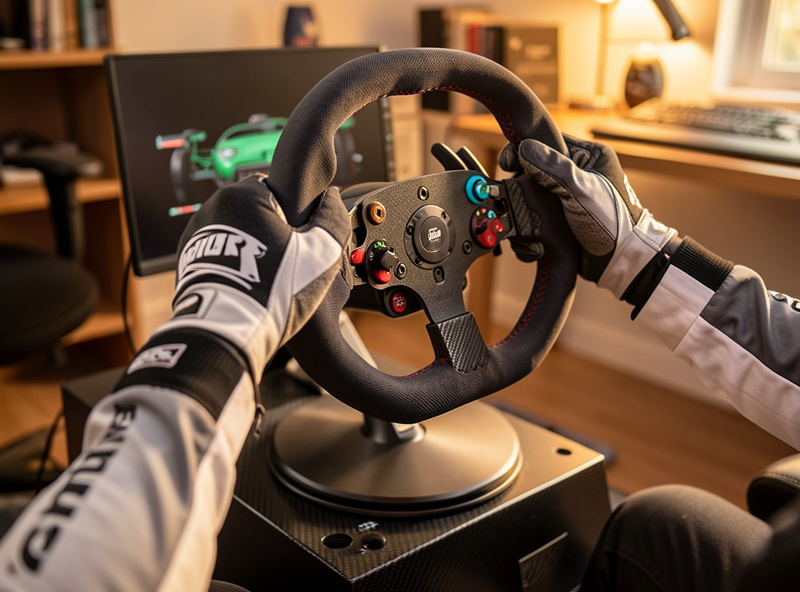
The rim and the base have to be sized to each other, and this is where most first-time buyers go wrong. Base torque is measured in newton-metres (Nm), and a rim’s diameter multiplies or divides how heavy that torque feels at your hands. Put a big-leverage rim on a small motor and the FFB feels vague; put a small rim on a strong motor and it feels punchy and alive. The rim isn’t stronger or weaker — it’s gearing.
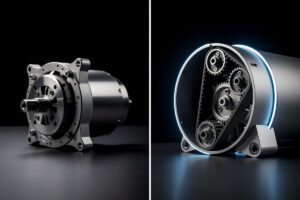
On a 5-8 Nm entry direct-drive base, a 28-30cm rim keeps the forces feeling substantial. On a 8-12 Nm mid base like the one I run daily, 30cm is the sweet spot and 32cm still works. Only on high-torque 15-21 Nm bases does a 32cm rim really come into its own, because the motor has the muscle to make the extra leverage feel weighty rather than soft. If you’re still choosing a base, my guides to the best direct-drive wheelbase brands and the entry direct-drive fight between Fanatec CSL DD and Moza R5 pair naturally with this rim decision. And if you’re weighing motor technologies, the direct drive vs belt drive breakdown explains why direct-drive rims transmit so much more texture.
GT3-Style Rims: The Home-Racer Default
If I had to recommend one rim for the largest number of home racers, it’s a GT3-style sculpted round rim. GT3 is the most popular category in iRacing and ACC by a wide margin, the cars use plenty of steering lock, and a suede-wrapped GT3 rim with a couple of thumb-reachable rotaries covers brake bias and traction-control tweaks without a cluttered face. It’s the rim that feels right in the most cars, which is exactly what most people actually want.
The upgrade GT3 rims buy you over a plain round rim is ergonomics: contoured thumb rests, better-placed paddles, and a grip section shaped for a relaxed hold over a two-hour endurance stint. That last point is underrated — a rim that fights your hands at lap 4 will wreck your consistency by lap 40. I cover specific shapes and what to look for in the best GT3-style wheel rims guide, and the encoder-heavy alternative in best encoder wheels.
Common Rim-Buying Mistakes
The mistakes repeat across every forum and Discord I read. First: buying a formula rim because it looks fast, then racing GT3 with hands that keep hitting the flats. Second: buying a huge carbon rim for a weak base and wondering why the FFB feels dead. Third: pairing a premium rim with a bargain plastic quick-release that reintroduces all the slop the rim was supposed to remove. Fourth: blaming a “numb” rim when the base is clipping and the fix is in the FFB menu, not the wallet.
The fifth mistake is buying three rims before mastering one. Every rim has muscle memory attached — button layouts, paddle throw, where the clutch bites. Swapping rims every week means you never build that memory. Pick the rim for your main discipline, learn it cold, and only add a second when you genuinely race a different category with different ergonomic needs. For open-wheel specifically, the open-wheel sim racing guide explains why a formula rim earns its place there.
When a Second Rim Is Actually Worth It
A second rim makes sense when you split your seat time between two genuinely different disciplines — say GT3 and formula, or GT3 and rally. The formula rim gives you the flat-top clearance and the dual-clutch launch; the round rim gives you the lock for everything else. That’s a real ergonomic difference, not a cosmetic one, and a quick-release means the swap takes seconds. What doesn’t make sense is a second rim that’s just a slightly different round rim — you’ll leave it in the box.
If you do run two rims, that’s exactly where the quick-release earns its keep. A good metal QR turns rim-swapping into a five-second job between sessions instead of an unbolting chore, and it holds zero-slop across both rims. This is the argument I make in detail in the quick-release adapters guide — the QR is the enabler that makes a two-rim setup practical instead of annoying.
What I’d Spend on a Rim at Three Budgets
Rim prices swing wildly, so it helps to anchor the decision to a budget. Under about $150, buy a round rubber-grip rim and put whatever’s left toward a metal quick-release — a plain round rim on a rigid QR beats a fancier rim rattling on a plastic coupling every time. This is the tier where most first rigs should live, because the money you save here goes into the pedals and the rig that actually lower your lap time. A rubber rim isn’t a compromise at this level; it’s the honest choice.
Around $250-350 is the sweet spot for the majority of home racers: a 30cm suede or leather GT rim with crisp magnetic paddles, a couple of thumb-reachable rotaries, and a base-native metal quick-release. That single rim covers GT3, touring, road, and rally, and it’s the tier I’d steer roughly 80% of people toward. You get the ergonomics of a shaped grip and the controls a GT car actually needs without paying for carbon you’ll never feel through the wheel.
Above about $400 you’re buying a carbon plate, shift lights, and denser encoders. Those are real upgrades for endurance immersion and for open-wheel cars with a lot of on-the-fly adjustment, but none of them is a faster lap on its own. I only reach for that tier once the rig, pedals, and base are already sorted — spending there first is the classic mistake of fixing the last 10% before the first 90%. Whatever the budget, spend on the quick-release before the rim plate: a $60 metal QR under a $120 rubber rim feels crisper than a $300 carbon rim on a $20 plastic adapter, because the coupling decides how much of the base’s torque reaches your hands.
One factor the price tiers don’t capture is hand size, and it matters more than the spec sheet admits. Larger hands are happier on a 30-32cm rim with a thicker grip section so your knuckles don’t crowd on tight lock; smaller hands are better served by a slightly thinner 28-30cm grip you can wrap fully without straining. I have average hands and find a 30cm rim with a medium grip simply disappears under my palms, which is exactly the goal — a rim you stop noticing three corners in. If you can, hold one before buying, because a grip a size too thick nags at your forearms by the end of a long stint the same way an ill-fitting tool does on the bench.
How the Rim Interacts With Force Feedback
Here’s the part the spec sheets skip: the rim changes how the base’s force feedback reaches your hands, even though it produces none of it. Diameter sets leverage, weight sets inertia, and the quick-release sets how cleanly the torque transmits. A heavy carbon rim smooths out fast direction changes but dulls the tiny texture cues; a light rim transmits more detail but can feel nervous. None of it matters if the base is clipping — you’ll feel a wall of flat force instead of texture.
Before you blame a rim for feeling numb, check your FFB for clipping on a telemetry overlay. Nine times out of ten a “dead” rim is a base cranked past its headroom. Get the force feedback honest first — my force feedback tuning guide and the iRacing FFB settings guide walk through diagnosing clipping — then judge the rim. The direct vs belt drive feel comparison explains why detail-rich bases reward lighter rims.
As an Amazon Associate I earn from qualifying purchases. When a rim or quick-release adapter is genuinely worth a look I link an Amazon search so you can compare current options — for example a sim racing quick-release adapter or a GT-style sim racing rim. Buy for your discipline, not the photo.
Frequently Asked Questions
What is the best all-round sim racing wheel rim?
A 30cm round GT-style rim with Alcantara or leather grip, magnetic shift paddles, and a solid metal quick-release covers GT3, touring, road, and rally. It is the most versatile shape and suits mid-torque direct-drive bases without needing extra torque to feel weighty.
Do I need a formula rim for open-wheel racing?
You do not strictly need one, but a formula rim helps. Open-wheel cars use only 240-300 degrees of rotation, so a flat-top-and-bottom rim never rotates far enough for the flats to bother you and it clears your thighs. A round rim works too, just less ergonomically for formula cars.
Does wheel rim diameter change how force feedback feels?
Yes. A larger 32cm rim adds leverage that makes the base feel lighter and smoother, while a 28cm rim feels meatier because there is less leverage working against the motor. Match diameter to your base torque: bigger rims suit higher-torque bases.
Is a metal quick-release worth it over plastic?
On anything above roughly 8 Nm, yes. Plastic quick-releases flex under torque and introduce a small dead zone at center where you need the most precision. A solid metal quick-release adapter removes that slop and preserves the crispness the base produces.
Alcantara or leather for a sim wheel grip?
Alcantara gives the highest dry grip and the most authentic feel but soaks up sweat and needs cleaning. Leather is more forgiving of sweaty bare hands and wipes clean at a small grip cost. Gloved drivers should pick Alcantara; bare-handed drivers in warm rooms often prefer leather or rubber.
Should I buy the rim before the pedals?
No. Spend on a rigid rig and load-cell pedals first, then the wheelbase, and the rim last. The rim is the final ten percent of the cockpit. A plain rubber rim on a rigid rig with a load-cell brake will make you faster than a carbon rim on a wobbly stand.